 Life & Style

Solcis launches open compliance layer for AI agents on NVIDIA OpenShell
1.
|
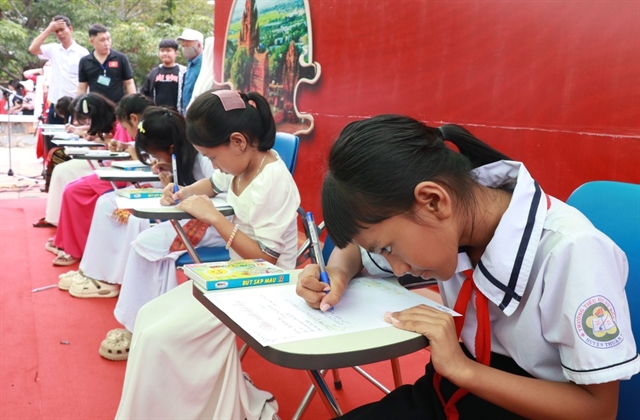
| Chăm primary pupils carefully practise each stroke of the traditional Chăm script during a handwriting contest in Khánh Hòa Province. VNA/VNS Photos Phan Sáu |
KHÁNH HÒA On a quiet morning in Phước Hữu Commune, the sound of pencils brushing paper fills a brightly decorated hall, as children lean over their desks and patiently trace the graceful curves of the ancient Chăm script. Concentration shows on their faces, but so does pride — a quiet confidence born of learning a language that carries the memory and spirit of their people.
Over the past few years, Khánh Hòa Province has stepped up efforts to introduce Chăm language classes in schools in areas with large Chăm communities. The programme is part of a broader drive to improve education for ethnic students while safeguarding traditional languages and cultural values that risk being forgotten in the digital age.
First stroke
At Tân Đức Primary School in Phước Hữu, Chăm language lessons are held twice a week. Depending on their grade, pupils start with basic strokes and the alphabet before progressing to reading and writing short Chăm texts.
For fifth-grader Quảng Nữ Huyền My, practising at home is just as important as learning in class.
“To write beautifully, I have to spend a lot of time practising by myself,” she said, her notebook filled with neat lines of Chăm characters. “I really love my script and my mother tongue.”
Teachers share the same passion. Their biggest wish, they say, is for students to be able to use and cherish the writing system of their own people, and to develop a deep respect for the language and heritage they were born into.
Many also hope that more playgrounds and creative spaces will be created so children can show their love for the Chăm script, especially during traditional festivals.
A festival of letters
|
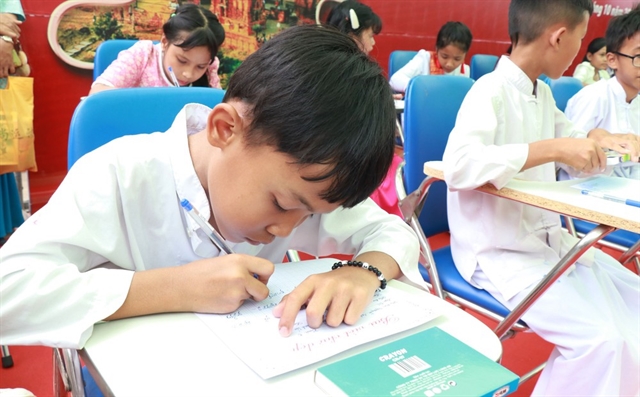
| Writing in Chăm is challenging and requires regular study and practice from students to master the ancient characters. |
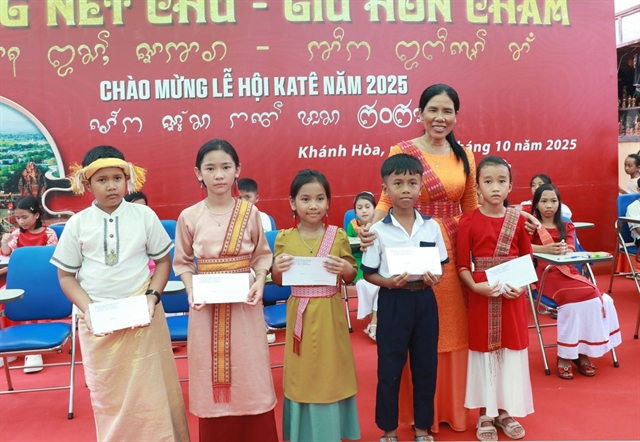
That hope took shape in October last year, when the provincial Department of Culture, Sports and Tourism organised a Chăm handwriting contest under the theme "Bright Strokes – Keeping the Cham Spirit Alive" as part of the Katê Festival.
Held at the special national heritage site of Pô Klong Garai Towers in Đô Vinh Ward, the contest drew a large number of primary and secondary students from schools offering Chăm language classes.
Nguyễn Khắc Duy, deputy director of the Khánh Hòa Cultural Centre, said the competition was a success thanks to the enthusiastic participation of Chăm students.
“It is not just a playground for them, but also a way to awaken their love for their ethnic script and raise their awareness of the responsibility to preserve cultural identity,” he said.
According to Duy, being able to write and read Chăm fluently helps students absorb lessons more easily and become more confident in communication and daily life.
“In the future, these children will be the ones who carry the torch – preserving their mother tongue and even reading and translating ancient Chăm manuscripts,” he added.
Language in life
|
| Chăm students receive prizes at the 'Bright Strokes – Keeping the Cham Spirit Alive' handwriting contest held in October 2025. |
In the 2025–2026 school year, Khánh Hòa has 32 schools with primary levels across nine communes and wards, offering Chăm language classes.
The programme now reaches 317 classes, with 8,890 students and 38 teachers involved.
Lê Thái Trường Thi, deputy director of the provincial Department of Education and Training, said introducing ethnic languages into schools is a “correct and deeply humane policy”.
“Teaching minority languages helps nurture students’ love and pride in their origins and traditions. It also creates opportunities for students of other ethnic groups to understand, respect and celebrate cultural diversity,” she said.
“That, in turn, strengthens solidarity and builds a friendly, sustainable school community rich in identity.”
At present, schools allocate two periods a week to the Chăm language. While limited in time, the lessons meet students’ needs for learning and practising the language.
To improve effectiveness, schools also integrate Chăm into extracurricular activities, such as youth club meetings, art performances, folk games and ethnic culture days. These activities create a natural, lively environment for students to listen, speak and use their mother tongue beyond the classroom.
The education sector is also developing Chăm language clubs and producing more visual teaching materials, alongside digital tools such as videos, educational games and learning apps to spark students’ interest.
The involvement of the Chăm community itself – from cultural exchanges to classroom support – is considered a key factor in ensuring the language is not only taught, but truly lived.
Together, these efforts are helping Chăm students in Khánh Hòa preserve their linguistic heritage, strengthen their sense of pride and pass on precious cultural values to the next generation. — VNS
Life & Style
 Life & Style
 Life & Style
 Life & Style
 Life & Style
 Life & Style
 Life & Style
 Life & Style
 Life & Style
 Life & Style
 Life & Style
 Life & Style
 Life & Style
 Life & Style
 Life & Style