 Life & Style

Sovico and Hamburg Forge Partnership to Expand Vietnam-Germany Economic Ties
1.
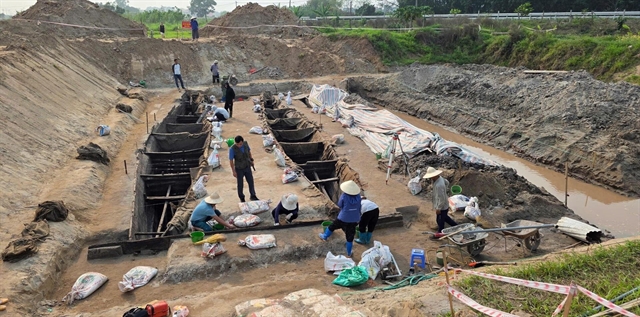 |
| Although its exact age awaits confirmation through carbon-14 analysis, historical records indicate that this vessel type existed in Việt Nam, particularly during the Lý dynasty.Photo kenh14.vn |
BẮC NINH Two ancient wooden boats discovered in the northern province of Bắc Ninh are now set for careful preservation, with experts saying the find could reshape understanding of early Vietnamese shipbuilding and inland waterway culture.
In March, the provincial People’s Committee authorised an emergency excavation in Công Hà Quarter, Song Liễu Ward, after traces of the vessels were uncovered on the Dâu River, a tributary of the Thiên Đức (Đuống) River that runs along the western ramparts of the ancient Luy Lâu Citadel. The discovery site lies about 1km from the citadel and roughly 600m northeast of Dâu Pagoda.
Each boat measures 16.1m in length, divided into six compartments, with a depth of 1.5m and a width ranging from 1.9 to just over 2m.
Preliminary assessments indicate a double-hull vessel. The remains found consist of two fully submerged hull sections. The upper structure has disappeared, likely dismantled or lost to time.
Although the exact age is still unknown and carbon-14 test results are pending, historical records confirm the presence of this vessel type in Việt Nam, particularly during the Lý dynasty.
The boat’s uniqueness lies in its construction: it was built entirely of wood without any metal components or joints. Based on existing studies of ancient boats, scholars have described the find as a relic of exceptional scale, complexity and craftsmanship, and potentially the only fully wooden, metal-free structure of its kind recorded in Việt Nam – and possibly beyond.
Experts agree that precise dating must await carbon-14 analysis, though technical evidence suggests it was likely built in Việt Nam, continuing Đông Sơn-era boatbuilding techniques, seen in the similarities between its double-hull base and traditional dugout structures.
The discovery is regarded as an archaeological milestone. It deepens understanding of shipbuilding history, inland transport and the material culture of early Vietnamese communities. It also gives Bắc Ninh important opportunity to develop preservation models that protect and promote the heritage for scientific research and community education.
Recognising its significance, the Ministry of Culture, Sports and Tourism has ordered the provincial People’s Committee to take urgent measures to safeguard, preserve and promote the value of the ancient boats.
The ministry has further called for immediate assessment to identify the type, characteristics and age of the site. It has recommended organising conferences and workshops to seek expert advice on management, conservation and heritage-promotion solutions in line with cultural-heritage law. VNS
Life & Style
 Life & Style
 Life & Style
 Life & Style
 Life & Style
 Life & Style
 Life & Style
 Life & Style
 Life & Style
 Life & Style
 Life & Style
 Life & Style
 Life & Style
 Life & Style
 Life & Style




