 Life & Style
Lotte, Phát Đạt combine strengths in Thu Thiem project
1.
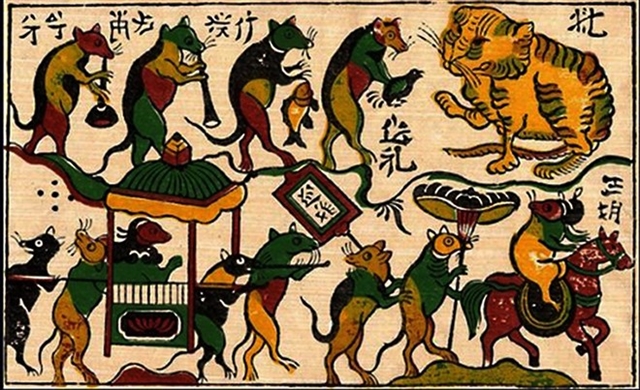 |
| The Đông Hồ folk painting “The Mouse Wedding” on dó paper. — Photo laodong.vn |
HCM CITY — Dó (poonah paper) painting, long linked to Việt Nam’s folk art heritage, is experiencing a quiet revival as artists reinterpret the traditional medium through a modern visual language.
Once confined to folk traditions and craft villages, dó paper is now re-emerging in contemporary art spaces, featuring in exhibitions, individual practices and the experimental works of a new generation of artists.
Rustic beauty, aesthetic depth
A sheet of dó paper is thin, porous and light, seemingly fragile yet remarkably resilient.
Working with the material demands a thorough understanding of its absorbency, the way colours bleed and the structure of its fibres.
Even a slight misjudgement in loading ink or controlling water on the brush can damage the surface. These exacting demands present challenges, but they are also what give dó its distinctive appeal.
Made from the bark of the dó tree, dó paper is produced entirely by hand through a complex traditional process involving soaking in limewater, boiling, pounding, filtering and mixing with a natural binding agent derived from the mò plant.
The pulp is then spread on bamboo moulds to form individual sheets. Each stage requires patience, experience and a finely honed craft sensibility.
Free from chemical treatment, dó paper is highly durable and resistant to decay and termites, making it suitable for the long-term preservation of artworks and historical documents.
Historically, dó paper formed the foundation of Đông Hồ and Hàng Trống folk paintings, as well as numerous Hán-Nôm manuscripts and royal edicts.
Today, artists are exploring the material in new directions, applying contemporary themes, personal perspectives and experimental techniques.
By blending folk-inspired linework with modern visual thinking, they are expanding the expressive range of dó painting.
Another notable characteristic of dó paper is its transformation over time.
As it ages, the paper becomes softer, allowing colours to spread more smoothly across the surface.
Many artists therefore store dó paper for extended periods before using it.
Pure dó paper is thin, smooth and supple, while blended varieties are thicker and stiffer, suited to different creative purposes.
Variations in thickness, such as single-layer, double-layer or multi-layer dó, offer artists a wider range of technical options.
According to experts, painting on dó requires restraint.
Colour palettes tend towards subdued tones rather than vivid hues, with artists focusing on planes, forms, the “breathing space” of the paper and the translucency of the dó surface.
Brushwork must be decisive and controlled, while retaining natural softness.
Mastery of ink and water often requires daily practice, making disciplined brush training central to the distinctive character of dó painting.
Beyond its artistic value, dó painting also plays an important role in preserving traditional craft heritage.
The continued cultivation of dó trees, the production of handmade paper and the transmission of related skills all contribute to safeguarding craft villages and sustaining Việt Nam’s folk culture.
Renewing tradition
On display at the Việt Nam Fine Arts Museum (66 Nguyễn Thái Học Street, Hà Nội), Góp Dó 3 brought together 15 artists from different generations and artistic backgrounds, united by their shared engagement with dó paper.
Nearly 100 works on display demonstrated the material’s versatility, accommodating approaches ranging from lyrical and realist to expressionist and abstract.
Participating artist Đặng Tiến said the “Góp Dó” group was formed in 2018 by a small circle of colleagues before gradually expanding through successive exhibitions.
While not all members work with dó on a long-term basis, the exhibition highlighted the paper’s capacity to absorb diverse styles and techniques.
Among the participating artists, Bùi Văn Tuất was noted for his refined realist oil technique, Đoàn Đức Hùng for bold expressionist brushwork, and Bùi Tiến Tuấn for bringing the softness of silk painting to dó paper.
Hà Huy Mười’s Night series explored tonal shifts and rhythm, while Đặng Hữu presented robust urban compositions with fast, forceful brushstrokes.
Speaking about the material’s appeal, Tiến said dó paper can be combined with various media, from Chinese ink and watercolour to acrylic and oil paint, provided artists understand its inherent qualities.
Its rustic character and expressive depth continue to attract younger practitioners.
Artist Vũ Thái Bình, who has worked with dó for more than two decades, described it as a beautiful yet demanding medium. Soft and highly absorbent, the paper leaves little room for correction, requiring careful handling and long-term mastery.
For him, dó is more than a traditional material, it is a uniquely Vietnamese foundation for contemporary artistic expression.
At Góp Dó 3, tradition is not preserved as a static legacy but reinterpreted through fresh experimentation, reaffirming the enduring vitality of dó paper in contemporary Vietnamese art. — VNS
Life & Style
 Life & Style
 Life & Style
 Life & Style
 Life & Style
 Life & Style
 Life & Style
 Life & Style
 Life & Style
 Life & Style
 Life & Style
 Life & Style
 Life & Style
 Life & Style
 Life & Style