 Life & Style

AIMCONNECT 2026 Held in Singapore, Bringing Global Automotive Leaders Together to Explore the Future of AI, Trust and Connected Mobility
1.
HÀ NỘI – A new music initiative is hitting all the right notes as it reimagines the timeless songs of Trịnh Công Sơn through the vibrant language of jazz.
Titled Hãy Yêu Jazz Đi (Fall in Love with Jazz), the project blends jazz, fusion and acoustic arrangements with translated lyrics in English, Japanese and Korean, offering a fresh perspective on the work of Trịnh, one of Việt Nam’s most influential songwriters, often likened to Bob Dylan for his evocative anti-war ballads.

|
| Singer Quỳnh Phạm, founder of Hanoi Blues Note and a fixture in Hà Nội’s jazz scene for over 25 years, is also the initiator of the music project ‘Hãy Yêu Jazz Đi’ (Fall in Love with Jazz). Photos courtesy of Hãy Yêu Jazz Đi |
The project takes its name from Trịnh’s beloved song Hãy Yêu Nhau Đi (Let’s Love Each Other) and is spearheaded by singer Quỳnh Phạm, founder of Hanoi Blues Note. A fixture in Hà Nội’s jazz scene for more than 25 years, Quỳnh Phạm describes the project as a response to a long-standing desire to build a coherent and connected musical journey rather than settling for scattered one-off experiments.
“For more than a decade, the idea of ‘revitalising Trịnh’s music’ has quietly inspired Vietnamese music culture, especially among younger audiences,” she said. “Yet most efforts have remained fragmented – beautiful notes, yes, but not yet a full, cohesive arrangement. No one has truly mapped out a structured journey to bring Trịnh’s music closer to the new generation and out into the world.”
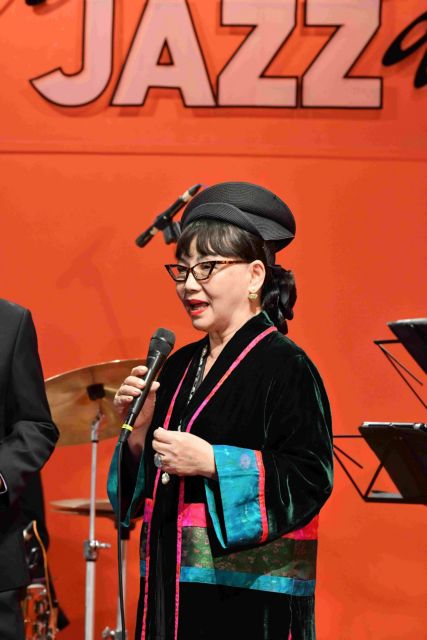
Supporting the project is singer Trịnh Vĩnh Trinh, the younger sister of Trịnh Công Sơn, who serves as its artistic adviser and 'Messenger of Trịnh’s Memories.' She expressed her admiration for the team’s heartfelt approach.
“I see in these artists a genuine love for Trịnh’s music and a desire to converse with it through their own musical language,” she said.
While jazz interpretations of Trịnh’s work are not new, Trịnh Vĩnh Trinh believes this project marks a significant step forward.
“Quỳnh Phạm is not the first to explore Trịnh’s music through jazz,” she said, “but by boldly translating the songs into English, one could say she and this project have nearly arrived.”
Running from October 2025 to the end of 2028, Fall in Love with Jazz unfolds in three phases. The first, lasting until 2026, focuses on outreach and talent discovery. It includes mini shows, online concerts and new album releases that foster a musical dialogue not only between jazz and Trịnh’s compositions but also between generations of listeners. Central to this phase is the creation of 'Jazz Love Stations' in Hà Nội, Huế, Đà Nẵng and Hồ Chí Minh City – spaces where young artists are mentored, inspired and given the stage to perform and debut their reimagined works.
Phase two, beginning in 2027, expands the project’s reach through international collaborations and digital releases. It also includes small-scale performances abroad and four larger concerts in Việt Nam’s major cities.
The final phase in 2028 will see the release of new works, a series of cultural exchange events between Vietnamese and international jazz communities and album launches in overseas markets. The team also hopes to feature guest vocals from globally recognised artists popular among younger audiences.
|
| Singer Trịnh Vĩnh Trinh said that she felt the artists behind ‘Hãy Yêu Jazz Đi’ (Fall in Love with Jazz) carry a genuine and heartfelt love for Trịnh Công Sơn’s music. |
Beyond live performances, the project will produce bilingual music releases in CD, vinyl and digital formats, timed to coincide with Trịnh Công Sơn’s birthday on February 28 – a symbolic gesture that ties past and present.
Discussing the musical adaptation, Music Director and pianist Vũ Quang Trung reflected on the challenge of blending jazz with Trịnh’s style.
“Jazz is improvisational – it plays with structure, rhythm, harmony and melodic solos,” he said. “Trịnh’s music, on the other hand, is rooted in poetic lyrics and simple, familiar melodies.”
His approach is one of careful balance: preserving the emotional intimacy and simplicity of Trịnh’s songs while introducing new textures and rhythms that offer a fresh perspective.
“It’s about keeping the music close to the listener,” he said, “but colouring it with something different, something intriguing – from harmony and rhythm to each artist’s interpretation.” VNS
Life & Style
 Life & Style
 Life & Style
 Life & Style
 Life & Style
 Life & Style
 Life & Style
 Life & Style
 Life & Style
 Life & Style
 Life & Style
 Life & Style
.jpg) Life & Style
Life & Style
 Life & Style
 Life & Style