 Economy


Vietnamese community in China urged to stay united, contribute to homeland
1.
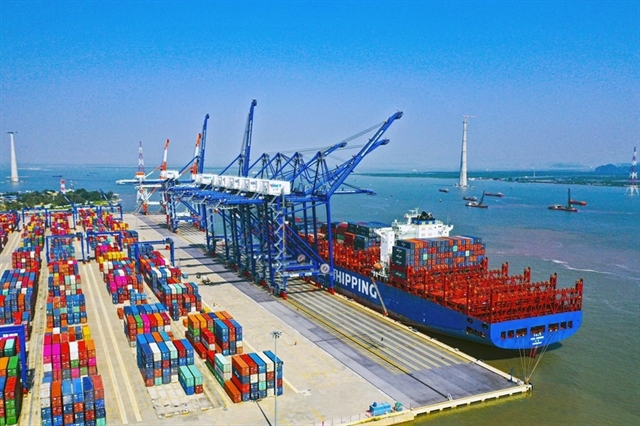 |
| Logistics has become a decisive factor in supply chain competitiveness. — Photo baocongthuong.vn |
HÀ NỘI — Logistics costs have become a major headache for exporters as it currently accounts for approximately 16-20 per cent of GDP, among the highest globally, experts said.
Nguyễn Phúc Khoa, Vice Chairman of the HCM City Food and Foodstuff Association (FFA), said World Bank's statistics indicated that Việt Nam's logistics costs remained high at 16-20 per cent of GDP, compared with only 8-10 per cent in the EU and the US; and 13-14 per cent in Thailand and China.
Exporters incurred many other hidden logistics costs, such as losses during the transport of raw materials to production sites and fees for handling empty containers. These factors contributed significantly to the overall rise in expenses.
Notably, international shipping rates for refrigerated containers in May and June surged from around US$2,800 to a peak of $7,800. Although rates had since eased, they remained above $5,000, driving up production and export costs for businesses.
Logistics has become a decisive factor in supply chain competitiveness. The country's total import-export turnover is projected to reach approximately $1 trillion for the full year of 2026.
Exporters view this as a massive opportunity, yet they note that increasing productivity and turnover without a corresponding rise in profits presents a significant challenge.
According to exporters, the current trend for reducing logistics costs and enhancing competitiveness is to partner with professional logistics providers rather than investing in the entire infrastructure themselves.
Exporters are also increasingly adopting digital technologies to monitor temperatures, ensure traceability, track shipments and optimise inventory management.
FFA’s Khoa proposed establishing a mechanism for regular collaboration between manufacturers and logistics providers, developing industry-specific logistics solutions, and promoting digital transformation and information sharing, aiming at creating a long-term, efficient and sustainable cooperative ecosystem.
Meanwhile, Trần Thụy Quế Phương, Deputy Secretary General of the Vietnam Association of Seafood Exporters and Producers (VASEP), highlighted current bottlenecks regarding the integration of cold storage infrastructure, refrigerated containers, transport networks and ports.
She also pointed to other shortcomings such as cost volatility and a lack of data sharing and seamless connectivity between raw material zones, processing plants, logistics providers, and customers.
Therefore, Phương proposed planning logistics zones in conjunction with raw material areas; developing ports, waterways, and road networks in a synchronised manner; implementing investment incentives; establishing regional cold logistics centres; strengthening links between seafood companies and logistics providers; and investing in suitable maritime transport fleets.
Besides, according to Đặng Quý Nhân, Vice Chairman and Secretary General of the HCM City Import-Export Association, the green transition in cold chain logistics is becoming a crucial factor for goods to access markets with stringent requirements.
He therefore proposed applying high-tech solutions for temperature monitoring, traceability and operational optimisation, as well as constructing cold storage facilities powered by renewable energy.
According to a strategy for developing Việt Nam's logistics services for the 2025–2035 period, with a vision toward 2050, logistics costs are targeted to decrease to 12-15 per cent of GDP. — BIZHUB/VNS
Economy
 Rikkeisoft ký kết MOU với LAC.Co, LTD - thúc đẩy hợp tác kinh doanh toàn diện trong lĩnh vực an ninh mạng.jpg) Economy
Economy
 Economy
 Economy
 Economy
 Economy
 Economy
 Economy
 Economy
 Economy
 Economy
 Economy
 Economy
 Economy
 Economy