 Economy

High margin debt, weak liquidity put pressure on stock market recovery
1.
|
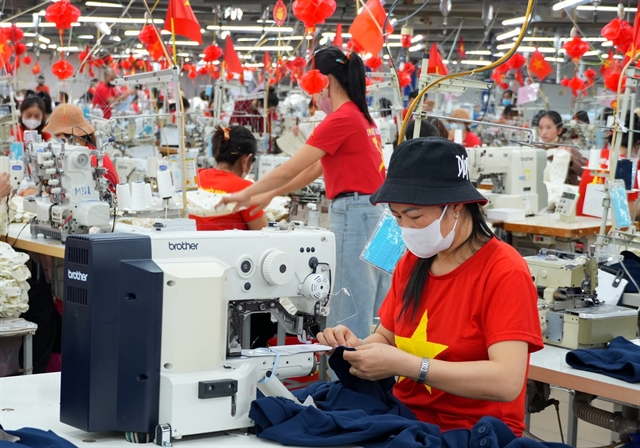
| Garment production at a company in Bắc Ninh Province. The tariff pressure from the US could provide a catalyst for a broader restructuring of Vietnamese businesses and their supply chains. — VNA/VNS Photo Đồng Thuý |
HÀ NỘI — The latest tariff decision by the US has prompted a call for Vietnamese exporters to move beyond simply seeking lower tariffs and instead strengthen supply chain transparency, traceability and compliance to maintain their competitiveness in the global market.
The US Trade Representative (USTR) imposed tariffs of either 10 per cent or 12.5 per cent on 60 economies, with Việt Nam among 42 facing the higher rate, under a Section 301 investigation into whether economies have adopted and effectively enforced bans on imports made with forced labour. The measures took effect on July 24, with certain products exempted.
Ministry of Foreign Affairs spokesperson Phạm Thu Hằng has said that the USTR's decision fails to fully reflect the realities on the ground and Việt Nam's efforts to prevent, reduce and eliminate forced labour, including its ban on imports of goods produced with forced labour.
Hằng stressed that Việt Nam strictly prohibits all forms of forced labour and fully complies with the regulations of the International Labour Organization (ILO), international treaties and free trade agreements to which it is a party.
Việt Nam will continue discussions with the US and ask Washington to fully assess its legal and enforcement efforts when determining tariffs on Vietnamese goods, she said.
The country has strengthened its legal framework and enforcement efforts to prevent forced labour and improve working conditions, with the 2013 Constitution and the 2019 Labour Code.
On July 22, the Government issued Decree 292/2026/NĐ-CP banning imports of goods extracted, produced or manufactured wholly or partly using forced labour. The Ministry of Industry and Trade said the decree demonstrated the Government's determination to strengthen the legal framework, fulfil ILO conventions and other international commitments, and enhance transparency and sustainability in supply chains.
The Government has also stepped up efforts on supply chain transparency, digital trade management, product traceability and labour inspections to help Vietnamese businesses meet requirements in demanding markets such as the US and EU.
Việt Nam has also continued to improve working conditions and strengthen labour safety, while businesses in key export sectors such as textiles and garments, footwear, seafood and electronics are required to comply with strict social responsibility and environmental, social and governance standards, including requirements to protect workers' rights.
These efforts have helped Việt Nam become a key link in global supply chains, with its products increasingly reaching markets with high standards, including the US and the EU.
Restructuring call
|
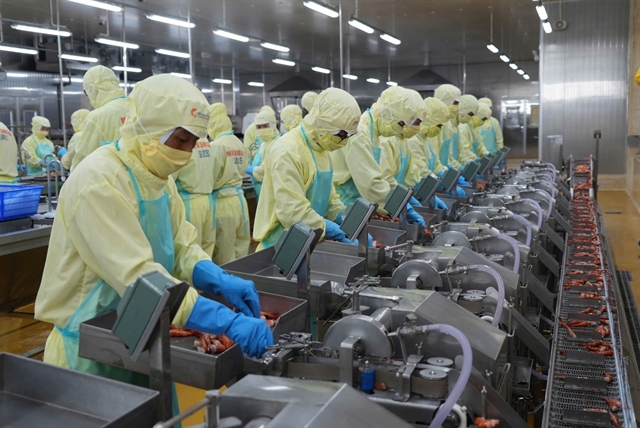
| Workers processing shrimp at a facility in Cà Mau Province. Việt Nam has taken steps to improve working conditions and strengthen labour safety. — VNA/VNS Photo Tuấn Phi |
The tariff decision should be seen as a prompt for Vietnamese businesses to renew their competitiveness, strengthen their supply chains and move higher up global value chains.
Mạc Quốc Anh, deputy chairman the Hà Nội Association of Small- and Medium-Sized Enterprises, said that the tariff could weaken the competitiveness of Vietnamese products and increase the risk that orders would shift to rival suppliers in countries such as Cambodia, Indonesia, Malaysia, Bangladesh and India, which are subject to the 10 per cent rate under the USTR's framework.
The risk is significant given that the US is Việt Nam's largest export market, he said, citing statistics that exports to the US reached about $86.4 billion in the first six months of 2026, accounting for nearly one-third of the country's total goods exports.
However, Anh said the tariff pressure could provide a catalyst for a broader restructuring of Vietnamese businesses and their supply chains.
Businesses that can demonstrate transparent supply chains, the absence of forced labour, effective origin controls and responsible business practices will not only be better positioned in the US market, but could also improve their access to the EU, Canada, Britain, Japan and global distribution networks, he said.
"Vietnamese businesses can only stand firm when they shift from a mindset of fulfilling orders to managing global value chains that can demonstrate transparent origins, compliance with labour standards and effective controls against forced labour and transshipment," Anh said.
Shared compliance centres should be developed to help firms access legal experts, social auditing, origin-tracing systems and international trade advice at affordable costs, he noted.
He also urged efforts to diversify export markets by making greater use of free trade agreements, including the EU-Việt Nam Free Trade Agreement, the Comprehensive and Progressive Agreement for Trans-Pacific Partnership (CPTPP), the Regional Comprehensive Economic Partnership (RCEP) and the UK-Vietnam Free Trade Agreement, while expanding into the Middle East, ASEAN and South America.
According to Mirae Asset Securities, the tariffs are expected to weigh most heavily on labour-intensive, low-margin export sectors, such as textiles and garments, footwear, seafood and wood and furniture.
Experts said the tariff challenge provides an opportunity for industries to reset their competitiveness rather than simply respond to individual trade barriers.
Diversifying export markets and increasing the share of deeply processed products could help reduce reliance on any single market, while tighter cost controls, stronger traceability and compliance with sustainability standards would further enhance competitiveness. — VNS
Economy
 Economy
 Economy
 Economy
 Economy
 Economy
 Economy
 Economy
 Economy
 Economy
 Economy
 Economy
.png) Economy
Economy
 Economy
 Economy