 Economy



Quy Nhơn Dialogue on Climate and Transition to provide platform for open discussion
1.
|
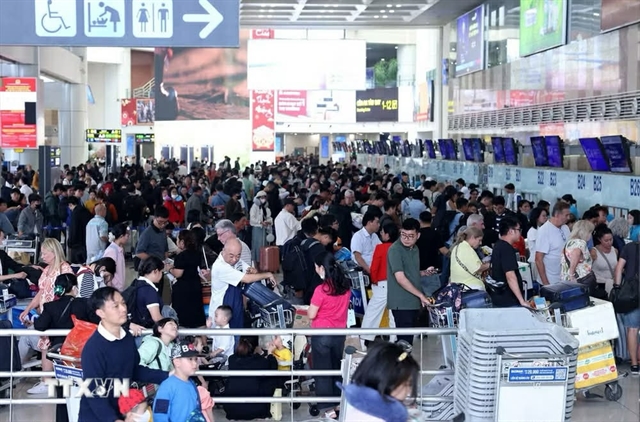
| Passengers queue to check in at the Nội Bài International Airport. — VNA/VNS Photo Quốc Khánh |
HÀ NỘI — International passenger throughput in the first six months this year reached 26.2 million passengers, up by 15.4 per cent compared with the same period last year, said the Civil Aviation Authority of Việt Nam (CAAV).
Vietnamese carriers carried 9.6 million passengers, up 0.2 per cent year on year, accounting for 36.6 per cent of international passenger numbers. Domestic passenger throughput reached 18.7 million, up 0.3 per cent compared with the same period last year.
International air cargo throughput totalled 706,700 tonnes, up 21.3 per cent year on year. Vietnamese carriers transported 119,000 tonnes, an increase of 8.6 per cent and accounting for 16.8 per cent of international cargo.
On international routes, Vietnamese carriers currently operate 109 international routes to 22 countries and territories worldwide. Foreign airlines from 41 countries and territories operate 235 scheduled routes to Việt Nam.
The CAAV noted increasing operational pressure during peak periods, extreme weather conditions, risks from unmanned aerial objects, birds and wildlife at airport areas, together with rising demands for human resources and safety-management capacity across units – all of which present significant challenges.
“With air transport volumes continuing to grow and operational pressures increasing, the demands on safety assurance are likewise rising. Therefore the entire sector must firmly internalise the principle that safety is the core value, the highest command and the foundation for the sustainable development of aviation; complacency, negligence or trading off safety for operational tempo or economic efficiency is absolutely unacceptable,” CAAV director general Uông Việt Dũng said.
Dũng urged agencies and units to continue to implement strictly the legal provisions on aviation safety and the standards and recommendations of the International Civil Aviation Organisation (ICAO); to strengthen hazard identification, risk assessment and control.
They should improve the effectiveness of Safety Management Systems (SMS), cultivate a safety culture at all levels, with leaders bearing direct responsibility for safety at their organisations.
Regulatory bodies need to continue to modernise oversight by adopting proactive, data-driven and risk-based approaches; intensify specialised inspections and audits to detect and rectify shortcomings promptly; and take strict action against breaches of aviation-safety regulations.
Aviation businesses, airports, maintenance organisations, air navigation service providers and other related units should prioritise investment in training and workforce development to raise personnel quality; increase application of science and technology, and digital transformation in management, monitoring and safety-data analysis.
They must also proactively review and mitigate latent risks, especially during year-end peak periods.
Previously, safety oversight and safety management were generally well conducted. The CAAV has carried out continuous safety oversight of aircraft operators, maintenance organisations, training organisations, air traffic service providers and airport operators, and has stepped up inspections to ensure safe aircraft operations during peak periods.
In addition, the CAAV has intensified safety supervision, inspections and specialised audits of aviation organisations and enterprises to detect and correct deficiencies and safety risks in a timely manner.
It instructed units to comply strictly with incident reporting, investigation and analysis, thereby implementing appropriate preventive measures. — VNS
Economy
 Economy
 Economy
 Economy
 Economy
 Economy
 Economy
 Economy
 Economy
 Economy
 Economy
 Economy
 Economy
 Economy
 Economy