 Economy



Cultural industry product 'The Moment' debuts to bring new staging experience to theatregoers
1.
|
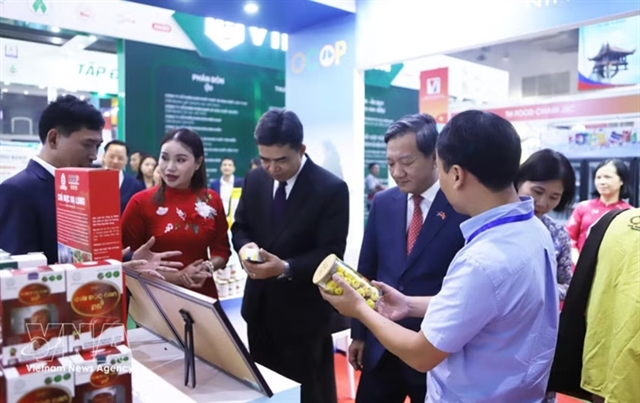
| Vietnamese Ambassador to Laos Nguyễn Minh Tâm and Lao Deputy Minister of Industry and Commerce Phouthavanh Nanthavong visit a Vietnamese booth at VIETLAO EXPO 2026. — VNA/VNS Photo |
HÀ NỘI — A Việt Nam–Lào business networking seminar was held in Vientiane on July 17, bringing together more than 120 officials and representatives of business associations and enterprises of both sides as the two countries seek to boost bilateral trade towards US$10 billion.
Held on the sidelines of VIETLAO EXPO 2026, the seminar aimed to help businesses explore trade and investment opportunities and foster cross-border production and supply chains.
Speaking at the event, Deputy Director General of the Vietnam Trade Promotion Agency Bùi Quang Hưng said economic, investment and trade cooperation remains a key pillar of the great friendship, special solidarity, comprehensive cooperation and strategic cohesion between Việt Nam and Lào.
To realise the vision of bringing bilateral trade to $10 billion set by the two countries’ leaders, Hưng stressed the need to strengthen direct business connections, reduce unnecessary intermediary costs and improve cross-border logistics infrastructure.
He affirmed that Việt Nam’s Ministry of Industry and Trade will continue supporting businesses through coordinated trade promotion mechanisms, both via digital platforms and direct channels, helping them better tap the two economies’ complementary strengths.
Chattouphonh Nakhavith, deputy director general of the Lao Ministry of Industry and Commerce’s Department of Foreign Trade, said Lào is working to improve its investment and business environment by simplifying administrative procedures, digitalising its national single-window system and offering incentives in special economic zones.
Lào encourages capable Vietnamese companies to increase high-quality investment and strengthen production linkages and technology transfer, particularly in organic agriculture and deep processing, he said.
Reports presented at the seminar showed that bilateral trade has maintained steady growth in recent years, supported by the effective implementation of bilateral and border trade agreements.
The two countries have highly complementary trade structures. Việt Nam mainly exports iron and steel, vehicles and spare parts, machinery and equipment, textiles and garments, and processed agricultural products to Lào.
In return, Lào supplies Việt Nam with natural rubber, wood and wood products, ores, minerals and agricultural commodities.
Participants noted that the current scale of trade has yet to match the potential of bilateral relations. They called for greater efforts to upgrade transport infrastructure, streamline customs clearance to reduce logistics costs and improve local-currency payment mechanisms to facilitate border trade.
Business networking sessions held on the sidelines of the seminar also produced tangible results.
Phạm Xuân Hùng, founder of Hoàng Hiệp F&B Co Ltd, said his company had connected with two potential Lao partners, including a major supermarket chain that is considering carrying its products and another company interested in Vietnamese Robusta green coffee beans.
Moukdavan Keovilay, director of Lao traditional food company Khua Luk Sao Kok, said her company had established connections with several Vietnamese customers and potential joint-venture partners. The sides are discussing plans to develop a production facility that could eventually be expanded into a larger factory.
Meanwhile, Hồ Thị Khánh Ngọc, CEO of Ngọc Phương Essential Oil Production Trading and Services Co Ltd, said her company had secured sales and contract manufacturing opportunities during the event, while a supermarket chain in Lào had received product samples for possible future cooperation.
The seminar concluded with dozens of memoranda of understanding and framework agreements signed between businesses from the two countries.
The outcomes are expected to generate new business opportunities and contribute to efforts to raise Việt Nam–Lào trade to $4 billion in 2026, paving the way towards the strategic target of $10 billion in the coming years. — VNA/VNS
Economy
 Economy
 Economy
 Economy
 Economy
 Economy
 Economy
 Economy
 Economy
 Economy
 Economy
 Economy
 Economy
 Economy
 Economy