 Economy


Alaya Consulting Study Finds Only 12.5% of Hong Kong Large-Cap Companies Fully Disclosed Scenario-Linked Financial Effects Ahead of Upcoming Mandatory Reporting Cycle
1.
|
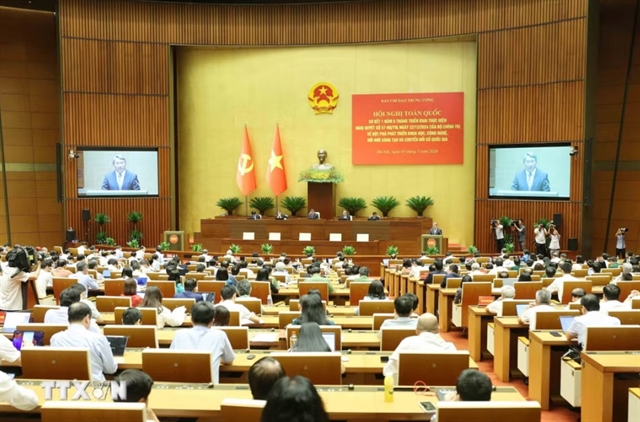
| Participants at the national conference reviewing 18 months of implementing the Politburo's Resolution 57 on Wednesday. — VNA/VNS Photo |
HÀ NỘI — Vietnamese technology companies and universities have called for stronger policy support to accelerate the development of strategic technologies, with proposals ranging from expanding AI infrastructure and regulatory sandboxes to boosting research commercialisation and domestic innovation.
The proposals were presented at a national conference reviewing 18 months of implementing the Politburo's Resolution 57 on science, technology, innovation and digital transformation, where business leaders and academics shared ideas on how to strengthen Việt Nam's technology capabilities.
A key proposal from industry was for the Government to create a stronger market for home-grown technology products, while businesses focus on improving quality and expanding into global markets.
VNPT chairman and general director Huỳnh Quang Liêm said Việt Nam should focus on solving major domestic challenges that enable businesses to develop core technologies instead of pursuing fragmented projects.
He proposed that the Government establish a national mechanism to commission major technology projects, assigning Vietnamese companies to lead their development with clearly defined deliverables, funding and accountability.
Liêm also called for public agencies to prioritise testing and adopting domestically developed strategic technologies that meet technical standards, while evaluating projects based on their lifetime value rather than initial investment costs.
Such an approach would allow the State to create the first market for Vietnamese technology products, while businesses commit to improving quality and bringing those products to international markets, he said.
Artificial intelligence was another major focus of the discussions.
Lưu Anh Tuấn, deputy general director of VinSmart Future, said AI and big data should be treated as foundational infrastructure for the digital economy rather than simply emerging technologies.
He proposed building a national AI data infrastructure through common standards, data-sharing mechanisms between Government agencies, businesses and universities, and open datasets and data trusts for strategic sectors.
These resources would support the development of AI models tailored to Việt Nam's language, economy and competitive advantages, he said.
The company also recommended launching a national AI programme to develop open 'Make in Việt Nam' foundation models, including large language models, multimodal AI and AI for robotics and smart manufacturing, enabling businesses to build a wider ecosystem of applications.
Tuấn further proposed establishing shared national AI computing infrastructure that universities, research institutes and businesses could access at reasonable costs. He said such computing capacity should be recognised as strategic national infrastructure, alongside electricity, telecommunications and transport networks.
To accelerate innovation, he urged the Government to introduce AI regulatory sandboxes, improve data governance, prioritise public procurement of domestic AI products and adopt more flexible funding and evaluation mechanisms for AI research programmes.
He also highlighted the need to develop high-quality AI talent and help Vietnamese AI companies commercialise their technologies internationally.

|
| An AI-powered camera system detects traffic violations. — VNA/VNS Photo Quốc Lũy |
Realtime Robotics, a Vietnamese unmanned aerial vehicle (UAV) developer, argued that targeted policy support could enable Việt Nam to become a major exporter of UAV technologies.
The company said it had already mastered most core UAV technologies but required greater resources to expand research and development, manufacturing capacity and exports.
It proposed that the Government procure proven UAV products for rescue operations, defence and power grid inspection. The firm also called for preferential loans to build a UAV manufacturing plant at HCM City's high-tech park and for dedicated UAV testing corridors in Tây Ninh.
Other recommendations included simpler import procedures for research materials and support, covering up to 50 per cent of R&D costs for UAV technologies targeting G7 export markets.
The company said such measures would strengthen Việt Nam's domestic UAV ecosystem, while helping position the country as a supplier of advanced UAV technologies to global markets.
Universities also stressed that scientific research would contribute more effectively to economic growth if stronger mechanisms were introduced to connect laboratories with industry.
Professor Lê Anh Tuấn, director of the Hanoi University of Science and Technology, said the university is restructuring its innovation ecosystem to shorten the path from research to commercialisation.
The model combines research institutes, joint laboratories where researchers work alongside industry engineers, and investment platforms that support technology start-ups emerging from the university.
He called for greater investment in shared research facilities, clearer regulations governing intellectual property valuation and university spin-offs and faster implementation of science and innovation funds at universities and research institutes.
According to Tuấn, closer collaboration among the Government, universities and businesses would be critical to transforming research into commercially viable technologies.
Together, the proposals reflected a common view that achieving the goals of Resolution 57 will require more than increased investment.
Speakers said success will depend on coordinated reforms that expand market opportunities for domestic technologies, strengthen research capabilities, modernise digital infrastructure and create a more flexible regulatory environment for innovation. — VNS
Economy
 Economy
 Economy
 Economy
 Economy
 Economy
 Economy
 Economy
 Economy
 Economy
 Economy
 Economy
 Economy
 Economy