 Economy


PM receives leaders of Lao Front for National Construction, Laos-Việt Nam Friendship Association
1.

|
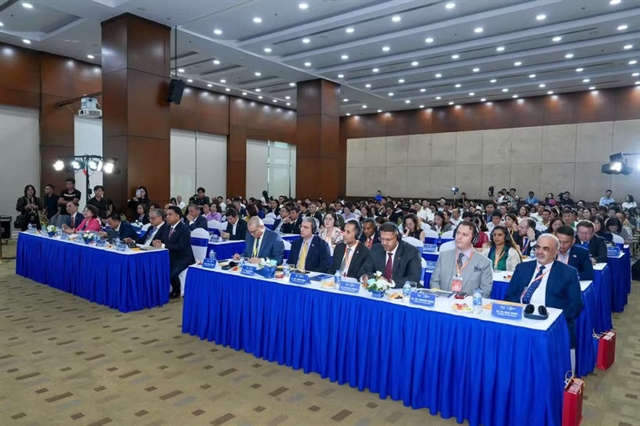
| Katayama Tōru, senior vice president for Alliances and International Affairs at ANA Holdings, speaking at the Vietnam Airlines' 2026 Annual General Meeting. — Photo courtesy of the airline |
HÀ NỘI — Japan's ANA Holdings has reaffirmed its long-term commitment to Vietnam Airlines, expressing confidence that the national flag carrier has laid the foundations for a new phase of sustainable growth after emerging from one of the most challenging periods in the aviation industry's history.
Speaking at Vietnam Airlines' 2026 Annual General Meeting on Sunday, Katayama Tōru, senior vice president for Alliances and International Affairs at ANA Holdings, said nearly a decade of partnership had given the Japanese aviation group first-hand insight into the airline's transformation.
"Based on the progress achieved, we believe Vietnam Airlines will continue to overcome challenges and develop sustainably in the years ahead," he said.
"ANA remains committed to accompanying Vietnam Airlines as its strategic shareholder while maximising cooperation between the two sides to drive business efficiency and long-term growth."
ANA became Vietnam Airlines' strategic shareholder in July 2016 after investing VNĐ2.43 trillion (approximately US$108 million) for an 8.77 per cent stake. Since then, cooperation has expanded beyond equity ownership to cover commercial operations, network development, cargo services, maintenance, workforce training, digital transformation and service quality improvement.
Since joining Vietnam Airlines' Board of Directors, ANA has accompanied the carrier during several major milestones, including its post-equitisation restructuring, fleet modernisation with Airbus A350 and Boeing 787 aircraft, recovery from the COVID-19 pandemic and ongoing financial restructuring.
Katayama noted that the past decade had been marked by unprecedented disruptions for the global aviation industry, ranging from the pandemic and soaring fuel prices to supply chain disruptions and aircraft shortages.
Against that backdrop, he said Vietnam Airlines had demonstrated flexible leadership and timely decision-making, enabling the carrier to maintain its recovery momentum.
Comprehensive restructuring measures, operational optimisation and efforts to improve efficiency had significantly strengthened the airline's business performance, while timely support from the Vietnamese Government had also played an important role in the recovery process.
Vietnam Airlines Chairman Đặng Ngọc Hòa said the partnership has evolved into one of the most comprehensive and enduring strategic collaborations between a Vietnamese airline and an international carrier.
Beyond commercial benefits, ANA's support has contributed to strengthening Vietnam Airlines' corporate governance, service quality and regional competitiveness, he said.
The continued commitment of one of Asia's most conservative aviation groups also reflects growing confidence in the airline's restructuring progress and governance foundations rather than simply an investment decision, providing a basis for both sides to look towards a new growth cycle.
That confidence has been reinforced by Vietnam Airlines' improving financial performance over the past two years.
Following the successful implementation of its 2021-25 restructuring programme, the airline has restored its financial position and eliminated negative equity. As of December 31, 2025, parent company equity had reached more than VNĐ8.87 trillion, while consolidated equity stood at nearly VNĐ6.82 trillion.
Vietnam Airlines remained in profit for a second consecutive year. Parent company after-tax profit nearly doubled to VNĐ5.51 trillion in 2025 from VNĐ2.77 trillion a year earlier, while consolidated after-tax profit stood at VNĐ7.71 trillion, compared with VNĐ7.96 trillion in 2024.
The airline has completed two capital increases worth a combined VNĐ16.93 trillion, restructured domestic and international borrowings and continued divestment from selected subsidiaries to improve capital efficiency.
Operationally, its route network has fully recovered to pre-pandemic levels while expanding into international markets including Germany, Italy, Denmark, India, Indonesia, China and South Korea.
The carrier is also developing an integrated aviation ecosystem linked to Long Thành International Airport through investments in logistics, cargo terminals, technical services, catering, ground handling and aviation fuel supply.
Katayama said the airline's greatest achievement was not simply returning to profitability but establishing a governance system capable of withstanding future external shocks, whether from another pandemic or volatility in global energy markets.
Vietnam Airlines has streamlined its organisational structure, optimised business processes and accelerated digital transformation while continuing to invest in pilots, engineers, cabin crew and future management talent to support long-term expansion.
The carrier ended 2025 with consolidated revenue of nearly VNĐ123.86 trillion and consolidated after-tax profit of VNĐ7.61 trillion. It operated 156,200 flights, transported 25.65 million passengers and handled 340,200 tonnes of cargo during the year.
Fleet utilisation also improved, with average aircraft utilisation reaching 11.8 hours per day, up 8 per cent year-on-year. Its network now comprises 113 routes connecting 22 domestic destinations and 39 international destinations across 22 countries.
Alongside operational improvements, the airline has introduced a range of customer-focused initiatives, including in-flight internet services, biometric check-in using the VNeID platform, service upgrades at T3 terminal of Tân Sơn Nhất International Airport and a new e-commerce platform.
Despite the positive momentum, Vietnam Airlines expects a more challenging operating environment for the remainder of 2026.
Chief Executive Officer Lê Hồng Hà said geopolitical tensions had pushed average Jet A1 fuel prices to a projected $128.54 per barrel this year, nearly 48 per cent higher than in 2025. The increase alone is expected to add around VNĐ11.9 trillion in costs, excluding the impact of exchange rate movements and production volume.
The airline also continues to face pressure from currency fluctuations, rising technical and logistics costs, global aircraft shortages, increasingly stringent green transition requirements and intensifying competition as airlines worldwide expand their fleets.
To address these challenges, Vietnam Airlines is adjusting flight frequencies in line with market demand, optimising commercial efficiency and protecting the core products of its domestic network while maintaining the leading market position of Vietnam Airlines Group, comprising Vietnam Airlines, Pacific Airlines and Vasco.
For 2026, the airline aims to transport 27.73 million passengers and 361,400 tonnes of cargo, representing increases of 8.1 per cent and 6.2 per cent, respectively. Consolidated revenue is projected to reach VNĐ138.9 trillion, up more than 12 per cent from 2025.
The company is also preparing resources for long-term expansion by restructuring its organisation, strengthening its workforce and continuing fleet investment despite ongoing global aircraft shortages.
Vietnam Airlines currently operates around 105 aircraft, including 31 wide-body jets. It has signed an agreement to purchase 50 new-generation Boeing narrow-body aircraft while working with partners to lease an additional 30 to 50 narrow-body aircraft and studying options to lease or acquire around 30 wide-body aircraft to support international expansion, particularly on long-haul intercontinental routes.
At the same time, the airline plans to expand its aviation ecosystem through investments in maintenance, logistics, ground services and airport infrastructure at major hubs, including Tân Sơn Nhất, Nội Bài and Long Thành airports.
At Long Thành, it aims to develop a regional-scale aircraft maintenance centre capable of serving both its own fleet and international airlines, while participating more deeply in the regional aviation technical value chain.
Chairman Hòa said the carrier was entering a new stage of development.
"If the 2021-25 period was about overcoming crisis and rebuilding our financial foundations, then 2026-30 will mark the transition from recovery to growth," he said.
"With the support of our shareholders, especially strategic shareholder ANA Holdings, Vietnam Airlines is ready to enter a new growth cycle for 2026-30, with the goal of becoming Southeast Asia's second-largest five-star full-service airline by 2030." — VNS
Economy
 Economy
 Economy
 Economy
 Economy
 Economy
 Economy
 Economy
 Economy
.jpg) Economy
Economy
 Economy
 Economy
 Economy
 Economy