 Economy
Đà Nẵng forum highlights integrated planning for sustainable development
1.
|
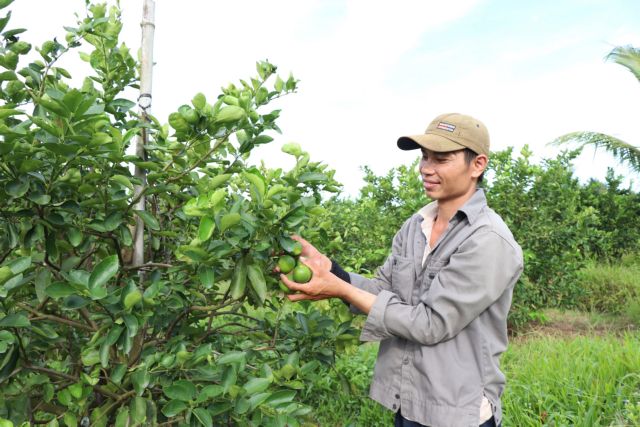
| A farmer harvests seedless lemons in Vĩnh Long Province. A national database covering all agricultural land, rather than only export-oriented production areas, is essential for meeting international standards and improving sector governance. — VNA/VNS Photo Thanh Hoà |
HÀ NỘI — Việt Nam needs to accelerate the development of a unified national database for farming areas to comply with the European Union's anti-deforestation regulation (EUDR) and support the digital transformation of agriculture, experts said at a conference on Tuesday.
Experts said at the conference held by Network for Agriculture and Forestry Policy Research that fragmented data systems and limited information sharing among Government agencies, businesses and farmers remain major obstacles to compliance with the EUDR, which requires exporters of commodities such as coffee, rubber and cocoa to prove their products are not linked to deforestation.
Hà Công Tuấn, chairman of the Vietnam Association of Agricultural Economics and Rural Development, said a national database covering all agricultural land, rather than only export-oriented production areas, is essential for meeting international standards and improving sector governance.
Phạm Đình Lai, director of the Điện Biên Province Agriculture Sub-Department, said the expansion of coffee-growing areas has faced problems in collecting and managing cultivation data due to limited funding, technical capacity and challenges in gathering geospatial information, such as coordinates, land parcels and land-use status.
The province has adopted an approach that places communes at the centre of data collection efforts. This has shown promising results, with farmers becoming more engaged in data collection and gaining a better understanding of market requirements for traceability, Lai said.
He added that stronger participation from businesses would be needed, particularly in data sharing, farmer training and monitoring compliance with EUDR requirements.
Tô Xuân Phúc, an expert at Forest Trends, said the main challenge is the fragmentation of information across multiple stakeholders.
"A farm database is much more than a planting area code," he said.
He pointed out that a farm database is a management system containing information on land, crops, productivity, producers and geospatial data that can support policymaking, risk management and supply chain monitoring.
Việt Nam possesses large amounts of agricultural data, but lacks mechanisms to integrate and update them, said Phạm Tuấn Anh, former director of Đắk Nông Province's Department of Agriculture and Rural Development.
He cited the durian sector as an example. While Việt Nam has more than 40,000ha of durian cultivation, only about 13,000ha have been granted planting area codes, and roughly 20 per cent of those codes are no longer active. This demonstrates the need for continuous data update and management, he said.
As global markets increasingly require traceability and sustainability verification, experts warned that delays in building a reliable agricultural data system could weaken Việt Nam's export position and increase compliance costs for producers and exporters.
Stressing the importance of a unified national database linked to digital maps and updated regularly, Tuấn said data should be classified into three categories — green, yellow and red — corresponding to different levels of compliance and land-use risk.
Such a system would help authorities identify potential violations early and improve monitoring of agricultural production areas, he said.
Tuấn also called for the development of a digital platform capable of integrating information from different ministries, local authorities and businesses while allowing authorised users to access and share data according to their responsibilities.
Experts said at the conference that building a comprehensive farming area database should be treated as a national priority rather than a purely technical task.
The Government should play a role by establishing standards and digital infrastructure while businesses would contribute data and support farmers in meeting market requirements, and farmers would provide and update information at the production level. — VNS
Economy
 Economy
 Economy
 Economy
 Economy
 Economy
 Economy
 Economy
 Economy
 Economy
 Economy
 Economy
 Economy
 Economy
 Economy