 Economy
Asian-American businesses help expand Việt Nam-US trade ties
1.
|
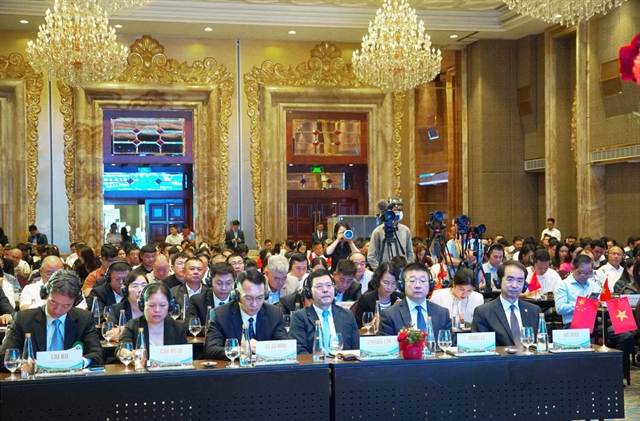
| Participants at the forum. — Photos nongnghiepmoitruong.vn |
HCM CITY — Vietnamese and Chinese officials, industry representatives and businesses called for stronger value-chain integration, faster market access procedures and deeper cooperation in logistics and digital transformation to unlock further growth in bilateral agricultural trade.
The recommendations were made at the first Việt Nam–China Agricultural Trade Connectivity Forum held in HCM City on June 24, which brought together policymakers, business associations, exporters, financial institutions and logistics service providers from both countries.
Permanent Deputy Minister of Foreign Affairs Nguyễn Minh Vũ described agricultural trade as one of the brightest spots in Việt Nam–China economic cooperation, noting that growing demand in China for safe, green and high-quality food products was creating significant opportunities for Vietnamese exporters.
He said the two countries should move beyond traditional trading activities and work towards building integrated production, supply and distribution chains.

|
| Deputy Minister of Foreign Affairs Nguyễn Minh Vũ speaks at the forum. |
According to Vũ, closer cooperation across the entire value chain – from seed development and high-tech farming to processing, logistics and branding – would help maximise the benefits of bilateral trade.
The deputy minister also called on relevant authorities to accelerate market-opening procedures for agricultural products by speeding up risk assessments and technical approval processes, while enhancing cooperation on standards, inspection, quarantine and product traceability.
He added that digital platforms and e-commerce should be leveraged more effectively to create new growth momentum for agricultural trade and improve connections between producers, processors and distributors.
Chinese Ambassador to Việt Nam He Wei said agricultural cooperation between the two countries was entering a new stage of development, gradually shifting from simple commodity exchanges towards more comprehensive supply-chain cooperation.
According to the ambassador, bilateral trade exceeded US$290 billion in 2025, setting a new record. Agricultural products remained among the fastest-growing sectors, with agricultural and food exports to China rising 37.4 per cent year-on-year in the first quarter of 2026.

|
| Chinese Ambassador to Việt Nam He Wei speaks at the forum. |
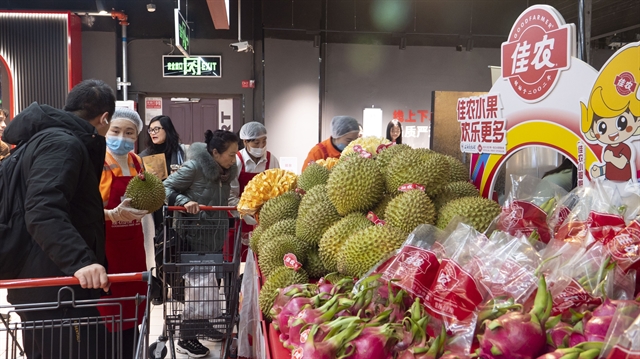
China remained Việt Nam's largest fruit and vegetable export market, importing about $5.5 billion worth of products last year and accounting for nearly two-thirds of the country's total exports in the category.
Durian continued to be the leading export product, generating more than $3.4 billion in 2025. Other products including bananas, dragon fruit, mangoes, jackfruit, pomelos, coconuts and passion fruit are also expected to see further expansion in the Chinese market.
Participants at the forum highlighted improving transport and logistics connectivity as a major factor supporting future growth.
Over recent years, the two countries have expanded cooperation in road, rail, maritime and air transport, while smart customs systems, green lanes for agricultural products and cold-chain logistics have helped shorten delivery times and reduce costs for exporters.
As a result, some fresh fruits harvested in Việt Nam can now reach consumers in China within a day, helping preserve quality and reduce post-harvest losses.
Digital transformation was another recurring theme throughout the discussions.
Chương Lâm, chairman of the Chinese Entrepreneurs Association in Việt Nam's HCM City chapter, said smart customs systems, smart border gates and QR-code traceability technologies were becoming increasingly important tools for improving supply-chain transparency and strengthening consumer confidence.
He said digitalisation would play a crucial role in supporting green agriculture and modern agricultural trade, while also helping businesses comply with increasingly demanding import requirements.
|
| Chinese shoppers select Vietnamese fruits on display at a supermarket in China. — VNA/VNS Photo |
Representatives from the quality inspection sector echoed these views, arguing that harmonisation of testing standards, greater mutual recognition of inspection results and wider adoption of digital traceability systems would improve trade efficiency and facilitate customs clearance.
Despite the positive outlook, speakers warned that exporters would face growing challenges as China tightens requirements on growing-area codes, packing facilities, plant quarantine and food safety standards.
Nguyễn Quốc Mạnh, deputy director of the Department of Crop Production and Plant Protection, said the fruit and vegetable sector must move away from a growth model based primarily on volume and focus instead on quality, value addition and sustainability.
He noted that the two countries had signed export protocols for a growing range of agricultural products but sustaining and expanding market access would require greater investment in standardised production, traceability, processing and logistics.
"Only by meeting increasingly stringent requirements on quality, transparency and sustainable development can Vietnamese agricultural products continue to expand their market share and enhance their value in international markets,” Mạnh said.
Industry leaders said future growth would depend less on increasing output and more on building integrated value chains that meet higher standards and evolving consumer preferences, with greater investment in branding, product quality, processing and digital capabilities needed to maintain competitiveness in the Chinese market. — VNS
Economy
 Economy
 Economy
 Economy
 Economy
.jpg) Economy
Economy
 Economy
 Economy
 Economy
 Economy
 Economy
 Economy
 Economy
 Economy
 Economy