 Economy
Lotte, Phát Đạt combine strengths in Thu Thiem project
1.
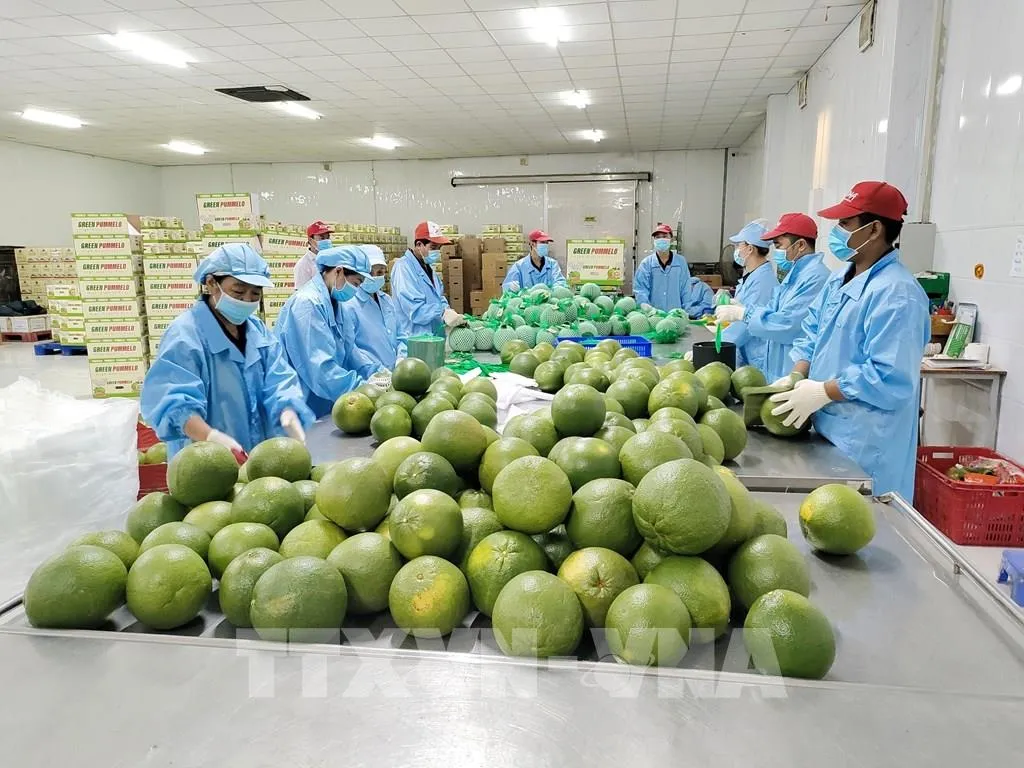 |
| Processing pomelos for export at Kim Thành packing factory (Giao Long Commune, Vĩnh Long Province). VNA/VNS Photo Huynh Phuc Hau |
VĨNH LONG — The first container of green-skinned pomelos from Vĩnh Long province has hit the shelves of premium Australian supermarkets, marking a breakthrough for the signature fruit and demonstrating that local growers can clear the high bar set by the world’s most demanding markets.
Together with the official export channel into the vast Chinese market widening, Vĩnh Long farmers are scaling up specialised growing zones and tightening production standards, aiming to lock in sustainable growth for pomelo cultivation and more prosperity across the Mekong Delta province.
For years, Trịnh Ngoc Trung, a farmer in Giao Long commune, grew pomelos under VietGAP and organic-leaning standards. That changed when his cooperative landed orders from China, forcing him to rapidly fine-tune his methods to satisfy the new market’s requirements.
Trung said his earlier bet on certified production meant the extra requirements were manageable. His 1.2-ha orchard now pumps out more than 20 tonnes of fruit a year.
Đàm Văn Hưng, Director of the Hương Miền Tây pomelo-buying facility in Phuoc Mỹ Trung commune, noted that green-skinned pomelo has become the eighth Vietnamese fruit to win entry to Australia. The opening of new overseas markets, he said, will push growers to carve out larger export-oriented production areas and lift their incomes.
Phan Kim Tuyền, head of the economic division of Giồng Trôm Commune, said the locality now farms close to 1,000 ha of citrus, including roughly 350 ha of green-skinned pomelo clustered around the former Giồng Trôm town and Bình Hòa Commune.
Local authorities, working with agricultural extension agencies and the Vĩnh Long seed and ornamental plant centre, have distributed 2,000 green-skinned pomelo seedlings to 50 households, a small down-payment on a much larger expansion.
The locality is simultaneously pushing new technology and safe production practices, such as VietGAP and organic ones, to raise both quality and yield. Training has accelerated, alongside efforts to knit farmers more tightly to buyers, aiming to match supply with demand for green-skinned pomelos.
Lâm Văn Tần, Director of the provincial Department of Agriculture and Environment, said Vĩnh Long sits in the heart of the Mekong Delta, with its dense river network and year-round alluvial deposits from the Tiền and Hậu rivers delivering near-perfect conditions for fruits.
Among the province’s staple crops, green-skinned pomelo is a standout, exceptionally well-suited to local soil and climate. Pomelo is a flagship product, spanning some 18,000 ha. The pink-fleshed green-skinned variety spans more than 13,800 ha, and over 10,000 ha are already bearing fruit, yielding 12–15 tonnes per ha annually.
Many growers have adopted VietGAP, while 10 green-skinned pomelo products have earned four-star OCOP (One Commune, One Product) certification. The province has also secured 233 production unit codes for export covering 1,224.87 ha.
In recent years, green-skinned and Nam Roi pomelos have made their way to the European Union, New Zealand, the US, the Republic of Korea, and now Australia.
The province intends to deepen the pomelo value chain by tightening production and market links. Vĩnh Long now boasts 21 cooperatives and eight cooperative groups dedicated to growing green-skinned pomelo.
The agricultural sector has actively facilitated ties among farmers, cooperatives and exporters to build stable raw material zones that can satisfy importer requirements on quality, traceability and food safety.
Going forward, it will assist growers in adopting processes tailored to each export market. Farmers are being nudged into cooperatives and cooperative groups to pool bigger land, strike stronger partnerships with businesses, and secure stable markets, thus ensuring sustainable development for Vĩnh Long’s green-skinned pomelo industry. — VNS
Economy
 Economy
 Economy
 Economy
 Economy
 Economy
 Economy
 Economy
 Economy
 Economy
 Economy
 Economy
 Economy
 Economy
 Economy