 Economy



Vietnamese Prime Minister meets Cambodian National Assembly President
1.

|
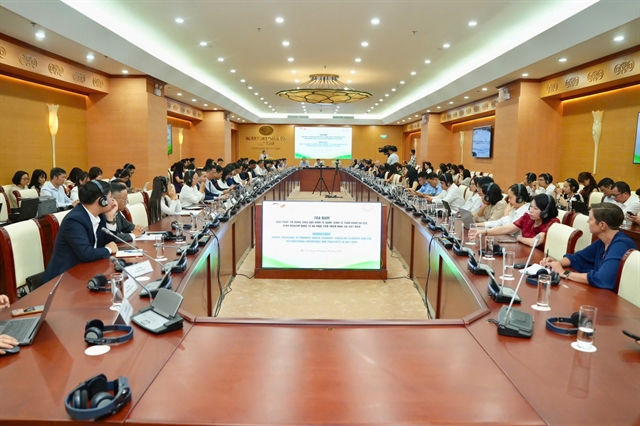
| Speakers at the discussion. — VNS Photo Mai Hương |
HÀ NỘI — Việt Nam is betting heavily on artificial intelligence to boost economic growth, but experts say the country faces a growing shortage of AI talent.
According to estimates by the Boston Consulting Group (BCG), AI could contribute between US$120 billion and $130 billion to Việt Nam's economy by 2040 through higher productivity and new sources of revenue.
Speaking at a forum on workforce development in the AI era held at Hanoi University of Science and Technology on June 8, experts said the biggest bottleneck facing businesses is no longer access to AI tools but the lack of people who can effectively build, manage and deploy them.
“AI is no longer optional. It has become a requirement,” said Nguyễn Thị Lệ Quyên, head of Enterprise Supporting Department at the National Innovation Centre (NIC).
Quyên said NVIDIA's decision to set up an AI research and development centre in Việt Nam in late 2024 highlighted the country's growing appeal as a technology hub.
She said one of the main reasons behind the investment was Việt Nam's young workforce and its ability to rapidly adopt new technologies, a strength that many international technology companies value when choosing investment destinations.
According to speakers, in the AI race, technology can be bought and infrastructure can be funded, but skilled talent cannot be created overnight, speakers said.
Nguyễn Đức Long, executive director of AIUni Technology Academy, said business leaders are under increasing pressure to keep pace with rapid advances in AI, with new models, applications and success stories emerging almost daily.
That urgency, however, can lead companies to implement AI projects without adequately preparing their workforce or governance structures.
“Without a solid foundation, AI becomes little more than a shiny ornament that can easily break,” Long said.
He said Vietnamese businesses are ready to move from digital transformation to AI transformation, but the process remains in its early stages.
“The biggest challenge lies in overcoming resistance to change among people.”
Data governance presents another challenge.
Vũ Mạnh Cường, enterprise business director at NVIDIA Vietnam, warned that businesses relying heavily on public AI platforms may expose sensitive corporate information if they fail to establish proper safeguards.
“If companies simply upload data to external AI systems, they risk losing control of business secrets,” he said.
According to Cường, AI development rests on three pillars: data, algorithms and infrastructure. While Việt Nam is making progress in areas such as national data centres and computing capacity, human capital remains the most critical element.
Large banks, telecommunications firms and technology companies are already struggling to recruit AI specialists. Some employers have begun approaching university students before graduation, intensifying competition for a limited talent pool.

|
| Students from the School of Information and Communication Technology under Hanoi University of Science and Technology conduct research at the AI4Life Centre. — Photo daibieunhandan.vn |
The growing importance of AI is also reshaping corporate structures.
Some companies have begun creating new executive roles such as Chief AI Officer (CAIO), reflecting the increasingly strategic role of AI in business operations and decision-making.
The shortage is particularly striking given Việt Nam’s large base of information technology engineers. Many possess strong technical skills but lack specialised AI training, creating what experts describe as a significant untapped opportunity.
To address the gap, industry and academic institutions are expanding cooperation to provide AI education beyond traditional computer science programmes.
New training initiatives are increasingly targeting professionals in finance, banking, manufacturing and business management, where AI applications are expected to grow rapidly.
Long said companies should establish clear standards to assess AI capabilities among employees and avoid treating AI adoption as a branding exercise.
“The first step is to standardise AI competencies across the organisation,” he said.
“Businesses need to understand where their people are today before deciding where they want to go.”
One initiative highlighted at the event is a partnership involving the National Innovation Centre (NIC), Hanoi University of Science and Technology and Hong Linh Education to expand AI training in Việt Nam.
The forum was held as part of efforts to implement a 2025 memorandum of understanding between the three partners.
The programme brings NVIDIA's Deep Learning Institute (DLI) courses to Vietnamese learners and aims to equip students and working professionals with practical AI skills. It aims to develop a transparent and standardised system for assessing AI competencies, much like IELTS and TOEFL provide benchmarks for language proficiency.
Organisers said the initiative reflects a broader effort to strengthen cooperation among government agencies, universities and businesses in developing the country's AI workforce. — BIZHUB/VNS
Economy
 Economy
 Economy
 Economy
 Economy
 Economy
 Economy
 Economy
 Economy
 Economy
 Economy
 Economy
 Economy
 Economy
 Economy