 Economy


Winners of the 2026 INPD Awards Announced, C-Beauty Takes Home Multiple Prestigious Honors
1.

|
| Residential and urban development projects in Việt Nam. Property developers are increasingly turning to the bond market for capital amid tighter bank lending conditions. — VNA/VNS Photo |
HCM CITY — Property developers are accelerating bond issuance as access to bank loans becomes increasingly constrained, with many firms raising trillions of đồng through the debt market since the beginning of 2026 to supplement cash flow and refinance maturing obligations.
Real estate developer Minh An Investment and Development JSC recently submitted a report to the Hanoi Stock Exchange announcing the results of its latest corporate bond offerings.
On April 23, the company issued 13,000 bonds under code MAD32601 with a face value of VNĐ100 million each, raising a total of VNĐ1.3 trillion (US$50 million).
The bonds have a 12-month tenor and are scheduled to mature on April 23, 2027.
On the same day, Minh An issued another 62,000 bonds under code MAD12602, also with a face value of VNĐ100 million each, equivalent to VNĐ6.2 trillion ($238 million).
These bonds have a 30-month tenor and are expected to mature on October 23, 2028.
The two offerings enabled the company to mobilise a combined VNĐ7.5 trillion through the corporate bond market in a single day.
Earlier, Vinhomes JSC announced the successful issuance of bond lot VHM12601 worth VNĐ6 trillion ($231 million) during April 13 to 15, 2026. The bonds are due to mature on October 13, 2028.
In April, Tam Tài Lộc Import Export Trading JSC also raised VNĐ5.7 trillion ($219 million) through a corporate bond issuance.
The bonds carry a one-year tenor with a fixed interest rate of 10 per cent per year, backed by collateral assets, and are scheduled to mature on April 23, 2027.
The trend of stronger bond issuance among property developers has become increasingly visible since the start of the year.
Other major issuers include Marina Center Investment LLC with VNĐ10.2 trillion, T&T New Era JSC with VNĐ8 trillion, and Phát Đạt Real Estate Investment and Development LLC with VNĐ5.6 trillion.
According to statistics from VPBank Securities, the property sector recorded the largest corporate bond issuance value in March 2026.
Total issuance value in March reached VNĐ30.31 trillion ($1.17 billion), up 76.2 per cent year on year and significantly higher than the combined VNĐ8.49 trillion recorded in the first two months of the year.
Property developers accounted for 78.5 per cent of the total issuance value across the market.
This marked a sharp contrast with the same period last year, when most corporate bond issuance came from banks and securities firms.
Analysts at VPBank Securities forecast that corporate bond issuance activity will remain active in the coming months, especially among property developers, as demand for project funding and refinancing of maturing debt remains high.
At the same time, credit growth is being managed more cautiously, while bank lending to the property sector is becoming increasingly selective.
|
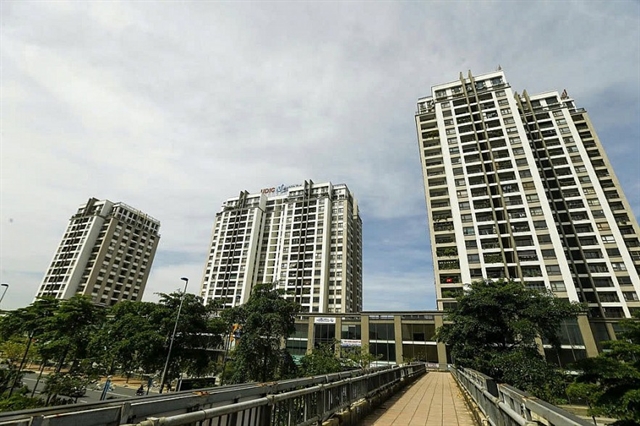
| Real estate developers account for a large share of corporate bond issuance in March 2026. — VNA/VNS Photo |
In its latest residential property market update, VIS Rating also said developers are expected to rely more heavily on bond issuance and capital markets as real estate credit conditions tighten.
According to VIS Rating, after real estate credit surged by around 36 per cent in 2025, the State Bank of Việt Nam signalled a move to curb overheating by targeting overall credit growth of around 15 per cent in 2026. This has made access to bank loans more difficult for property firms.
Against that backdrop, bonds continue to serve as an important funding channel.
In 2025, total property bond issuance reached approximately VNĐ129 trillion ($4.96 billion), up 40 per cent from the previous year.
VIS Rating expects the trend to continue in 2026 as refinancing demand rises sharply. Around VNĐ99 trillion ($3.8 billion) worth of property bonds are due to mature this year alone, up 74 per cent year on year.
Besides debt restructuring, many developers are also increasing bond issuance to finance new projects.
Beyond the bond market, property firms are expected to step up capital raising through the stock market and merger and acquisition activities.
VIS Rating noted that a potential market upgrade and improving sentiment among foreign investors could provide additional support for capital inflows into the property sector.
In 2025, registered foreign direct investment in real estate reached around $7.1 billion, up 13 per cent year on year, while equity issuance value rose by approximately 34 per cent.
However, VIS Rating also warned that divergence among property developers is likely to become more pronounced.
Large developers with strong execution capability and stable project delivery progress are expected to enjoy better access to funding.
Meanwhile, firms facing legal obstacles or focusing heavily on resort property projects may continue to experience liquidity pressure throughout 2026.
Analysts said the large volume of bond maturities in 2026 and 2027 also highlights the need for closer supervision of the property bond market, particularly regarding collateral assets, capital use purposes and risk classification among different groups of issuers.
As capital flows become increasingly selective, financially strong developers with transparent legal status and stable project progress are expected to gain a competitive advantage in raising funds, while weaker firms may face mounting liquidity pressure in the period ahead. — VNS
Economy
 Economy
 Economy
 Economy
 Economy
 Economy
 Economy
 Economy
 Economy
 Economy
 Economy
 Economy
 Economy
 Economy
 Economy