 Economy


Bắc Ninh farmers boost agricultural produce sales through online platforms
1.
|
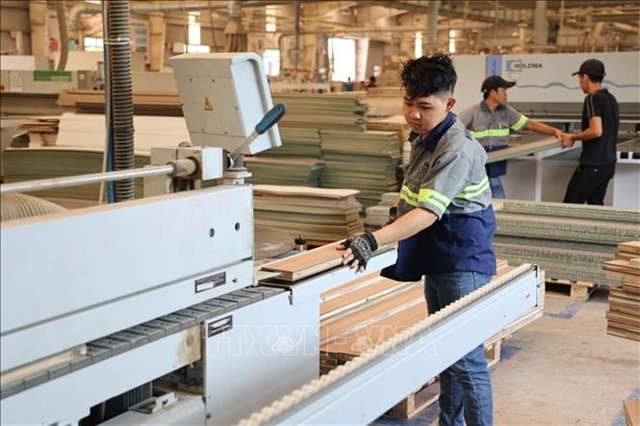
| Exports in the first four months of this year were estimated at $5.42 billion, up 0.4 per cent year-on-year. — VNA/VNS Photo |
HÀ NỘI — Major players in Việt Nam’s wood industry are urging authorities to clarify value-added tax (VAT) rules on timber products, warning that inconsistent implementation across provinces is increasing compliance risks and disrupting domestic supply chains.
The sector, one of Việt Nam’s main export earners, generated about US$18.3 billion in export revenue in 2025. Exports in the first four months of this year were estimated at $5.42 billion, up 0.4 per cent year-on-year.
At a seminar on VAT policy for the wood industry held on Thursday, businesses and industry representatives said frequent regulatory changes and differing interpretations by local tax authorities were creating uncertainty for manufacturers and exporters.
The concerns come ahead of new VAT-related regulations that took effect on January 1, including the amended VAT Law and related implementing guidelines Decree 181, Decree 39 and Circular 84/2025 issued by the Ministry of Agriculture and Environment.
Under the new rules, 'normally processed wood' refers to timber that has undergone initial processing, such as sawing, peeling, chipping or grinding without changing the essential nature of the material. The category includes rough-sawn timber, veneer, wood chips and by-products such as sawdust and wood shavings.
However, businesses said enforcement remains inconsistent.
Some provinces only exempt VAT for companies that directly own plantation forests and process timber themselves, while others extend the same treatment to firms purchasing raw wood from growers before processing it.
Industry representatives also said some local authorities do not classify kiln-dried sawn timber as a normally processed product, despite drying activities being covered under existing regulations. Imported timber products, although legally exempt from VAT, still face tax declaration and payment requirements due to the lack of detailed guidance.
According to the Vietnam Timber and Forest Product Association (VIFOREST), the lack of consistency was increasing invoice and documentation risks while making it harder for exporters to prove the legality of supply chains in major markets, including the US and the EU, where traceability and anti-fraud requirements are tightening.
“Businesses are becoming reluctant to use domestically grown plantation timber because of difficulties in explaining records and tracing origins,” Cao Xuân Thanh, chief office representative of the association, said at the event.
He warned that prolonged uncertainty could affect the livelihoods of around 1.5 million forest-growing households.
Cù Văn Dũng, representative from Phú Thọ-based Thinh Dat Phu Tho JSC, also raised concerns about potential 'tax-on-tax' situations in the timber supply chain, saying VAT obligations could arise repeatedly when semi-processed wood passes through multiple intermediaries, increasing costs and distorting the principle that VAT should only apply to value added at each stage.
In addition to tax issues, businesses said procedures related to timber origin verification and VAT refunds remained cumbersome.
Some companies reported having VAT refunds worth tens of billions of đồng delayed for months or even years due to prolonged origin verification processes, affecting cash flow and production activities.
The association urged the Ministry of Finance to issue unified guidance on VAT treatment for semi-processed timber products, including kiln-dried wood and imported timber, to reduce legal uncertainty for exporters.
The industry group said resolving the regulatory issues would help reduce legal risks, stabilise domestic raw material supply chains and strengthen the competitiveness of Việt Nam’s wood exports as international markets impose stricter transparency and traceability standards. — VNS
Economy
 Economy
 Economy
 Economy
 Economy
 Economy
 Economy
 Economy
 Economy
 Economy
 Economy
 Economy
 Economy
 Economy
 Economy