 Economy


Int’l cooperation helps address nuclear power workforce shortages
1.
|
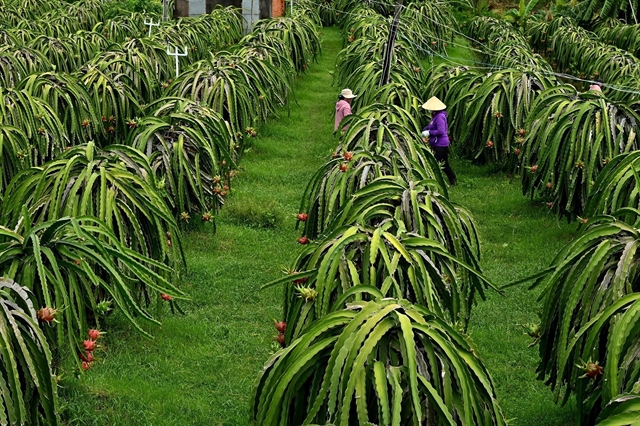
| Farmers harvest dragon fruit at an orchard in Lâm Đồng. — VNA/VNS Photo Hồng Hiếu |
LÂM ĐỒNG — Authorities in Lâm Đồng Province are seeking measures to improve the quality and competitiveness of dragon fruit exports as growers face fluctuating prices, tightening import standards and weak supply chain linkages, delegates heard at a conference on Thursday.
Speaking at the conference, Vũ Đình Cường, deputy director of the Lâm Đồng Department of Agriculture and Environment, said dragon fruit remains one of the province’s key agricultural products, contributing significantly to rural employment and household incomes.
Cường said provincial authorities had introduced several policies to support the sector’s sustainable development, including a dragon fruit development project through 2030, a VietGAP production programme and a broader crop development strategy extending to 2050.
However, he said the sector continues to face multiple challenges, including unstable prices, weak production and consumption linkages and increasingly strict import requirements related to food safety, plant quarantine and traceability.
Trần Đức Thiện, deputy head of the Lâm Đồng Production and Plant Protection Sub-Department, said prolonged price volatility had prompted some farmers to switch to other crops, reducing cultivation area and output.
Thiện added that management of planting area codes, packaging facilities and export procedures still faced obstacles. Many farmers continue to follow fragmented and spontaneous farming practices, increasing risks linked to pesticide residues and food safety.
Record-keeping for production, import and export activities and quarantine monitoring also remains inadequate, limiting traceability efforts, he said, adding that supply chain cooperation remains underdeveloped, with most farmers still relying on intermediaries to sell their produce, exposing them to price instability and market risks.
Huỳnh Cảnh, chairman of the Bình Thuận Dragon Fruit Association in Lâm Đồng, said many growers continued to cultivate dragon fruit based on trends rather than market demand. He added that production should be closely linked to consumption contracts, market signals and consumer demand.
Cảnh added that beyond agricultural production, dragon fruit orchards also carry cultural and agri-tourism value.
He called for stronger branding and promotion efforts built around the cultural identity of dragon fruit cultivation to strengthen the fruit’s position in international markets and promote the image of Vietnamese agriculture globally.
Cường said the department would continue coordinating with relevant authorities to tighten oversight of planting area codes and packaging facility codes and strengthen inspections to ensure compliance with export market regulations.
He said the agricultural sector would also step up guidance for farmers on safe production standards, including VietGAP, GlobalGAP and organic farming practices, while promoting electronic production logs, traceability systems and digital transformation in agriculture.
Authorities will also expand trade promotion activities, strengthen market information services and diversify domestic and export markets while adapting to increasingly stringent import regulations, particularly on plant quarantine and food safety, he said.
The province currently has around 25,800 hectares of dragon fruit cultivation, with nearly 36 per cent produced under VietGAP standards. Authorities have granted 571 planting area codes covering more than 25,200 hectares, along with 282 packaging facility codes for export activities.
Alongside the domestic market, Lâm Đồng dragon fruit is shipped to foreign markets including China, the US, Japan, South Korea, the EU, Australia, New Zealand, the Middle East and Southeast Asia. — VNS
Economy
 Economy
 Economy
 Economy
 Economy
 Economy
 Economy
 Economy
 Economy
 Economy
 Economy
 Economy
 Economy
 Economy