 Economy



LANDMARK Launches ‘Destination CENTRAL’: A District-Wide Invitation to Explore the Dynamism, Luxury, and Soul of Central
1.
|
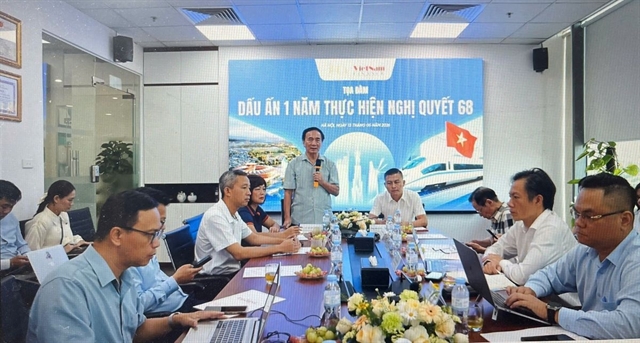
| A view of the event. —Photo vietnamfinance.vn |
HÀ NỘI — One year after Politburo Resolution No. 68-NQ/TW on private sector development was issued, Việt Nam’s private economy is showing stronger momentum in policy reform, investment inflows and business confidence, experts said at a seminar on Wednesday.
At a review seminar marking one year of the resolution’s implementation, Hoàng Anh Minh, permanent vice president of the Vietnam Financial Consulting Association, said that since the resolution was introduced in May 2025, visible changes have emerged not only in policy but also in governance thinking and business sentiment.
A series of important policies related to the investment and business environment have since been introduced, including Resolution No. 198/2025/QH15 on special mechanisms and policies for private sector development, Investment Law No. 143/2025/QH15, and Decree No. 141/2026/NĐ-CP amending tax policies for household and individual businesses.
“What is notable is that recent policies are no longer merely directional statements, but are increasingly focused on directly addressing major bottlenecks related to institutional quality and the business environment. This is considered a key factor in attracting large capital flows in the new development phase, while creating conditions for domestic private enterprises to become the core driving force of the economy,” Minh said.
“Immediately after Resolution 68 was issued, the market witnessed a very strong positive response from the business community, experts and economic forums,” he added.
According to Minh, the clearest outcome so far has been a wave of new private investment plans, particularly from major corporations. Many of the projects are unprecedented in scale, with total investment reaching hundreds of trillions of Vietnamese đồng and land use areas spanning thousands, and in some cases more than 10,000 hectares for a single project cluster.
Lê Duy Bình, director of Economica Vietnam, said Resolution 68 had generated strong enthusiasm within the private sector during its initial implementation phase. However, he noted that although capital flows are rising rapidly, they remain concentrated mainly among large enterprises.
“The surge in projects worth hundreds of trillions of đồng shows that large enterprises are expanding investment very aggressively. However, this positive impact does not appear to have spread to small and micro enterprises. We need to clearly recognise this issue in order to develop more appropriate solutions going forward,” he said.
Regarding the target of reaching two million enterprises by 2030, Bình said it would be difficult to achieve without a fundamental shift in thinking about business models.
He cited Singapore, where around 50 per cent of newly registered businesses each year are sole proprietorships. In France, the figure is about 70 per cent, while in many developed economies it ranges from 50 to 70 per cent. By contrast, according to data from the Ministry of Finance and the Private Enterprise Development Agency, among the 100,000 to 200,000 newly registered businesses each year in Việt Nam, only around 2,000 to 4,000 are sole proprietorships.
“Sole proprietorships are a much-needed business model because they are simple, low-cost and suitable for individuals starting a business or testing ideas to earn a living. When successful, owners can later develop into limited liability companies or joint-stock companies. However, Việt Nam currently lacks an appropriate legal framework to effectively support this model, and this is an issue that requires further research,” Bình said.
Sharing the same view, Nguyễn Đình Cung, former director of the Central Institute for Economic Management Research, said that if current trends continue, achieving the target of two million businesses by 2030 will be very difficult.
According to Cung, confidence remains the biggest challenge facing the private sector. When businesses do not clearly see the benefits of policies, they are reluctant to invest capital to expand operations or enter the market. Although some positive signs have emerged, particularly among large enterprises, the overall pace of implementation remains slow and has yet to generate sufficiently strong momentum.
He added that a sustainable economy must be built on science and technology, innovation and digital transformation. However, resources allocated to these areas have not yet resulted in leading projects or enterprises. BIZHUB/VNS
Economy
 Economy
 Economy
 Economy
 Economy
 Economy
 Economy
 Economy
 Economy
 Economy
 Economy
.jpg) Economy
Economy
 Economy
 Economy
 Economy