 Economy


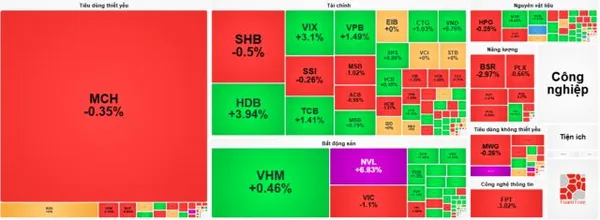
VN-Index ends lower despite liquidity hit over $1 billion
1.
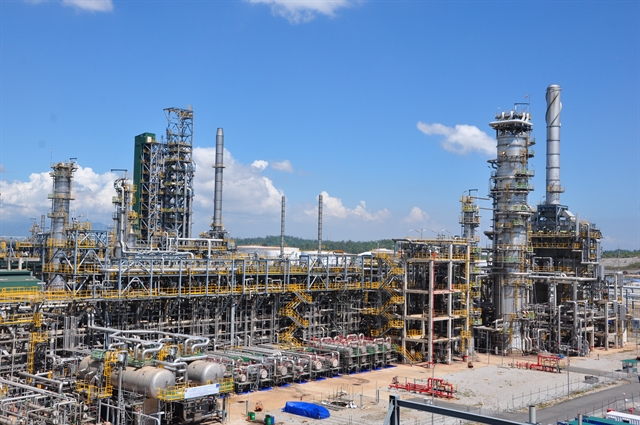 |
| The Dung Quất refinery. — Photo bsr.com.vn |
Compiled by Ly Ly Cao
HÀ NỘI — Việt Nam's push to commercialise green fuels is beginning to move beyond the pilot stages, as policymakers and energy companies test the technical and economic viability of alternatives like sustainable aviation fuel (SAF) and sustainable marine fuel oil (SMFO), while also preparing to scale up biofuels like E10 gasoline.
The shift is closely tied to the country's broader energy transition agenda, particularly under Resolution 70-NQ/TW, which sets out targets for energy security and emissions reduction through 2030 with a longer-term vision to 2045.
Within that framework, domestic refiners and distributors are positioning themselves to build new value chains around low-carbon fuels.
At the Dung Quất refinery, operated by Binh Son Refining and Petrochemical (BSR), research has been focused on developing SMFO as a transitional solution for the maritime sector.
According to refinery director Cao Tuấn Sĩ, the fuel offers a practical pathway to cut emissions without requiring major overhauls in ship technology or infrastructure.
The approach relies on blending conventional marine fuel with sustainable components derived from waste streams, including tyre pyrolysis oil and plastic pyrolysis oil.
In January, BSR successfully delivered its first experimental batch of SMFO to a vessel operated by PetroVietnam Transportation Corporation, marking a technical milestone in real-world application.
That initial delivery has helped validate the product's feasibility, paving the way for gradual commercialisation.
The refinery is now capable of supplying between 12,000 and 15,000 tonnes of SMFO per month, a scale considered sufficient to support stable market demand in the near term.
Parallel developments are taking place in aviation.
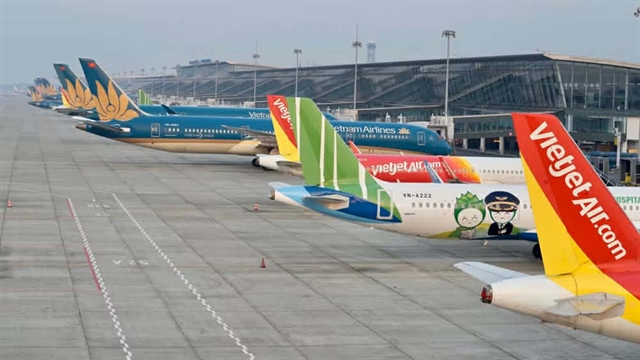
Both BSR and Petrolimex introduced SAF products in 2025 that meet international standards and can reduce lifecycle carbon emissions by up to 80 per cent. These fuels have already been used on domestic commercial flights, including in aircraft operated by Vietnam Airlines and Vietjet, signalling early adoption within the sector.
Yet, despite the technological progress, cost remains a central barrier. Data from Vietnam Airlines shows that the use of SAF increased fuel expenses on European routes by nearly 6 per cent in 2025, equivalent to an additional US$6 million, as SAF prices are currently two to three times higher than conventional jet fuel.
Projections from the Ministry of Construction suggest that, over the next five years, SAF adoption could add around $25 million to the aviation sector's fuel bill.
The figures underscore the tension between environmental targets and commercial realities, particularly for airlines operating in highly competitive markets.
Industry stakeholders point to supply constraints and evolving production technologies as key factors behind the high costs.
Andreea Moyes, global head of aviation sustainability at Air BP, noted that limited feedstock availability and the early stage of technological development are keeping prices elevated, though costs are expected to decline as production scales up and processes mature.
In response, several countries have introduced policy packages to accelerate market formation, including tax incentives, research funding and public-private partnership models aimed at reducing investment risks and expanding supply.
Coordinated strategies, such as those led by US federal agencies to scale SAF production, are often cited as reference points for emerging markets.
In Việt Nam, policymakers are also looking at how to stimulate demand and lower costs across the value chain.
The Ministry of Industry and Trade has highlighted the potential for SAF to create a new domestic fuel market while opening export opportunities to regions like the EU and ASEAN, particularly given Việt Nam's access to renewable feedstocks like agricultural residues and biomass.
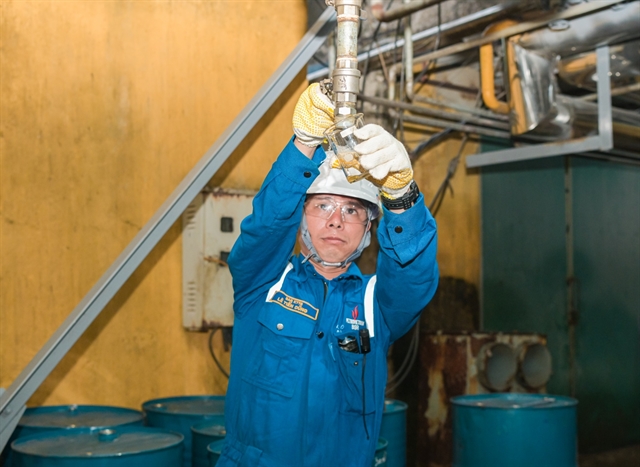 |
| A worker at a pilot biodiesel fuel project launched by BSR. — Photo bsr.com.vn |
E10 offers a glimpse of market dynamics
While SAF and SMFO represent the future of green fuels in heavy transport, Việt Nam's experience with E10 biofuel in the road sector provides a useful snapshot of the challenges ahead.
The fuel, which blends 10 per cent ethanol with conventional gasoline, is already being piloted in major cities including Hà Nội, HCM City and Hải Phòng.
However, market acceptance remains closely tied to pricing.
Economist Nguyễn Thường Lạng argued that E10 must be priced sufficiently lower than mineral gasoline to encourage widespread consumer adoption, noting that the current price gap of around VNĐ600 per litre compared to RON95 is not yet compelling.
Policy design is therefore emerging as a critical factor.
Proposed measures include tax reductions, temporary subsidies and preferential credit schemes to support both producers and consumers during the early stages of market development.
At the same time, improvements in logistics and distribution systems are seen as necessary to bring down overall costs.
Technical concerns over E10 have also surfaced among consumers, though industry representatives and researchers maintain that the fuel does not adversely affect engine performance or durability.
Officials say that hesitation is largely psychological, stemming from unfamiliarity rather than documented issues with quality or efficiency.
As Việt Nam navigates the complexities of commercialising green fuels, the interplay between technology readiness, cost structures and policy support continues to shape the pace at which these alternatives can move from pilot projects to mainstream adoption. — BIZHUB/VNS
Economy
 Economy
 Economy
 Economy
 Economy
 Economy
 Economy
 Economy
 Economy
 Economy
 Economy
 Economy
 Economy
 Economy
 Economy