 Economy



Rural tourism needs to cash quantities over goods sold
1.
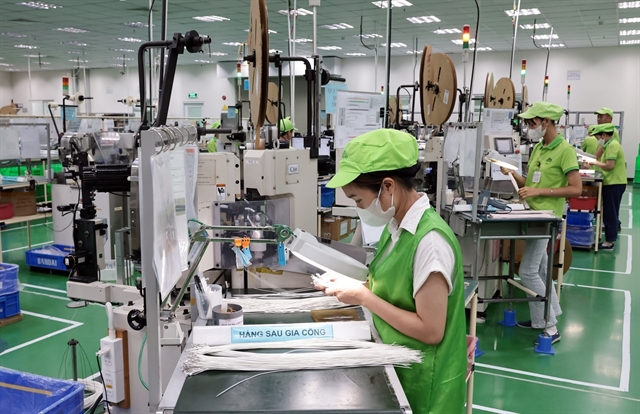 |
| Workers operate production lines at a factory in Đồng Nai Province, which is accelerating the development of supporting industries and digital transformation. — VNA/VNS Photo |
ĐỒNG NAI — Supporting industry enterprises will play a central role, with the Government acting as a facilitator by creating transparent institutions and providing support in resources, science, technology and market access.
These businesses are, in turn, expected to drive production, innovation and market expansion.
This is the direction set out in Đồng Nai Province’s supporting industry development programme for 2026–30 recently approved by its People’s Committee.
The province has identified supporting industries as the foundation for building a sustainable, self-reliant and modern industrial base.
The sector is expected to strengthen domestic production capacity, enhance industrial autonomy and reduce dependence on imported components, materials and equipment.
Đồng Nai will focus on developing supporting industries linked to regional and global value chains.
It aims to attract investment and improve the capacity of domestic companies so they can move further up global supply chains, particularly in areas like smart electronics, automobiles, mechanical engineering and automation, textile, and footwear.
Development will go hand in hand with technological innovation, digital transformation and sustainability.
The province plans to accelerate the use of high technology and automation in production while ensuring compliance with environmental, energy efficiency and green standards.
Supporting industries are expected to account for 22-25 per cent of the province’s total industrial production between 2026 and 2030.
The sector is projected to grow at 8-10 per cent annually, and have around 1,200 enterprises by 2030.
To meet these targets, the province will expand international cooperation, help companies enter new markets, strengthen supply and demand linkages, and help them benefit from national policies and programmes, including investment in machinery and equipment.
At the same time Đồng Nai is developing specialised industrial parks to attract supporting industry projects and make it easier for businesses to access land and production space.
It will also accelerate digital transformation and the adoption of smart factory solutions in production and management to improve competitiveness in the context of the fourth industrial revolution.
The province plans to implement Resolution No. 57-NQ/TW on breakthroughs in science, technology, innovation and national digital transformation, while improving connectivity and production capacity.
According to the People’s Committee, in 2025 the total output of the manufacturing sector in Đồng Nai exceeded VNĐ1.56 quadrillion (US$62.4 billion). It had 9,688 enterprises employing 794,518 workers.
Supporting industries accounted for 21.8 per cent of the output and 47.8 per cent of industrial exports.
The sector grew by 8.1 per cent last year while its average growth rate between 2021 and 2025 was 6.3 per cent.
Đồng Nai has 997 supporting industry enterprises, 713 of which are foreign-owned.
Key industries they operate in include textile and garment, leather and footwear, mechanical engineering, and electronics. — VNS
Economy
 Economy
 Economy
 Economy
 Economy
 Economy
 Economy
 Economy
 Economy
 Economy
 Economy
 Economy
 Economy
 Economy
 Economy