 Economy

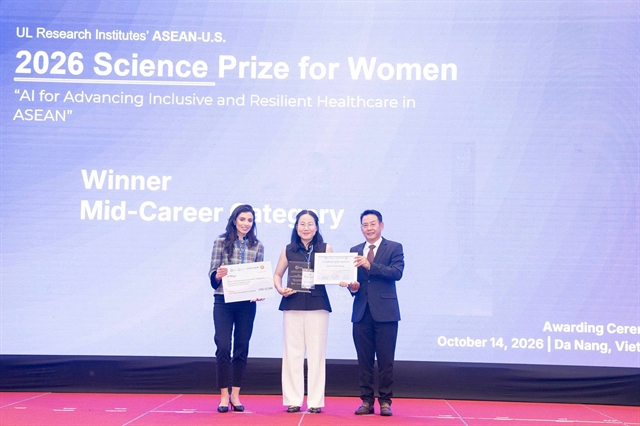
Vietnamese scientist wins ASEAN-US Science Prize for Women
1.
|
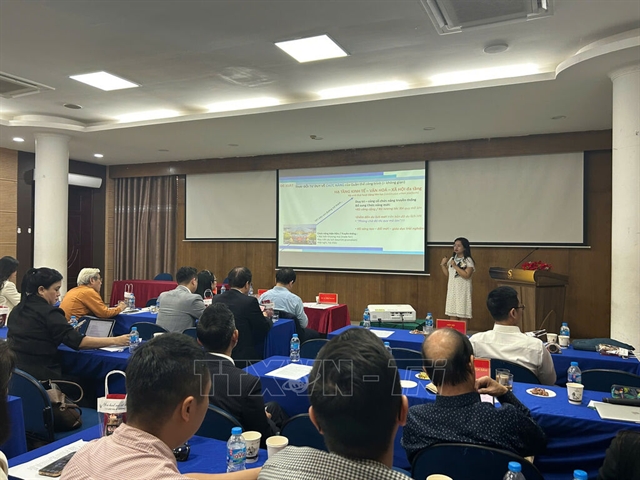
| The overview of the seminar. — VNA/VNS Photo |
HÀ NỘI — Exhibition and fair spaces are increasingly seen as more than event venues, emerging as multifunctional hubs that generate cultural, economic and tourism value while driving urban development.
The Scientific Union for Sustainable Tourism Development (STDe) organised a seminar in Hà Nội on Friday on transforming fair and exhibition spaces into high-value tourism products.
In her opening remarks, Dr Nguyễn Thu Hạnh, STDe chairwoman, said that amid the momentum of the global creative economy, many countries are reassessing the role of fair and exhibition spaces, viewing them not just as venues but as engines of urban value creation.
In these spaces, culture, commerce, tourism and experiential technology are interconnected within a single ecosystem, turning each fair or exhibition into a cultural-tourism-economic event capable of attracting millions of visitors.
A fundamental shift is required, as fairs and exhibitions should no longer be seen simply as infrastructure but as platforms that generate integrated value, operate continuously and combine economic, cultural and tourism functions, said Trần Thọ Đạt, chairman of the scientific council of STDe’s Vietnam Center for Cultural Industries Research and Development.
Such spaces could become new growth poles for the service economy and even symbols of Việt Nam’s cultural industry development, he added.
To strengthen the country’s position in high-end tourism, particularly by blending business and leisure travel (MICE) with experiential tourism at regional and global levels, Đạt emphasised that creative ideas must be matched by consistent development strategies, appropriate policy frameworks and close coordination among stakeholders.
Proposing an integrated model of experience, trade promotion and tourism at the National Exhibition and Convention Centre in Cổ Loa, Dr. Nguyễn Thanh Tú from Hanoi University of Civil Engineering suggested that relevant ministries and sectors first undertake interdisciplinary research in planning, architecture, tourism and technology to develop suitable exhibition and tourism space models, providing a scientific basis for the centre’s design and operation.
Pilot projects should also test night-time economy models, experiential spaces and digital exhibitions before scaling up, she said. Scientific and technological solutions should be applied to improve space utilisation and enhance visitor experience.
Pilot mechanisms based on research findings and practical evaluations should inform policy refinement, while a collaborative network among regulatory agencies, research institutes, universities and businesses should create a continuous cycle of research, piloting, evaluation and scaling, Tú added. — VNS
Economy
 Economy
 Economy
 Economy
 Economy
 Economy
.jpg) Economy
Economy
 Economy
 Economy
 Economy
 Economy
 Economy
 Economy
 Economy
 Economy