 Economy



Green transformation boosts sustainable growth
1.
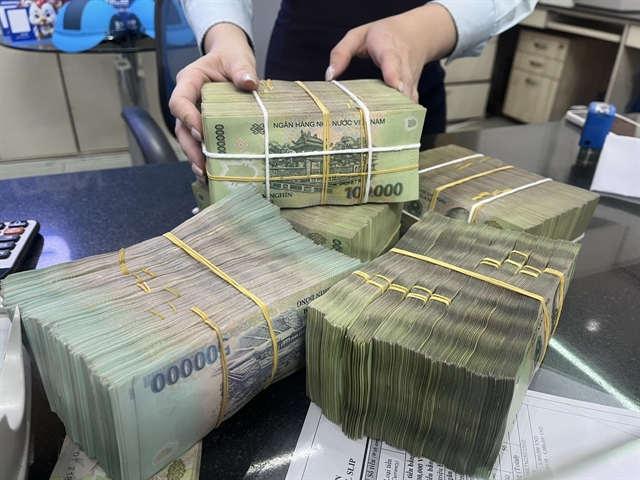 |
| A bank employee counts stacks of cash at a transaction counter of a private commercial bank in HCM City. — VNS Photo Bồ Xuân Hiệp |
HCM CITY — Việt Nam's interbank interest rates have retreated from recent multi-year highs but remain elevated, signalling persistent liquidity pressure and possible spillover into lending and deposit costs.
Data from the Vietnam Interbank Market Research Association (VIRA) showed the average overnight interbank rate – a key benchmark for short-term funding between banks – stood at about 8.5 per cent on Thursday, down sharply from 17-17.5 per cent a week earlier.
Rates for one-week to one-month tenors ranged between 9 per cent and 9.2 per cent, well above late-2025 levels.
Interbank rates reflect the cost at which banks borrow from one another to meet short-term liquidity needs and mandatory reserve requirements set by the State Bank of Vietnam (SBV). Elevated rates typically indicate tighter liquidity and can feed through to broader funding costs.
A senior executive at a major commercial bank told Việt Nam News that liquidity could remain a key challenge for lenders in 2026, warning that higher funding pressures may complicate credit expansion and profitability in what is shaping up to be a tougher year for the sector.
Analysts, however, say the recent spike appears largely cyclical and technical rather than a sign of systemic stress.
Nguyễn Hoàn Niên of Shinhan Securities said the surge was likely temporary but could set a higher base for interbank rates through at least the first quarter.
SSI Securities described the recent volatility as “short-term and technical,” citing seasonal fiscal flows and market dynamics rather than structural weaknesses.
Liquidity tightened in late January as the State Treasury accelerated withdrawals linked to public investment disbursements before the fiscal deadline, temporarily draining funds from the banking system.
Rising gold prices also drew speculative capital, adding to short-term liquidity strains.
The central bank responded by injecting liquidity through open market operations and foreign-exchange swaps, easing the sharpest spikes in overnight rates.
After maintaining very low levels since early 2023, deposit rates have risen to around 7-8 per cent per year, with some banks offering up to 8.5 per cent to attract funds.
Analysts say sustained pressure on interbank funding could continue to influence commercial lending rates, particularly as credit growth has outpaced deposit mobilisation since late 2025.
Market observers note that Việt Nam’s interest rate environment has become more sensitive since late 2025 amid stronger credit demand, seasonal liquidity swings and heightened competition for deposits.
However, most analysts stress that the volatility does not point to weakening macroeconomic fundamentals.
“Liquidity pressures are present but cyclical,” SSI analysts said in a market note, adding that the recent spike should be viewed as a technical adjustment rather than evidence of economic deterioration.
The SBV’s proactive liquidity support is expected to stabilise short-term rates in the coming weeks, though interbank costs will remain a key barometer for lending and deposit trends this year. — VNS
Economy
 Economy
 Economy
 Economy
 Economy
 Economy
 Economy
 Economy
 Economy
 Economy
 Economy
 Economy
 Economy
 Economy
 Economy