 Economy



AIMCONNECT 2026 Held in Singapore, Bringing Global Automotive Leaders Together to Explore the Future of AI, Trust and Connected Mobility
1.
|
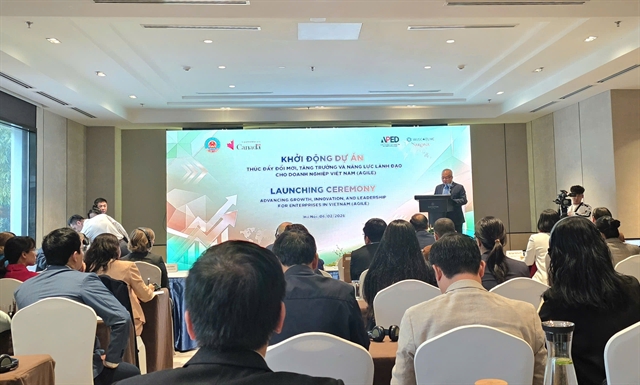
| Đỗ Thành Trung, Vice Minister of Finance, speaks at the event on Friday morning. — VNS Photo Ly Ly Cao |
HÀ NỘI — The Ministry of Finance, in coordination with Global Affairs Canada, on February 6 officially launched the Advancing Growth, Innovation and Leadership for Enterprises (AGILE) project, marking a significant step towards strengthening Việt Nam’s climate enterprise ecosystem and promoting sustainable economic growth.
Speaking at the event, Vice Minister of Finance Đỗ Thành Trung warned that Việt Nam is among the countries most vulnerable to climate change, as rising temperatures, sea-level rise and extreme weather increasingly threaten key economic sectors, food security and livelihoods.
He said the private sector plays a pivotal role in national development. Resolution No 68-NQ/TW identifies it as the most important driving force of the economy, contributing to growth, job creation, productivity and the restructuring of the economy towards a green, circular and sustainable direction.
“The AGILE project is not only a testament to the long-standing and trustworthy strategic partnership between Việt Nam and Canada, but also a significant contribution to the Vietnamese Government’s efforts to promote private sector innovation and sustainable growth,” he said.
Funded by Global Affairs Canada and overseen by the Ministry of Finance, the 2025–29 project aims to enhance the capacity of climate enterprises, support inclusive development and strengthen the resilience of vulnerable groups affected by climate change.
|
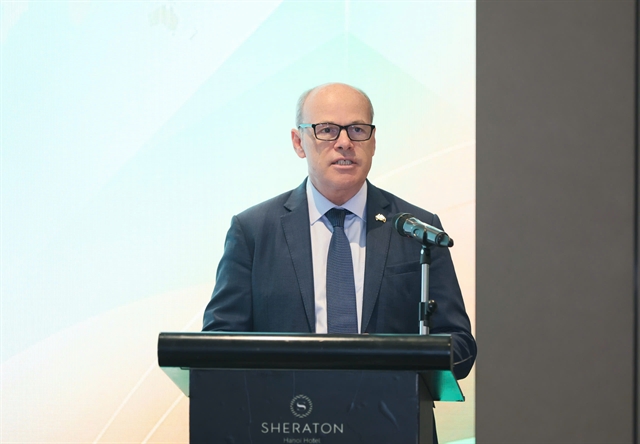
| Jim Nickel, Ambassador of Canada to Việt Nam, delivers a speech. — Photo courtesy of the organiser |
Jim Nickel, Ambassador of Canada to Vietnam, described the launch as an important milestone in Canada–Việt Nam cooperation, bringing together government, the private sector and development partners around a shared commitment to sustainable and inclusive growth.
“By helping enterprises become investment-ready, AGILE will unlock capital more effectively, accelerate the adoption of climate solutions and reduce the vulnerability of communities most affected by climate change, particularly women working in climate-sensitive sectors,” he said.
Canada is increasingly using official development assistance as a catalyst to reduce risk, mobilise private capital and scale solutions that advance climate action and inclusion, reflecting a broader development vision centred on mutual prosperity and long-term partnerships.
The project is built around three pillars: strengthening ecosystem support for climate enterprises, scaling investment in gender-responsive businesses and improving capital deployment by helping investors integrate gender considerations into their practices.
Small and medium-sized enterprises (SMEs), regarded as the backbone of the national economy, often face constraints in accessing finance and technology for sustainable transitions, with these barriers even more pronounced for women-led businesses.
Representing an implementing partner, World University Service of Canada (WUSC) Senior Director of Programmes Sam Landon said the initiative is grounded in continuous learning and collaboration.
“We do not merely provide resources; we work alongside enterprises, enterprise support organisations and investors to demonstrate gender-integrated financial models. Our goal is to build a scalable network of knowledge and solutions that strengthens the resilience of Việt Nam’s business ecosystem in the face of global challenges,” he said.
AGILE adopts an ecosystem approach in which international partners collaborate with local enterprise support organisations to improve business development services and connect firms more effectively with capital.
The framework is also expected to create new opportunities for Canadian and international investors to engage with Việt Nam’s expanding green economy.
Innovative models are already emerging nationwide, including digital tools that help farmers manage climate risks, accessible clean energy solutions and circular economy approaches that transform agricultural by-products into valuable inputs while reducing waste and emissions.
One example is RetriV JSC, a climate technology company focused on recovering value from food-processing wastewater, a largely overlooked emissions source despite its rich nutrient content.
Traditional treatment methods often destroy proteins and lipids while increasing greenhouse gas emissions such as CO2 and methane. RetriV was developed around a simple philosophy: recover value before it is destroyed, said Nguyễn Vân An, a representative of RetriV.
The company’s integrated, containerised system intervenes upstream in the production process, linking shrimp by-products and factory wastewater into a circular nutrient loop that allows recovered materials to be reused or converted into new products.
Pilot trials at the largest surimi factory in northern Việt Nam showed that a single plant could raise annual revenue by between US$100,000 and $400,000, with a payback period of less than six months.
The solution could also cut emissions by more than 500 tonnes of CO2 equivalent a year, roughly comparable to planting about 23,000 trees. — BIZHUB/VNS
Economy
 Economy
 Economy
 Economy
 Economy
 Economy
.jpg) Economy
Economy
 Economy
 Economy
 Economy
 Economy
 Economy
 Economy
 Economy
 Economy