 Economy



Ping An Digital Bank Completes HKMA’s Second GenA.I. Sandbox Cohort
1.
|
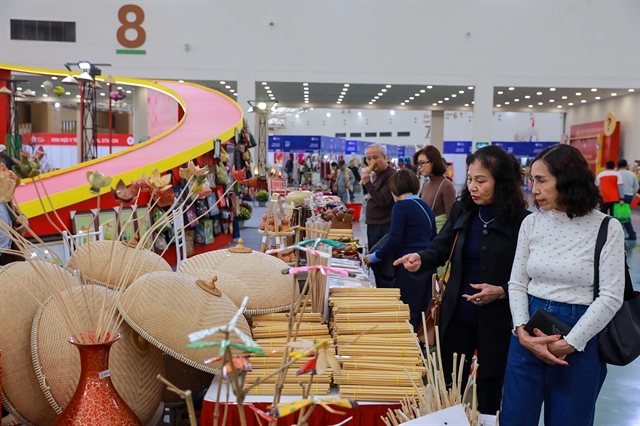
| The “Tết Family Reunion” zone at the Việt Nam Glorious Spring Fair 2026 attracts strong interest from visitors. — VNA/VNS Photo Khánh Hoà |
HÀ NỘI — Strongly implementing the Politburo’s Resolution 57 on national digital transformation, the Việt Nam Glorious Spring Fair 2026 in Hà Nội has made a clear mark through the widespread application of digital technologies across individual booths, creating a highlight in trade promotion activities and enhancing the shopping experience for consumers.
From cashless payments and product traceability to digital platform promotion, the use of digital technology is opening new pathways, helping increase product value, effectively connect supply and demand and drive economic development.
Spreading across trade promotion activities
Digital transformation at the fair has been clearly reflected at every stage of organisation, promotion and commercial transactions.
From the registration phase, many businesses completed participation procedures entirely online, while booth information and product catalogues were digitised, facilitating management for organisers and improving connectivity among participants.
Within the exhibition space, QR code systems were widely used, allowing consumers to quickly access information on organisations, product origins, quality standards, production processes and distribution channels.

|
| QR codes are widely displayed at booths, enabling cashless payments and product traceability. VNA/VNS Photo |
Hoàng Thu Hà, a visitor from Bồ Đề Ward in Hà Nội, said this was her first time at the Việt Nam's Exposition Centre and she was impressed by the scale and professional organisation of the event.
“The organisers worked in a very orderly, systematic and scientific way, so even with large crowds it never felt chaotic. I particularly liked the QR codes displayed on electronic boards above. Just scanning the code allows you to instantly look up the overall layout, the location of each zone and the specific booths you want to find,” Hà said.
“This approach is very modern, saves time and aligns well with digital transformation trends, helping visitors move around and access information more proactively.”
At the Tết Family Reunion zone organised by the Hà Nội People’s Committee, booths were arranged in a rational, diverse and visually appealing manner, with a special focus on displays from traditional craft villages.
Alongside typical Tết products, many craft establishments applied digital technologies to expand their customer outreach. At their booths, business owners not only introduced products directly to consumers but also livestreamed on social media, posted information, closed orders and interacted with remote buyers.
Some units even attached QR codes linking to online stores, fanpages or e-commerce platforms, enabling visitors to easily follow and place orders after the fair. This flexible approach shows that craft villages are not only preserving traditional values but also gradually adapting to digital business trends, increasing consumption opportunities.
|
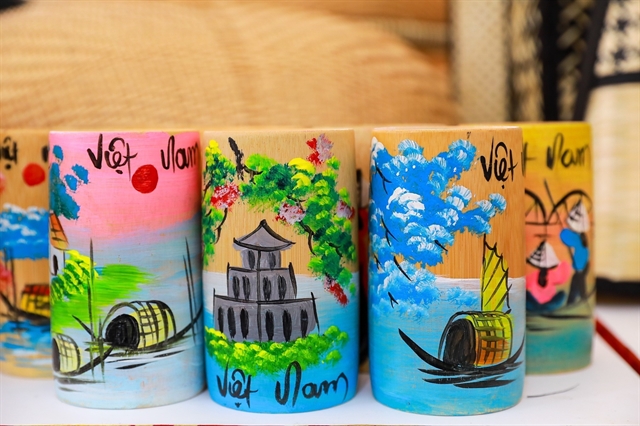
| Handicraft products are showcased at the fair. VNA/VNS Photo |
Embroidery artisan Lê Thị Xuân, owner of Tú Hoa Embroidery Enterprise in Khoái Nội Village, Chương Dương Commune, Hà Nội, said that in recent years her business has moved beyond relying solely on traditional sales methods and has proactively reached customers through a range of direct and digital channels.
Alongside participation in fairs and exhibitions to promote products, the enterprise has stepped up the introduction of handmade embroidery through social media, e-commerce platforms and online sales channels.
“Digital transformation helps us reach customers faster, more widely and at lower cost than before. Customers far away can still view products in detail, discuss designs, place orders and make convenient payments. As a result, order volumes are more stable and the craft village’s brand is more widely recognised. For traditional handicraft businesses, this is an effective direction to both preserve the craft and expand the market,” Xuân said.
|
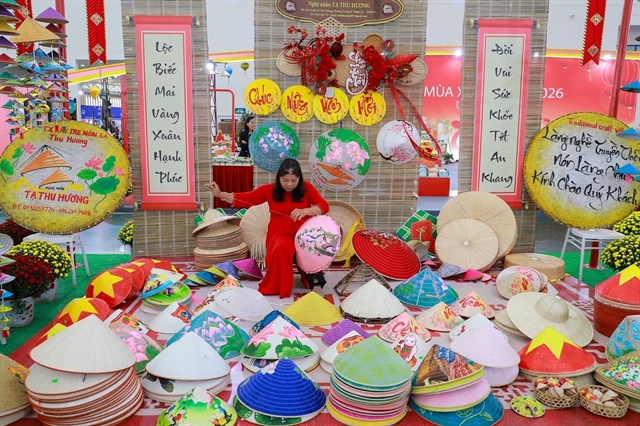
| Artisan Tạ Thu Hương from Chuông Hat Village demonstrates traditional conical hat-making at the fair. VNA/VNS Photo |
A practical environment for digital transformation
At the spring fair, many enterprises stepped up digital transformation in product presentation and distribution. Most booths integrated QR codes for product traceability, enabling consumers to easily check production processes, quality standards and product origins.
At the same time, cashless payment methods were widely adopted through QR scanning, e-wallets and digital banking, shortening transaction times and boosting convenience and transparency.
According to Nguyễn Hữu Tĩnh, director of Thanh Cao KINOKO Import-Export Co Ltd in Hương Sơn Commune, Hà Nội, faced with the spread of mushrooms of unclear origin on the market, the company chose not to compete on price.
“Consumer safety is not something to bargain with. Instead, we confront the issue with absolute transparency,” he said.
Each mushroom pack produced by the company carries an identification QR code, allowing consumers to trace the entire growth process from the inoculation date and nutrient levels to the time of harvest and delivery to supermarkets.
“Coming to the Spring Fair 2026, our booth is not only about promoting products and brands in the conventional way. Our bigger goal is to help consumers clearly understand and correctly choose clean and safe products. All our products are publicly labelled with QR codes so visitors can quickly look up information on origins, production processes and quality standards right at the booth. Just one scan provides full data. It’s very transparent and convenient,” he said.
“We also clearly introduce our official website and fanpage so consumers can easily connect, learn about and access our products anytime and anywhere, even after the fair ends.”
At the booth showcasing bronze products from the traditional casting village of Ngũ Xã in Ba Đình Ward, Hà Nội, Phạm Văn Hiệp, representative of Văn Nhân Bronze Enterprise, said the application of digital technologies in production, promotion and sales has been identified as a long-term investment direction.
According to Hiệp, given the high value of handicraft products and the strong need for information transparency and customer trust, digitising product data, images, craft village stories and distribution channels helps improve market outreach.
“We consider digital transformation an integral part of our sustainable development strategy, from order management and product introduction to after-sales customer care. When digital channels are well developed, competitiveness improves not only domestically but also with international customers. The fair is an opportunity for us to test and further refine digital solutions, but the idea is to implement them in a long-term and systematic manner,” he said.
The Việt Nam Glorious Spring Fair 2026 is not only a destination for shopping and experiences but also helps spread digital economy thinking, encouraging enterprises to proactively innovate business models, enhance transparency and improve consumer outreach.
The models and experiences piloted at the fair are expected to be further replicated, making practical contributions to the national digital transformation process in trade and production. — VNS
Economy
 Economy
 Economy
 Economy
 Economy
 Economy
 Economy
 Economy
 Economy
 Economy
 Economy
 Economy
 Economy
 Economy
 Economy
.jpeg)