 Economy

Việt Nam, Denmark issue joint statement on establishment of Comprehensive Strategic Partnership
1.
|
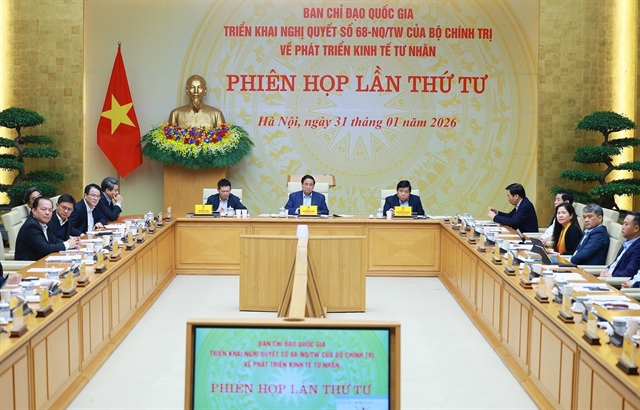
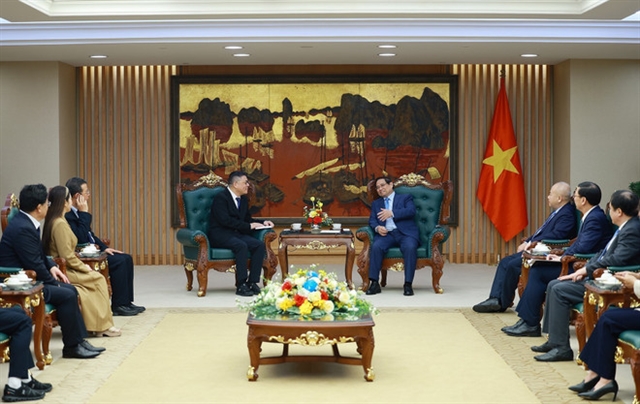
| Prime Minister Phạm Minh Chính chairs the fourth meeting of the National Steering Committee for the implementation of Politburo’s Resolution 68-NQ/TW on private sector development. — VNA/VNS Photo Dương Giang |
HÀ NỘI — Prime Minister Phạm Minh Chính on Saturday called for swift and concrete action to accelerate private sector development and turn it into the most important growth engine of the national economy.
Charing the fourth meeting of the National Steering Committee for the implementation of Politburo’s Resolution 68-NQ/TW on private sector development, PM Chính said implementing the resolution in line with the new spirit of the Party’s 14th National Congress was an “action mandate”, calling for engagement “from heart to heart” between the Government and the business community.
“Actions must be taken with the principle of businesses as the centre, infrastructure as the foundation and institutions as the driving force to enable the private sector to achieve a breakthrough and truly become the most important engine of the national economy,” the leader said.
Reviewing progress since the issuance of Resolution 68, PM Chính said most 2025 targets already completed, focusing on accelerating reforms, effectively safeguarding property rights, ownership rights, freedom of business and fair competition for the private sector.
Measures have also been taken to facilitate access to key resources such as land, capital and high-quality human resources, while promoting science and technology, innovation, digital transformation, green transition and more efficient and sustainable business models.
According to the steering committee, after eight months of implementation, Resolution 68 has delivered positive impacts, including a sharp rise in newly established and returning businesses, improved stock market performance, stronger export-import activity and growing contributions from the private sector to the State budget.
Specifically, from May 2025, an average of about 18,000 new businesses were established each month, while more than 8,300 firms resumed operations, bringing the total number of active firms to more than one million by the end of 2025.
The VN-Index closed 2025 at nearly 1,785 points with an average daily trading value of about VNĐ29.5 trillion (US$1.2 billion), while market capitalisation rose to nearly VNĐ10 quadrillion, equivalent to around 70 per cent of GDP.
Total import-export revenue in 2025 reached $930 billion, placing Việt Nam among the world’s top 25 economy by trade.
State budget revenue from the non-state sector was estimated at more than VNĐ497 trillion in 2025, exceeding the target by 34 per cent and rising 27 per cent year on year. Revenue from household and individual businesses surged by more than 36 per cent, the fastest growth rate in the 2021-25 period.
However, the implementation of Resolution 68 still faces shortcomings, the steering committee said, pointing to problems in the investment and business environment, difficulty in access to production resources such as credit and land for small- and medium-sized enterprises (SMEs) and household businesses, and their limited competitiveness, technology and governance capacity.
|
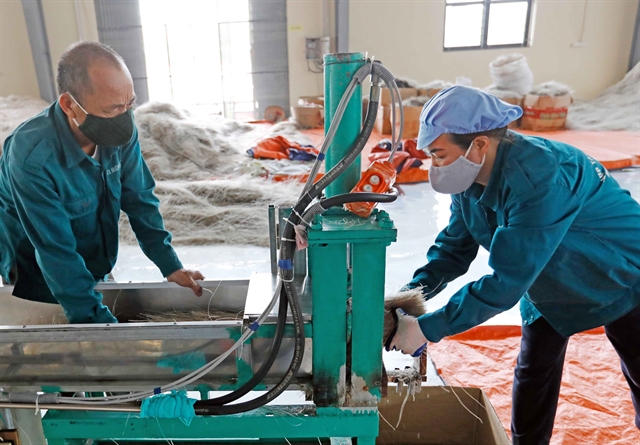
| A household business producing vermicelli in Thái Nguyên Province. Việt Nam aims for double-digit economic growth, which would require the private sector to also expand at double-digit rates. — VNA/VNS Photo Trần Việt |
The committee said that institutions must be further improved, including reviewing and amending key laws such as the Law on Support for SMEs, the Law on Commerce, the Law on Competition, the Law on Foreign Trade, the Law on Consumer Protection, the Law on Handling of Administrative Violations, the Law on Land, the Law on Science, Technology and Innovation, and the Law on Digital Technology Industry.
Besides, administrative reforms must be sped up to cut unnecessary business conditions, simplify market entry procedures, shift from pre-inspection to post-inspection, together with rolling out practical support measures in finance, credit, taxation, digital transformation, innovation, green transition, training, consultancy and access to production and business premises.
Looking ahead, PM Chính said Việt Nam aims for double-digit economic growth, which would require the private sector to also expand at double-digit rates.
He reaffirmed the commitment to a facilitating Government, with businesses taking the lead and local authorities acting as partners, to ensure Resolution 68 is implemented decisively and effectively.
The PM urged ministries and Government agencies to deliver the “five enablers” for businesses, including more open and transparent institutions and procedures, seamless and synchronised infrastructure, smart governance and improved human resources, improved access to production resources, and timely response and empathy in addressing difficulties faced by enterprises.
At the same time, he called on businesses to take the lead in five areas, notably innovation, digital and green transformation, workforce training, institutional development, corporate culture and mobilisation of resources for national development.
Private enterprises must pursue “five transformations”, namely digitalisation, greening, resources optmisation, smarter governance and interests harmonisation, he urged.
The PM also urged the creation of mechanisms to assign major, difficult and breakthrough tasks to private enterprises, saying this would demonstrate trust, a facilitative Government mindset and a stronger accountability toward businesses.
Stressing that the development of businesses is the development of the country, PM Chính at the meeting assigned specific tasks to ministries and agencies to conduct a comprehensive review of regulations governing private businesses with focus on improving institutions and investment climate.
The PM urged enterprises to support one another, with larger firms helping smaller ones integrate into their ecosystems so that household businesses can grow into small enterprises, small firms into medium-sized companies, and medium-sized firms into large and eventually global enterprises. — VNS
Economy
 Economy
.jpg) Economy
Economy
 Economy
 Economy
 Economy
 Economy
 Economy
.jpg) Economy
Economy
 Economy
 Economy
.jpg) Economy
Economy
 Economy
 Economy
 Economy