 Economy


Polish PM’s Việt Nam visit to strengthen bilateral ties: Ambassador
1.
|
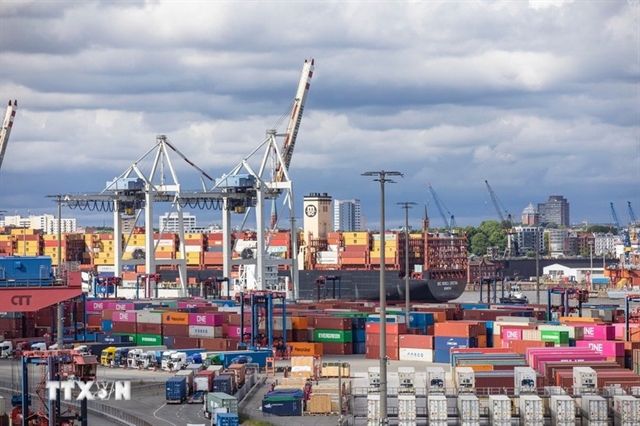
| A cargo port in Hamburg, Germany. — Xinhua/VNA Photo |
GENEVA — The World Trade Organisation (WTO) on Thursday released its annual Trade Monitoring Report, with Việt Nam among 46 members actively providing data for the assessment of global trade developments.
The report notes that between mid-October 2024 and mid-October 2025, new tariffs and other import measures affected US$2.64 trillion worth of global merchandise imports, equivalent to 11.1 per cent of total imports and more than four times higher than the previous period’s $611 billion, marking the highest level in more than 15 years. On the export side, the measures impacted around $2.966 trillion of trade, over three times the $888 billion recorded a year earlier.
Alongside this trend, WTO members and observers also introduced more measures for facilitating trade in goods. During the review period, 331 new measures were launched, covering an estimated $2.09 trillion in trade, about 1.5 times higher than the $1.441 trillion shown in the previous report.
Addressing the WTO Trade Policy Review Body (TPRB), Director-General Ngozi Okonjo-Iweala stressed that the surge in tariff measures highlights a marked increase in protectionism since the year's beginning. Nearly 20 per cent of global imports are now affected by tariffs and similar measures introduced since 2009, up from 12.6 per cent just a year ago.
She also welcomed members’ efforts to prioritise dialogue over retaliation, enabling smoother cross-border trade flows. The WTO chief urged members to use the current momentum to advance long-delayed WTO reforms and address concerns related to recent unilateral actions.
WTO economists forecast global merchandise trade to grow by 2.4 per cent this year and 0.5 per cent next year. Better-than-expected growth in the first half of 2025 is attributed to front-loading of imports ahead of tariff changes, stronger demand for AI-related products, and continuous trade expansion among most members, particularly developing economies.
In trade remedies, the reviewed period saw an average of 32.3 new investigations per month - lower than the 2024 peak of 37.3. Although investigations do not necessarily lead to duties, a higher initiation number often signals the risk of more measures to be imposed. The average number of cases with terminated trade-remedy actions remained low, at 11.4 per month, indicating that many measures continue to be in force. Anti-dumping actions accounted for 46.5 per cent of all trade-related measures covered in the report.
In services, WTO members introduced 124 new measures, mainly aimed at facilitating trade and improving legal frameworks. More than half were cross-sectoral, with 50 per cent related to commercial presence (mode 3) and 25 per cent to the movement of professionals (mode 4). Around 20 per cent targeted Internet-based and digital network services.
The report also highlights rising support measures for key sectors such as the environment, energy, and agriculture, and notes a possible shift toward non-financial interventions to pursue broader strategic policy goals.
WTO members also raised numerous trade concerns at WTO committees and agencies, reaffirming these bodies' role as key platforms for addressing trade-related issues. — VNS
Economy
.jpg) Economy
Economy
 Economy
 Economy
 Economy
 Economy
 Economy
 Economy
 Economy
 Economy
 Economy
 Economy
 Economy
 Economy
 Economy