 Economy


Việt Nam, Denmark elevate ties to Comprehensive Strategic Partnership
1.
|
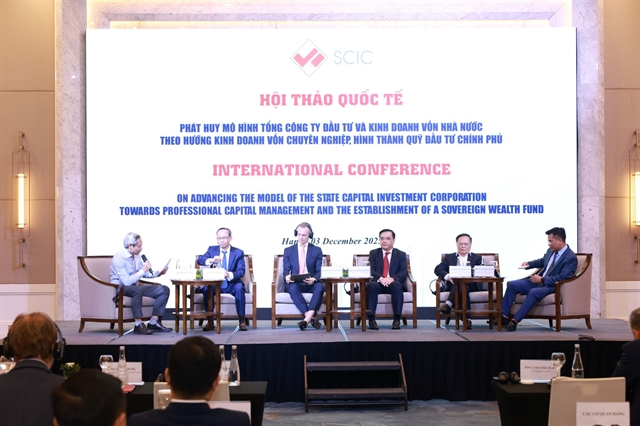
| Speakers during a QnA session at a conference organised by the SCIC in Hà Nội. — VGP Photo |
HÀ NỘI — Building a more competitive market for State capital must go hand in hand with a stronger regulatory framework, clearer autonomy and more modern governance to ensure the State Capital Investment Corporation (SCIC) can operate with greater efficiency and deliver higher returns, a conference heard on Wednesday.
These changes, experts said at a conference in Hà Nội on Wednesday, would help the SCIC use capital more effectively, improve performance and support overall economic growth.
Deputy Minister of Finance Cao Anh Tuấn said that since its establishment, the SCIC has taken over more than 120 enterprises, including 18 major groups and corporations, with over VNĐ24.7 trillion (about US$1.03 billion) in state capital. It has also helped settle long-standing issues at firms such as Vinaconex, Vinatex and Seaprodex. Today, the SCIC represents the State in 112 enterprises with a total book value of VNĐ56.3 trillion and is applying measures to optimise resources and safeguard State assets.
Since 2014, the SCIC has divested capital from 396 enterprises, collecting almost VNĐ48 trillion, equivalent to 4.4 times the original capital. These proceeds account for 90 per cent of all divestments made since the SCIC was founded. At the same time, the SCIC has increased new investments to more than VNĐ55 trillion.
Tuấn noted that the National Assembly (NA) has passed Law No 68/2025/QH15 on the management and investment of state capital in enterprises, replacing the 2014 legislation. The new law shifts the focus from simply using capital to actively investing it, giving State-owned assets a clearer framework and stronger legal protection.
To carry out the law, the Ministry of Finance is finalising three decrees covering the management and investment of State capital, the inspection and evaluation of State-owned enterprises and the restructuring of State capital. The ministry is also drafting six specialised decrees on the financial and operational mechanisms of major State corporations, including one dedicated to investment enterprises. This will give the SCIC the institutional tools it needs to operate more effectively.
Experts at the event said Việt Nam should study international models of Government Investment Funds. Organisations such as Temasek in Singapore, Khazanah in Malaysia and Indonesia’s Danatara offer useful examples of how to improve performance and governance.
During the seminar, representatives from financial institutions, consulting firms and research organisations shared experiences in reforming SOEs, examined the Temasek model and assessed equitisation efforts in Việt Nam along with SCIC’s role in recent restructuring. They stressed the need for improvements in organisational structure, operations, transparency and management practices that align more closely with international standards.
SCIC Chairman Nguyễn Chí Thành said many of the recommendations were practical, especially the call for greater autonomy in investment, divestment and corporate governance. With clearer authority and more flexible mechanisms, he said, SCIC could invest more professionally and efficiently and gradually develop into a Government Investment Fund with independent oversight and transparent information disclosure.
After nearly two decades, Thành said, "The SCIC has largely completed its early task of restructuring State-owned enterprises: we went from more than 1,000 enterprises to around 100 today. That is a significant transformation.”
He added that a clear development strategy will be essential for the next phase. The strategy to 2030, with a vision to 2035 approved by the Prime Minister in 2023, is providing an important foundation for drafting new decrees and carrying out the updated legal framework.
In terms of day-to-day operations, the SCIC has proposed more autonomy in investment decisions to avoid administrative bottlenecks. International experts agreed that investment decisions should follow market principles similar to the approach used by Temasek.
Another recommendation was to enlarge the amount of State capital transferred to the SCIC. At present, the SCIC manages only about two per cent of total State capital. Experts suggested giving the SCIC more responsibility, especially in large enterprises such as Vietnam Airlines, Sông Đà and Vinaconex, rather than setting up new specialised investment firms.
The SCIC has also proposed increasing its charter capital and allowing it to retain more post-tax profits for reinvestment. Under current rules, it can only allocate up to 30 per cent of profits to its development investment fund, which limits its ability to expand investment activities. — VNS
Economy
 Economy
.jpg) Economy
Economy
 Economy
 Economy
 Economy
 Economy
 Economy
 Economy
 Economy
 Economy
 Economy
 Economy
 Economy
 Economy