 Sci-Tech

World cultures shine in Hà Nội
1.
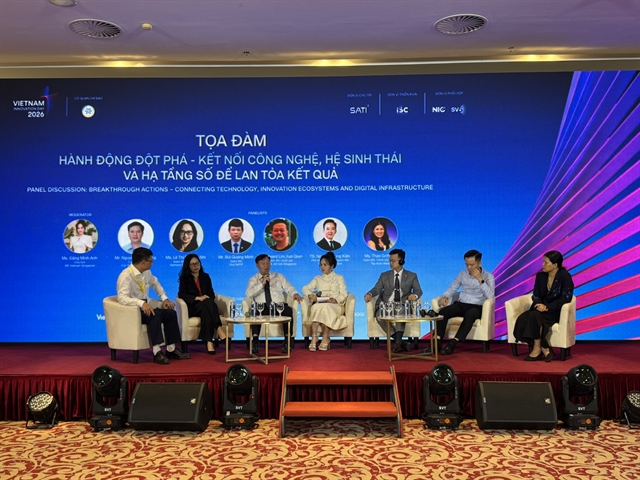 |
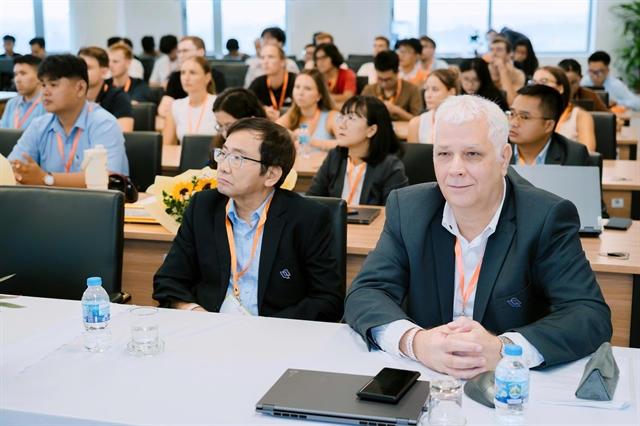
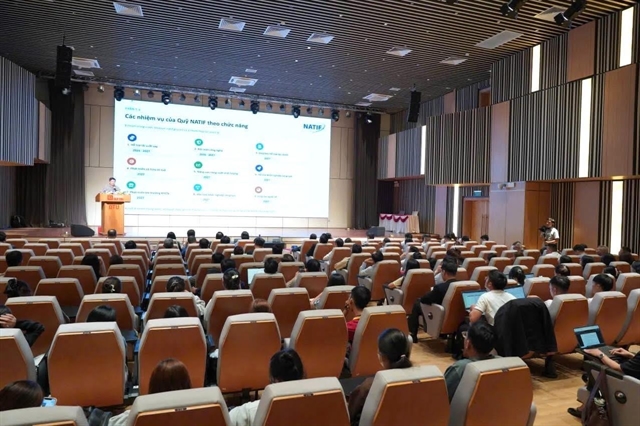
| Speakers at the panel discussion "Breakthrough Action – Connecting Technology, Ecosystems and Digital Infrastructure to Spread Results" at the 2026 National Innovation Forum in Hà Nội on Sunday. — VNS Photo Thu Vân |
Thu Vân
HÀ NỘI — Việt Nam has largely finished writing the rules for science, technology and innovation and must now make them deliver results, speakers told the 2026 National Innovation Forum on Sunday.
That will take a leading role for businesses, stable markets for long-term investors and simpler access to State funding, they said.
The panel discussion, titled "Breakthrough Action – Connecting Technology, Ecosystems and Digital Infrastructure to Spread Results", set out to link three pillars: strategic technologies, the innovation ecosystem and digital infrastructure.
It also sought to identify commitments, lead agencies and models that can be rolled out, measured and replicated after the forum.
Businesses as the connecting link
Nguyễn Mai Dương, director of the Department of Innovation under the Ministry of Science and Technology, said the common legal framework for science and technology had been basically completed over the past year or so.
The country was now moving from building institutions to putting them into practice, he said.
"In this phase, the leading role, the nucleus that connects everything, is the enterprise," Dương said.
Dương described the pillars as closely linked along the chain from scientific research to experimental development to finished products.
Strategic technologies set the long-term direction for national technology development. Innovation brings knowledge and technology into production and business to create new products and business models. Digital infrastructure provides the environment for creating, processing and using data, and for testing and bringing products to market.
"Businesses are not only where research results are put into production. They themselves have a very strong capacity to invest in research and development, especially the large corporations," he said.
He pointed to global groups such as Google, Nvidia and Huawei, which have poured vast resources into research and development to shape current and future technologies.
At home, Dương said, a number of large Vietnamese companies had begun placing orders, forming value chains and setting out problems for other firms to solve, giving them a way into production chains.
A steady market for offshore wind
Asked what would persuade a global technology group to invest for the long term and help Việt Nam move from importing equipment to mastering energy technology, Lê Thị Phương Nhi, Managing Director of Siemens Energy, took offshore wind as her example and named three conditions.
The first was the market. The Government has set a target of 6-17GW of offshore wind power by 2035, which she said was large enough, but what mattered more was stable volume over a long enough period.
Siemens Energy's studies point to 1-1.5GW of new capacity every year for 10 consecutive years, she said.
"Why don't we say 10 to 15GW in 10 years? We break it down to 1 to 1.5GW each year because investing in a factory requires stability," Nhi said.
A factory could not be built to serve a burst of projects in one year and then wait several years for the next, she said.
"It needs continuity and stability over many years," Nhi said.
The second condition was the readiness of the supporting ecosystem. Việt Nam has a foundation, she said, but gaps remain before it can take part in offshore wind.
The country already has a workforce serving onshore and nearshore wind projects, she said.
"Offshore wind needs a set of skills and experience that is not entirely the same as onshore and nearshore. That is the gap we need to close," she said.
Similarly, Việt Nam has steel and metallurgy industries, but not yet the large-scale casting and forging needed for wind turbines.
Closing those gaps would allow Vietnamese firms to join the supply chain and raise the localisation rate, she said, adding that Siemens Energy was studying the transfer of its most advanced offshore wind technology to Việt Nam.
The third was an industrial value chain that reaches beyond power generation. If Việt Nam mastered large-scale casting and forging, she said, the benefit would extend to many other industries.
"We hope to find a Vietnamese partner with the capacity to absorb the technology and, from there, build an ecosystem of supporting industries serving offshore wind," Nhi said.
'Policies have to run'
On State funding for business innovation, Bùi Quang Minh, director of the National Technology Innovation Fund (NATIF), began with where the fund sits among State funds.
While another State fund concentrates on funding and commissioning basic research and technology development, NATIF is built around businesses and puts them at the centre, he said.
The fund pays for and commissions innovation tasks, including technology upgrading, productivity and quality improvement, and support for innovative start-ups.
"The fund also subsidises loan interest, but it does not lend. Once a business has borrowed from a bank, we cover 50 per cent of the interest on eligible activities," Minh said.
Drawing on international experience, NATIF also plans to issue financial support vouchers. Several speakers at the forum had noted that many new products, new services and strategic technologies could qualify, he said.
"We are very keen to get a voucher pilot under way. We aim to run the pilot this year," Minh said, describing vouchers as a catalyst for innovation as a whole.
He acknowledged that current policies were not yet complete, but said waiting for perfect rules would only cause delay.
"My view is that policies have to run. Once they are running, we fix them as we go and they will gradually be completed," he said.
Minh also described a gap between interest and uptake. Businesses are enthusiastic when support policies are announced, but few have applied.
Some fear that taking State money will bring inspections and audits that disrupt their other operations. Others believe they need personal connections to reach the fund, or do not know where to submit an application.
"This is a real feeling. They are hesitant and do not know how to submit an application. I see this as an issue that needs very strong communication," he said.
The fund is designing an online system for submitting and reviewing applications and is inviting businesses to sit on its review panels, he said. The aim is a process that is as open and transparent as possible, in which applicants do not need to meet anyone in person.
Once that is in place, businesses will stop worrying about personal connections or about using State money, Minh said.
Procedures will be simplified as far as possible, he said, though post-approval checks are still needed to prevent abuse of the policy.
A business that follows the rules and is upfront when something comes up will have nothing to worry about, he added.
Many businesses had told him they needed the fund to cover only part of their costs, not a large sum, Minh said. They would go ahead with their projects anyway, but would do better with the fund behind them.
Backing from a national fund can also give a product more credibility in the market, he said. VNS
Sci-Tech
 Sci-Tech
 Sci-Tech
 Sci-Tech
 Sci-Tech
 Sci-Tech
 Sci-Tech
 Sci-Tech
 Sci-Tech
 Sci-Tech
 Sci-Tech
 Sci-Tech
 Sci-Tech
 Sci-Tech
 Sci-Tech