 World
World

Reviving Hà Nội's craft vilages
1.
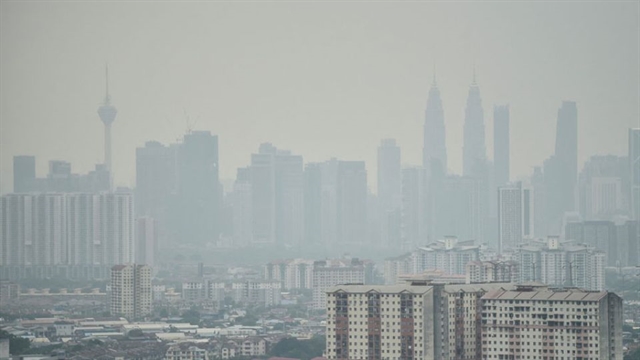 |
| Haze shrouds the Kuala Lumpur skyline on August 26 this year amid high levels of air pollution from regional wildfires. — AFP/VNA Photo |
JAKARTA — Toxic haze from forest and land fires in Indonesia have drifted further into neighbouring countries as far as the Philippines and triggered public health alerts in some major cities, as experts forecast it may also reach mainland Southeast Asian countries.
On Wednesday morning, seven air monitoring stations across the metropolitan area of Philippine capital Manila recorded “unhealthy levels” of PM2.5 pollutant particulate, according to the country’s Environment and Natural Resources Department (DENR).
“The observed haze is possibly associated with smoke and transboundary haze from ongoing fires in Kalimantan, Indonesia, which may have been transported toward the Philippines by prevailing winds,” the DENR said in a statement posted in its official Facebook account on Wednesday.
The administration of Quezon City, the most populous area in Metro Manila, issued on Tuesday a circular suspending all in-person classes and ordering public and private schools to turn to remote learning until further notice.
Air quality has also worsened in other parts of the Philippines, such as Central Luzon, Calabarzon, Mimaropa and Central Visayas.
Warnings from Philippine authorities marked the latest episode of cross-border haze linked to the widespread land and forest burning in Indonesia.
The haze reaching Indonesia’s northern neighbour followed forecasts from Europe-based earth observation platform Copernicus Atmosphere Monitoring Services (CAMS) that showed the general trajectory of pollution from wildfires in the country to cross the South China Sea toward the Philippines.
Other forecasts by the body predicted the haze reaching southern regions of Thailand, Cambodia and Việt Nam, according to CAMS senior scientist Mark Parrington.
“If the fire emissions continue to increase, as would be expected through September into October, the smoke and air quality impacts could persist for several weeks across the region,” Parrington told The Jakarta Post in an email on Wednesday.
According to the CAMS fire emissions platform, the total carbon emissions generated from Indonesia between August and September are estimated at 46 megatonnes (Mt) of carbon, equivalent to the annual emissions of around 45 coal-fired power plants.
It is the highest level compared with the same period since 2003, with around 38 Mt coming from fires in Kalimantan alone.
Forced indoor
The first episodes of transboundary haze were confirmed by the National Disaster Mitigation Agency (BNPB) in early August, when wildfire smoke from West Kalimantan crossed into the Malaysian part of Borneo Island.
Since then, more areas in Malaysia have been blanketed by haze as more lands are burned in Indonesia.
More than 200,000 hectares of land in the country had been engulfed by fire between January and late July, according to the Forestry Ministry. Around 100,000ha was burned throughout July alone.
The fires were fueled by deliberate land clearing for agricultural purposes amid El Niño climate conditions that have triggered a drier dry season in the archipelago.
On Wednesday afternoon, Kuching, the capital of Malaysia’s Sarawak state, was named the world’s most polluted major city with air quality reaching “hazardous levels”, according to Swiss-based air quality monitoring company IQAir.
Malaysia plans to launch cloud-seeding operations to encourage more rainfall, particularly in Sarawak, which has been the most affected by the haze. The operations are scheduled between September 3 and 5 depending on the weather conditions.
The worsening air quality in Sarawak forced the celebrations of Malaysia Day on September 16, a public holiday commemorating the formation of the Malaysian Federation, to be held indoors in Kuching, said Malaysian Communications Minister Datuk Fahmi Fazil as quoted by The Star.
Brunei Darussalam’s Health Ministry also issued a public health advisory following the worsening haze affecting the country. The ministry blamed the southwesterly winds blowing toward Brunei for carrying wildfire smoke from Kalimantan.
In the Brunei capital Bandar Seri Begawan, air quality on Wednesday afternoon was recorded at “unhealthy levels”, with PM2.5 concentration being around 13 times higher than the safety threshold set by the World Health Organisation (WHO), according to data from IQAir.
Similar conditions were observed in Singapore, where the country’s National Environment Agency (NEA) flagged on Tuesday the possibility of haze entering the city-state in the coming weeks following low-intensity rainfall and increased hot spots in the region.
The government claimed the work to put out fires had shown a positive trend in containing fires across several regions.
“But this is not a reason to be complacent,” Forestry Minister Raja Juli Antoni said in a press briefing on Tuesday. “September is a crucial phase for us to heighten our full vigilance and strengthen firefighting coordination.” — THE JAKARTA POST/ANN
World
 World
World
 World
World
 World
World
 World
World
 World
World
 World
World
 World
World
 World
World
 World
World
 World
World
 World
World
 World
World
 World
World
 World
World