 World
World
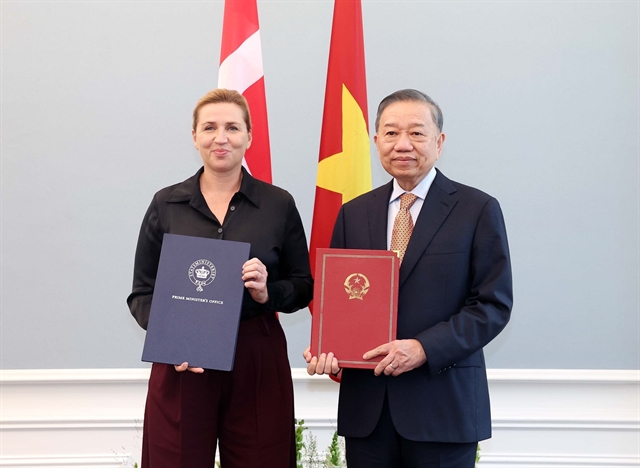
Việt Nam, Denmark elevate ties to Comprehensive Strategic Partnership
1.
 |
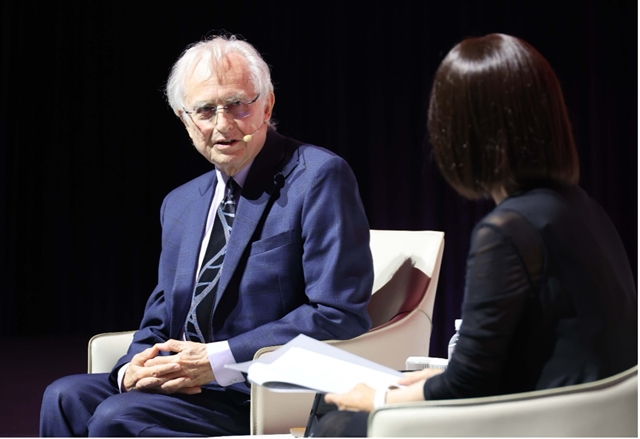
| Anchor Terry Martin, senior vice president of the U.S. Institute for Priority Policy Chad Wolf, president of the French Institute for International Relations Thierry de Montbrial, and writer Pepe Escobar (from left) share opinions at the 27th World Knowledge Forum "2027 Global Geopolitics Outlook" session held at the Shilla Hotel in Seoul on the 8th. Photo WKF |
SEOUL — The world is becoming more fragmented, with wars, competition among major powers and changing international relations creating new risks for 2027, speakers told the World Knowledge Forum 2026 in Seoul.
The discussion, titled 'Global Geopolitical Outlook 2027', brought together Chad Wolf, executive vice president of the America First Policy Institute; Thierry de Montbrial, founder and executive chairman of the French Institute of International Relations (IFRI); and Brazilian geopolitical analyst Pepe Escobar.
The three offered different views on the international system, the role of the United States, the rise of China, ongoing conflicts and the position of countries seeking to maintain relations with different major powers.
Asked what kind of international system was emerging, de Montbrial gave a short answer.
“Chaos. Sorry. Increasing chaos,” he said.
He argued that new sources of instability were appearing frequently and pointed to Iran as one example of how wars could develop in unexpected ways.
“It shows once more that when you start a war, you never know where it's going to be,” he said.
Wolf agreed that the world was turbulent, but offered a different view.
“I think the world is always in chaos; it just depends on what level of chaos at what time,” he said.
From his perspective, US foreign policy under President Donald Trump had become more focused on American interests and more transactional in dealing with both partners and competitors.
Wolf rejected the idea that the America First approach amounted to isolationism.
“I think what President Trump has shown is it absolutely is not, but it is conditions-based,” he said.
He said a more transactional relationship did not necessarily have to be seen negatively, arguing that the United States was putting the interests of the American people first while continuing to work with allies.
Escobar, meanwhile, said the world was moving towards what he described as a multipolar or 'multi-nodal' system.
“Well, we're watching the alignment of the elements being put together towards a multipolar, but the best definition, in fact, is a multi-nodal world,” he said.
He pointed to BRICS and the Shanghai Cooperation Organisation as examples of organisations playing a larger role in a changing international system.
New groupings, continuing ties
De Montbrial took a more cautious view of the idea that the world was simply dividing into rival blocs.
“I do not see personally the so-called Global South as an adversary of the West, nor an adversary of the East,” he said.
He described the position of many countries as a form of 'multi-non-alignment'.
While there was a tendency towards new groupings around major powers, he said economic and political links between countries remained too strong for completely separate blocs to emerge.
“The interdependencies are such that full blocs, isolated blocs, is impossible,” he said.
He argued that the international system would eventually need rules that allowed countries and different groups to continue working with one another.
The speakers also discussed Europe and the long-term challenges created by the conflict in Ukraine.
De Montbrial said Europe faced the difficult task of managing a large and diverse group of countries, and questioned how easily they could speak with one voice on major international issues.
Risks for 2027
Looking ahead to 2027, Wolf said there were several major issues to watch.
“I think the Taiwan Strait is obviously something that you've got to keep your eye on,” he said.
He said developments there would be important to relations between China and the United States.
“The question is, does that hold or does it not?” he said, referring to whether major powers could continue to avoid direct military confrontation.
Wolf also pointed to Ukraine and developments on the Korean Peninsula as areas to watch.
He said the future of the Ukraine conflict would depend partly on whether some form of settlement could be reached or fighting continued.
He also referred to the possibility of further contacts between the United States and the Democratic People's Republic of Korea.
De Montbrial gave a broader warning when asked about the greatest geopolitical risk in 2027.
“The risk is world war,” he said.
He explained that his concern was not necessarily that countries would deliberately choose a large war, but that smaller events could escalate.
“That is, the risk is a sequence of events starting with small things and which, through a series of unexpected increases, so to speak, lead to a big war,” he said.
He described the possibility of such unintended escalation as the most serious risk.
Escobar focused mainly on developments involving Russia and Ukraine and the situation in West Asia.
“It will depend on what happens with these two wars,” he said.
He argued that their outcomes could have wider consequences for political and security arrangements in Europe and West Asia.
The speakers differed in their views of the conflicts and the roles of major powers, but all pointed to the continuation or possible escalation of current tensions as an important issue for the year ahead.
Reasons for optimism
Asked to identify something that gave them confidence about 2027, the speakers again gave different answers.
Wolf pointed to the US administration's willingness to take decisions and explain them to the American public.
“Whether you agree with him or not, and I know a lot of people disagree, I think that's what gives me a little confidence leading into next year,” he said of Trump.
De Montbrial said one positive factor was that governments did not want a general war.
“I mean, the sign of hope is that nobody wants a general war. Nobody,” he said.
He also pointed to communication between political leaders as a reason to remain cautiously hopeful.
“The fact that nobody wants, and that today we have a lot of interaction between leaders, gives, I think, hope if everyone remains at least a little bit reasonable,” he said.
Role of middle powers
The panel also discussed how middle powers, particularly in Asia, were managing relations with major powers.
De Montbrial said countries such as India were seeking to maintain a balance in their relations rather than choose one side.
“These big emerging countries do not want to be forced to choose sides, and that's reasonable,” he said.
He said middle powers could play a role in creating a broader balance in international relations.
“It is the so-called middle powers who have to act as much as possible to gather together a sort of balance of power in a very large sense to avoid catastrophes,” he said.
Wolf also saw an important role for middle powers, although he described their approach differently.
“I think the middle powers more or less are trying to have it both ways, which is playing off of the great powers,” he said.
He noted that countries had different histories and relationships with the United States, citing South Korea and India as examples, and said countries including Indonesia, Brazil, South Korea and India remained important players.
Escobar described a similar effort to maintain relations with different major powers as a 'multi-vector policy'.
The discussion ended without a single view of what the global order would look like in 2027. Instead, the three speakers offered different perspectives on a world marked by competition among major powers, unresolved conflicts and efforts by many countries to balance their relations without being forced to choose sides. VNS
World
 World
World
 World
World
 World
World
 World
World
 World
World
 World
World
 World
World
 World
World
 World
World
 World
World
 World
World
 World
World
 World
World
 World
World