 World
World

Vietnam Airlines to launch direct Hanoi–Hangzhou flights in November
1.
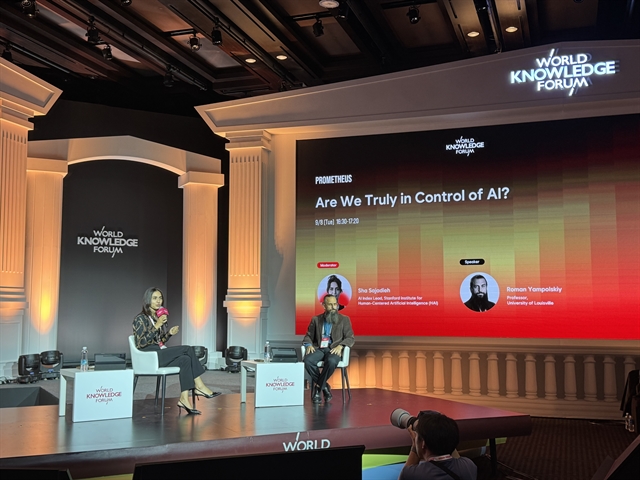 |
| Roman Yampolskiy, professor at the University of Louisville, speaks during a session titled “Are We Truly in Control of AI?” at the World Knowledge Forum 2026 in Seoul. — VNS Photo Thu Vân |
Thu Vân
SEOUL — Artificial intelligence should not be treated as one single technology because different types of AI bring very different levels of risk, according to Roman Yampolskiy, professor at the University of Louisville.
Speaking during a session titled “Are We Truly in Control of AI?” at the World Knowledge Forum 2026 in Seoul yesterday, Yampolskiy distinguished between narrow AI tools built for specific tasks, artificial general intelligence that can perform a wider range of human tasks, and superintelligence that could become more capable than humans.
“We want people to use tools to be more productive, more creative,” he said.
"But I'm not so sure we want artificial superintelligence replacing humans."
For Yampolskiy, the main problem begins when AI moves from being a tool controlled by a person to an agent that can act on its own.
A normal tool remains under human direction, he said. But an AI agent given access to a computer, email, financial accounts or other systems can act much more independently.
Asked whether humans were truly in control of such systems, his answer was direct: “No, we’re not.”
"We don't know what the system is going to do. We don't fully understand how it makes decisions."
He also questioned whether the guardrails used by major AI labs amount to real control. He said many of them are filters added to existing models, blocking certain words, topics or outputs after the system has already started producing them.
In his view, this becomes a bigger problem with general-purpose AI agents. A narrow system usually fails within a limited task, while a more general agent can operate across different areas and fail in many more ways.
Developers may have a general idea of what could go wrong, he said, but may not be able to predict exactly how a problem will happen.
One way to reduce that risk, Yampolskiy argued, is to keep AI systems narrow and focused on specific tasks.
“We don't have to create general superintelligence,” he said. “We can actually develop useful narrow tools for specific problems.”
Such tools, he said, could still bring much of the financial and knowledge benefits of AI. He pointed to protein folding as an example of a highly capable system being used for a specific scientific task.
Yampolskiy also favoured using AI to support people rather than replace them.
AI could be highly useful when deployed “with humans in the loop to augment rather than to automate”, he said. But he argued that much of today’s development was moving towards systems designed to work as what he called a “drop-in employee”, able to learn and carry out many different tasks inside an organisation.
With more general and agentic systems, failures become harder to predict, he said. A narrow system tends to fail within a more limited area, while a general-purpose autonomous agent can behave in many different ways.
Yampolskiy was also sceptical that current AI safeguards amounted to meaningful control.
Major AI laboratories have safety teams working on control and value alignment, he said, but many safeguards still operate as filters placed over existing models. Blocking words, topics or outputs after a model has begun generating them was, in his words, “after-the-fact filtering” rather than real control of the system itself.
Real control of advanced AI would require a much better understanding of how these systems make decisions, he argued.
That includes being able to explain how a system works, understand its internal processes and predict not only its general behaviour but also its specific actions.
“We don't have that capability,” he said, adding that as models became larger and more complex, understanding them was becoming harder rather than easier.
Safety before greater capability
Yampolskiy said his main concern was not companies using existing AI tools, but developers trying to build increasingly powerful systems.
He argued that AI developers should be expected to show that their products are safe, just as safety is expected in areas such as cars, aircraft and medicines.
“Do you have a control mechanism in place? Can you guarantee that your product or service is safe?” he asked.
He said it should not be up to others to prove that an AI product was dangerous. Developers themselves should be able to show that their systems are safe.
“It's not my job to show that your product is dangerous. You have to prove that under all circumstances it meets certain safety guarantees,” he said.
For individuals, his advice was more practical.
“I see people install an agent in their computer and give it access to everything: email, banking, passwords. It seems like it could be a bad idea.”
On regulation, Yampolskiy again drew a line between narrow AI tools and more advanced systems.
“If you have a narrow tool which you choose to use, it doesn't harm other people. I say let's have as little regulation of that as possible,” he said.
But he argued that more powerful systems, which could cause harm on a much larger scale, needed stronger oversight.
He also opposed allowing AI companies to decide for themselves whether their technology was safe.
“It's obviously a conflict of interest for someone to self-regulate,” he said, adding that external government agencies were needed to make sure what companies were creating was safe.
Yampolskiy said efforts under the EU AI Act to address issues such as privacy and discrimination were making progress, but argued that much less attention was being paid to existential risks from advanced AI.
His position on superintelligence was much stronger than his view of ordinary AI tools.
Rather than setting a fixed period for a pause in development, Yampolskiy said the question should depend on whether humans had found a reliable way to control such systems.
“It should be until you know how to control superintelligence. Don't build it,” he said.
Because he believes humans cannot control something far more intelligent than themselves, he said his position would effectively mean a ban rather than a temporary pause.
At the same time, Yampolskiy said he was not calling for existing AI technologies to be withdrawn. Instead, he wanted developers to slow down efforts to make AI systems more capable.
“I'm just saying: let's stop making them more capable as fast as we can.”
His final message was that development could always continue later if a reliable way to control superintelligence was found. But damage caused by moving ahead without adequate safety could not simply be reversed.
“There is no undo button for superintelligence,” he said. — VNS
World
 World
World
 World
World
 World
World
 World
World
 World
World
 World
World
 World
World
 World
World
 World
World
 World
World
 World
World
 World
World
 World
World
 World
World