 World
World

Archaeological sites bring history to life, captivating visitors and researchers
1.
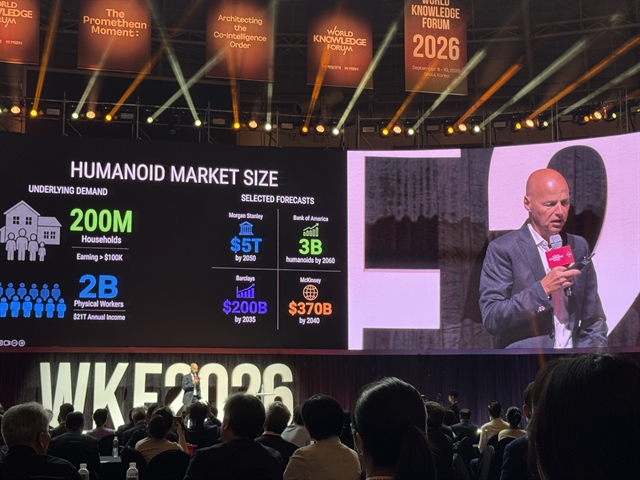 |
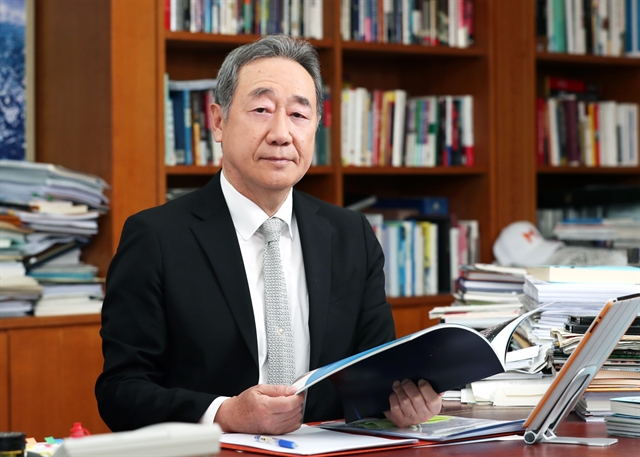
| Sebastian Thrun, founder of Google X and a pioneer of autonomous driving, discusses the potential scale of the humanoid robotics market during a session at the 27th World Knowledge Forum in Seoul on September 8. — VNS Photo Thu Vân |
Thu Vân
SEOUL — Physical artificial intelligence (AI) could bring profound changes to industries and labour over the coming decade as AI moves from software into vehicles, factories, robots and homes, Sebastian Thrun, founder of Google X and a pioneer of autonomous driving, told the World Knowledge Forum in Seoul on Tuesday.
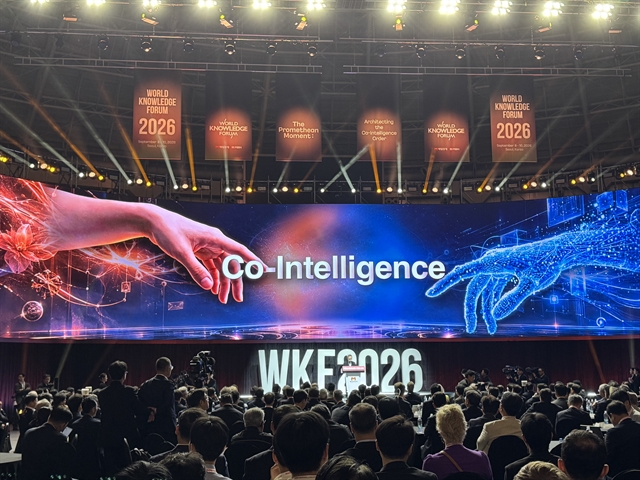
Speaking at an open session titled “The Physical AI Revolution: Co-Intelligence on the Move” at the 27th World Knowledge Forum on September 8, Thrun argued that the next frontier of AI would extend far beyond the language models that have driven much of the recent technological boom.
“We interact with the physical world every waking moment,” he said.
“So physical AI is an order of magnitude bigger when it comes to opportunity for innovation, but it’s also harder.”
Unlike virtual AI, where an incorrect answer can often be identified and corrected by a user, mistakes by AI systems operating in the real world can have immediate physical consequences, he said.
“At this moment we cannot have a Waymo hallucinate,” Thrun said. “If a Waymo hallucinates a red light for a green light, that is disastrous.”
That much smaller margin for error has made physical AI considerably more difficult to develop, but Thrun argued that advances in autonomous driving demonstrate how technologies once considered highly experimental can eventually move into everyday use.
From Stanley to Waymo
Thrun traced his interest in autonomous driving back to a traffic accident during his youth in which a neighbour was killed, an experience that led him to question whether technology could reduce deaths caused by human error.
Years later, while a professor at Stanford University, he led a student team that developed Stanley, the autonomous Volkswagen Touareg that won the US Defense Advanced Research Projects Agency's Grand Challenge in 2005.
“This to me is the historic moment, not just of self-driving cars, but of physical AI,” he said of the vehicle reaching the finish line.
The work eventually contributed to the development of Google's self-driving car project and later Waymo.
Thrun said the technology required years of development because physical AI needed to do more than simply work.
He pointed to Waymo's accumulated driving experience and safety record, while distinguishing published safety estimates from his own more optimistic assessment of the technology's performance.
Beyond autonomous cars, Thrun also turned to flying vehicles, describing the idea of moving transport hundreds of metres above congested roads and travelling directly to a destination.
He acknowledged that the idea could still appear futuristic, but drew a parallel with autonomous driving, which he said had also once seemed unrealistic.
“Ten years ago, self-driving was a dream that no one believed in,” he said, “and now this is a dream that people are beginning to believe in.”
Humanoids move closer to practical use
Thrun identified humanoid robots as one of the hottest areas of physical AI development, with hundreds of companies now working on systems designed for industrial and domestic tasks.
The challenge is no longer simply enabling robots to walk, he said, but allowing them to manipulate objects reliably in unpredictable environments.
He pointed to emerging systems capable of tasks such as handling laundry, loading dishes and performing basic work around the home, although he acknowledged that today's robots remain far from perfect.
“They're not perfect yet,” he said.
“But again, look at how my self-driving car evolved and how painful it was to make it work. But eventually it worked.”
Looking further ahead, Thrun said physical AI could have major implications for the global workforce.
He pointed to around two billion people engaged in physical work worldwide and predicted that robots would gradually become capable of taking on more physical tasks as their cost falls and reliability improves.
“I think step by step we're going to see these robots be able to carry out the same physical work at a lower price point, with higher reliability than humans,” he said.
“And that's going to be a gargantuan shift of society.”
Thrun compared the potential transformation with the mechanisation of agriculture, which over more than a century sharply reduced the share of people working in farming.
He suggested that transformations that once took more than a century could now unfold much faster.
“Things have accelerated to a point that the past is not a good predictor for the future,” he said.
“Don't be a laggard.”
Building the physical AI ecosystem
Thrun said countries seeking to compete in physical AI should focus on areas where they already have strong capabilities rather than trying to lead across every field.
“The very first point is don't focus on everything,” he said. “That's a mistake.”
“Focus on a few things where you're already world class.”
He also stressed the importance of building strong supply chains, creating room for real-world experimentation and connecting innovators with established industries that can become early users of new technologies.
“I think whoever is able to own the supply chain will have a massive advantage,” he said.
Trust as a competitive advantage
Alongside talent and capital, Thrun highlighted trust and safety as another important factor in the development of physical AI.
He called for concentrated pools of talent and capital, drawing lessons from Silicon Valley's ability to attract people and investment from around the world.
His final recommendation was to use safety and trust as a competitive advantage.
“People need to trust the technology,” he said. “People need to feel it is safe. It needs to be safe.”
Thrun argued that trust and safety should themselves be treated as competitive advantages as physical AI becomes more widely deployed.
He pointed to Waymo as an example of how building public trust in physical AI can take time, particularly when people's safety depends directly on the technology.
“That trust and safety is not to be underestimated,” he said.
He also called for continued dialogue among technologists, governments, the media and industry as physical AI develops.
The aim, he said, should be to understand where the technology is heading and “jointly steer the world in the right direction”. — VNS
World
 World
World
 World
World
 World
World
 World
World
 World
World
 World
World
 World
World
 World
World
 World
World
 World
World
 World
World
 World
World
 World
World
 World
World