 World
World

AITO Looks Ahead to Europe, Building a Thriving Automotive Ecosystem
1.
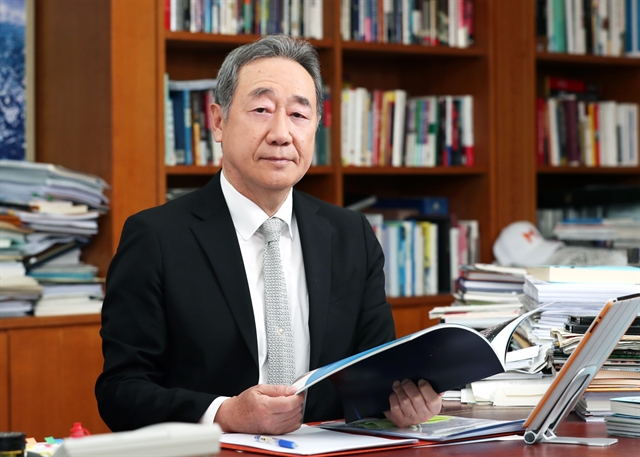 |
| World Knowledge Forum founder Dr Chang Dae-whan. Photo WKF |
In our talk last year, you described AI as an unavoidable transformation that would determine the survival of nations. This year’s theme goes further by describing the present as a “Promethean Moment”. What has changed over the past year to convince you that the world has reached a genuine turning point, rather than simply another stage in the development of AI?
Until last year, much of our discussion focused on how rapidly AI would advance and how far it might go in replacing human capabilities. In just one year, however, I believe the question itself has changed. AI has moved beyond the realm of possibility and become a real force shaping our economies, industries, labour markets and national security. AI is now rapidly diffusing into everyday life while also becoming increasingly important in the military and national security domains.
This shift is clearly reflected in the White House strategy report released last year, “Winning the Race: America’s AI Action Plan”. The title itself reflects how AI has become central to the strategic race for national competitiveness and global leadership. The report described the potential of AI as “an industrial revolution, an information revolution, and a renaissance, all at once”.
In other words, transformations that once unfolded over centuries are now taking place simultaneously.
That is why this year’s World Knowledge Forum defines the present as a “Promethean Moment”. Just as Prometheus gave humanity fire in Greek mythology, AI is giving us capabilities that were once unimaginable.
But just as fire gave rise to civilisation while also bringing new dangers, AI presents us with both extraordinary possibilities and risks that may be difficult to control.
Last year, we said that the rise of AI was an unavoidable transformation and that how nations and businesses responded to it would increasingly determine their survival.
This year, we must go one step further. The question is no longer whether we should embrace AI. We have reached the point where we must ask what principles should guide us in designing a new civilisation and a new order in which humans and AI coexist.
This year’s theme calls for “Architecting the Co-Intelligence Order”. What would such an order look like in practice, and how would it differ from the world we live in today?
When ChatGPT first emerged three years ago, we tended to think of “co-intelligence” simply as a way for humans and AI to work together. Today, however, AI is reaching deeply into virtually every part of our economies and societies.
AI is already processing vast amounts of information, identifying patterns and rapidly taking on many tasks that were once performed by humans. Its capabilities will only continue to grow.
But we cannot leave it to machines to decide what direction society should take, determine what is right or wrong, or bear responsibility for those decisions. Creativity, empathy, value judgements and responsibility must remain fundamentally human domains.
The central challenge of the co-intelligence era, therefore, is not simply how powerful we can make AI. Even if AI surpasses humans in many areas, humans must remain the ones who set its direction, define its boundaries and retain ultimate responsibility. What matters more is how we define and coordinate the respective roles of humans and AI, and what institutions and rules we build to govern that relationship.
We need to create a new order in which humans and AI can truly coexist. That is what I mean by “co-intelligence”.
The most advanced AI models, computing resources and platforms are concentrated in a small number of countries and companies. Can a genuine co-intelligence order emerge while access to AI remains so unequal?
This is a very important question. Today, the most advanced AI models, semiconductors, computing infrastructure and platforms are concentrated in a small number of countries, including the United States and China, and in the hands of a few global companies. If this concentration continues, AI could widen existing gaps among nations, companies and individuals rather than narrow them.
However, I do not believe that AI competition should be viewed simply as a race to see who possesses the largest models or the greatest computing resources. The true economic and social value of AI will ultimately come from how effectively we apply the technology across real-world industries and society.
Historically, global leadership has never belonged simply to those who first lit the fire. It has belonged to those who spread that fire the farthest. The printing press, the steam engine, electricity and information technology all followed this path. The decisive factor in the future of the AI revolution will likewise be “diffusion”.
Ultimately, the success of a co-intelligence order will be measured by how widely the productivity gains and new opportunities created by AI are shared, and by whether they contribute to the advancement of humanity as a whole.
This is precisely the question we hope to explore at this year’s World Knowledge Forum. We must go beyond asking how powerful AI will become and instead ask how we can place that powerful intelligence within an order that transforms it into shared prosperity for humanity. That also means harnessing AI to address global challenges such as energy and food crises, hunger, pandemics and environmental problems. That is the fundamental question at the heart of this year’s theme: “Architecting the Co-Intelligence Order”.
As the United States and China compete for technological supremacy, what realistic options remain for middle powers such as South Korea? Should Korea continue investing in sovereign AI models, or concentrate its limited resources on areas where it already holds a competitive advantage, such as semiconductors and advanced manufacturing?
For a middle power like South Korea, competing head-on with the United States and China across every field of technology is simply not a realistic strategy. The real question is how we prioritise our limited capital and talent, and which core capabilities we must secure.
In that sense, I do not believe this should be framed as a simple binary choice between sovereign AI and semiconductors or advanced manufacturing. It is unrealistic for South Korea to compete with the United States or China in general-purpose AI models at the same scale. But at the same time, relying entirely on foreign technology for AI capabilities that are likely to become part of our critical national infrastructure would also carry significant risks.
Korea’s greatest strengths lie in semiconductors and advanced manufacturing. Growing US demand for Korean investment in shipbuilding, defence, semiconductors and nuclear power underscores the strategic importance of these sectors. As the AI race intensifies, the physical foundations of AI, including semiconductors, data centres, power infrastructure, robotics and smart factories, will become even more important. Given our limited national resources, I believe strengthening these areas of comparative advantage should be a priority.
That does not mean sovereign AI is unnecessary. We should think about sovereign AI not as a race to build the world’s largest proprietary model, but as a means of securing meaningful technological sovereignty. Korea needs to retain control over critical data, develop the talent and computing capacity required to build and operate AI models, and avoid excessive dependence on any single country or company.
Ultimately, Korea should pursue “strategic interdependence” rather than technological self-sufficiency, strengthening areas where it can remain difficult to replace while selectively securing the AI capabilities it needs. This also requires broader cooperation with the United States, the EU, Japan, China and emerging Asian economies such as Việt Nam. I believe this is the most realistic and sustainable path for a middle power like Korea.
AI may increase productivity, but the companies and workers that bear the costs of disruption may not be those that receive the greatest benefits. If AI eliminates jobs faster than economies can create new ones, who should bear the cost of that transition?
One of the most important economic questions in the AI era is how we distribute the gains from higher productivity and the costs of transition. We cannot and should not stand in the way of technological progress. But if the costs of that progress fall disproportionately on certain workers or businesses, it will be difficult to sustain that innovation over the long term. I believe businesses, governments and individuals all have a role to play, but those who derive greater economic benefits from AI should also bear a greater share of the responsibility.
So I suggest that governments and companies invest in job transformation, or JX, in the age of AI, enabling people to equip themselves with AI-related knowledge and know-how. What I call JX can also enhance the capabilities of the existing workforce and help workers adapt to AI-related tasks. In addition, as AI becomes more deeply integrated into the economy, the labour market is likely to become more flexible.
At the same time, we should be careful not to place excessive burdens on businesses in ways that discourage AI investment and innovation.
Governments should support workers as they retrain and move into new industries, while also creating an environment in which businesses can adopt AI, develop new businesses and create new jobs. This may also require more flexible forms of employment, including sharing available work more broadly even if it means lower pay in some cases. This means modernising regulations that fail to keep pace with technological change and giving companies sufficient room to innovate.
The goal of policy should not be to preserve every existing job at all costs. It should be to enable workers to move into new industries while allowing businesses to create the jobs of the future. Ultimately, what matters is how effectively we can turn the productivity and wealth created by AI into new investment and new jobs. At the same time, competition among individuals and nations will not disappear. If anything, it may become even more intense in the AI era.
As a media leader, what concerns you most about the growing role of generative AI in shaping how people discover and consume news: misinformation, the erosion of trust, or the transfer of power from publishers to technology platforms?
I am concerned about all three, but ultimately, what concerns me most is the erosion of trust. Misinformation and the growing power of technology platforms both contribute to a broader challenge: whether audiences can still distinguish reliable journalism from information that is inaccurate, misleading or unverified.
Generative AI is fundamentally changing how people access news. Increasingly, audiences may encounter news through AI-generated summaries or answers rather than by visiting a news organisation directly. That creates risks, especially when misinformation can be generated and distributed at unprecedented speed.
At the same time, I believe this makes the role of legacy media more important, not less. Our responsibility is to verify facts, provide context, exercise editorial judgement and remain accountable for what we publish. Technology may change the interface through which people consume news, but it does not eliminate the need for credible journalism at the source.
The challenge for legacy media is to adapt to new ways of discovering and consuming information while preserving the principles that underpin trusted journalism. As it becomes harder to distinguish fact from fabrication, trusted news organisations must remain an anchor of credibility in the information ecosystem. As long as publishers and journalists remain on the front line of news and knowledge, we can continue to build trust with readers and audiences, and that trust will be essential to surviving the AI transformation. This also depends on preserving the freedom of the press, which enables journalism to remain independent, credible and accountable. VNS
World
 World
World
 World
World
 World
World
 World
World
 World
World
 World
World
 World
World
 World
World
 World
World
 World
World
 World
World
 World
World
 World
World
 World
World