 World
World
Top leader and spouse depart for Denmark, European Union and Belgium
1.
|
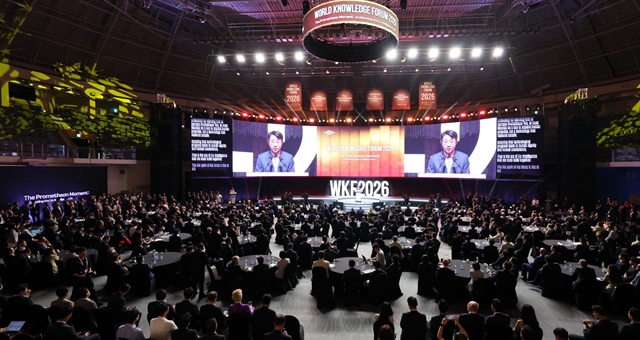
| Chang Dae-whan, Chairman of Maekyung Media Group and founder of the World Knowledge Forum, delivers remarks at the forum’s opening ceremony. VNS Photo Thu Vân |
Thu Vân
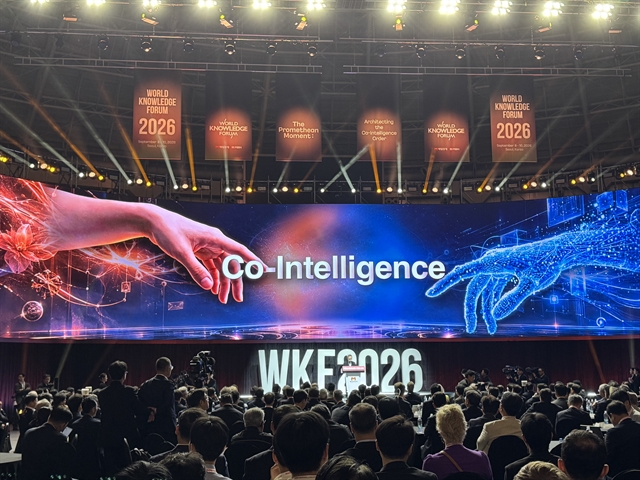
SEOUL — The 27th World Knowledge Forum opened in Seoul on Tuesday, bringing together global political, business and academic leaders for three days of discussions on how humanity can shape a new relationship with artificial intelligence amid profound changes in the global economy and international order.
Organised by Maekyung Media Group from September 8 to 10, this year's forum is themed 'The Promethean Moment: Architecting the Co-Intelligence Order', drawing on the image of Prometheus bringing fire to humanity as a metaphor for both the transformative potential and risks of AI.
Opening the forum, South Korean National Assembly Speaker Cho Jeong-sik said technological progress should ultimately be judged not simply by the speed of innovation, but by whether it serves people.
“The fire that Prometheus gave in myth was a torch of civilisation that lit up the darkness, but at the same time, it carried the risk of reducing everything to ashes,” Cho said.
“Today, we are once again facing a Promethean Moment.”
AI, he said, was moving far beyond its role as a technological tool and changing how people work and live, while simultaneously raising questions over employment, inequality and human alienation.
“What determines the level of a civilisation is not how fast or how far technology advances, but whom it is for,” Cho said.
“AI must likewise be a tool to expand human potential, not a technology that replaces people.”
|
| South Korean National Assembly Speaker Cho Jeong-sik delivers a speech at the event. Photo WKF |
He said the challenge was to ensure that technological advances contributed to human dignity and coexistence, describing this as central to the emerging era of “Co-Intelligence”.
RoK's National Assembly would work to establish an institutional framework that encouraged innovation while ensuring AI safety and reliability and helping its benefits translate into opportunities for society as a whole, he added.
From invention to diffusion
Chang Dae-whan, Chairman of Maekyung Media Group and founder of the World Knowledge Forum, took the concept further, arguing that the decisive question for the AI era was no longer simply who developed the technology first, but how widely and deeply it could be integrated across society.
Drawing parallels with the printing press, steam engine, electricity and information technology, Chang said history showed that the impact of transformative technologies was ultimately determined by their diffusion.
“The true battleground is not the technology itself. It is diffusion,” he said.
“We must become a country where all citizens use AI as fluently as their mother tongue.”
Chang said the concept of Co-Intelligence had also evolved rapidly since the emergence of generative AI.
When ChatGPT first appeared, he said, Co-Intelligence could be understood largely as cooperation between humans and AI. As the technology increasingly permeates industries and societies, however, a broader framework is now needed to govern how the two coexist.
“Humans use AI to broaden the horizons of their thinking, while AI operates within the norms set by humans,” he said.
“That is what I call ‘Co-Intelligence’.”
For Chang, the key question was how deeply AI could take root across society, rather than simply who developed the technology first.
Over the three-day forum, international scholars, political figures and business leaders are expected to examine AI alongside changes in the global economy, industry, entrepreneurship and international affairs.
Leadership in uncertain times
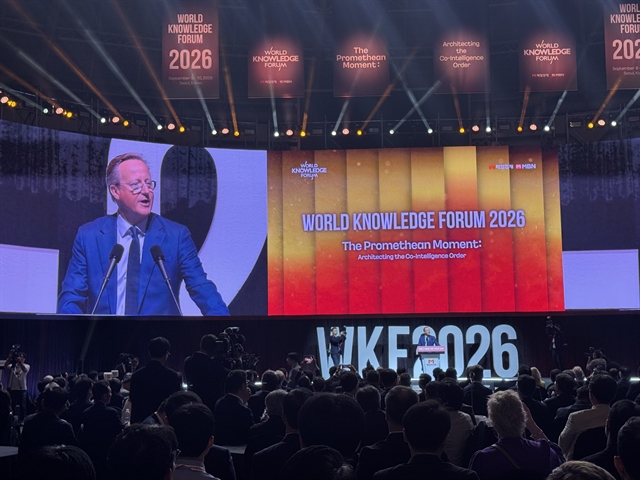
|
| Former British Prime Minister David Cameron delivers his keynote speech at the forum’s opening ceremony. VNS Photo Thu Vân |
Former British Prime Minister David Cameron, delivering a special address following the opening remarks, shifted the focus from technological transformation to the broader challenge of political leadership at a time of growing global uncertainty.
Cameron described the current situation as a 'double-headed crisis', combining an increasingly difficult international environment with unstable domestic politics in many countries.
“To me, it is a double-headed crisis: an increasingly dangerous world and an unstable and populist-driven domestic politics that affects so many of our countries,” he said.
“And these two things are completely connected.”
He attributed domestic political instability partly to stalled living standards, the uneven consequences of globalisation and wider social pressures, while arguing that social media had further fragmented public discourse.
“People increasingly have their own news, their own truth, their own facts,” Cameron said, warning that this made consensus-building increasingly difficult.
He argued that leaders could not treat domestic economic conditions and foreign policy as separate challenges.
“There is no national security without economic security,” he said.
Cameron urged political leaders to resist what he called an 'optimism bias', or the assumption that an earlier period of expanding global trade and international cooperation would simply return.
“But I’m afraid they won’t,” he said. “We need an approach that is one of cold, hard-headed realism.”
He said governments should prioritise economic and national security, strengthen resilience and supply chains, and work with countries that share their values and interests.
He nevertheless cautioned against abandoning free trade and international cooperation, arguing instead for adapting them to changed circumstances.
“That doesn’t mean the end of free trade, but it means more national oversight,” he said.
“A course correction, not a revolution.”
Cameron also stressed the importance of having a clear plan and explaining policy choices to the public.
“Good leaders have to be great teachers,” he said. “In a democracy, our system is simple: it is government by explanation. And that explanation can never, ever stop.”
He closed on an optimistic note by pointing to South Korea's transformation over the decades since the Korean War.
Recalling his first visit to South Korea 16 years ago, Cameron said he met returning British veterans who were astonished by the country's transformation.
“They couldn't believe the progress, the prosperity, the confidence,” he said. “They will never forget that sensation, and frankly, neither will I.”
South Korea's development, he argued, showed that countries were not prisoners of geography or history.
“The most important thing we do is to choose our path, our politics, our way,” he said.
The World Knowledge Forum, launched by Maekyung Media Group in 2000, has developed into one of South Korea's major international knowledge platforms. This year's 27th edition is being held at Jangchung Arena and The Shilla Seoul under a programme examining the changing global order through the five pillars of power, capital, intelligence, planet and humanity. — VNS
World
 World
World
 World
World
 World
World
 World
World
 World
World
 World
World
 World
World
 World
World
 World
World
 World
World
 World
World
 World
World
 World
World
 World
World