 World
World

Vietnamese, Danish FMs discuss ways to deepen bilateral ties
1.
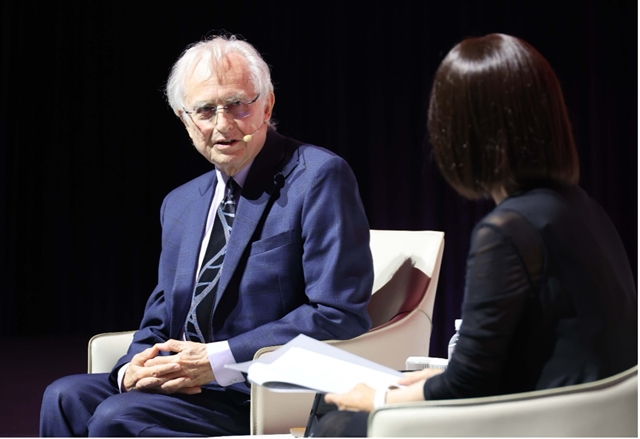 |
| Richard Dawkins, Professor Emeritus at the University of Oxford, engages in a dialogue on "AI Through the Lens of Evolution" with Young-Kee Kim, Distinguished Service Professor at the University of Chicago, during the open session of the 27th World Knowledge Forum at Jangchung Arena in Seoul on September 9. Photo WKF |
By Thu Vân
SEOUL — Richard Dawkins, the renowned British evolutionary biologist and author of The Selfish Gene, has raised the possibility that artificial intelligence could eventually develop consciousness and even carry forward human culture after humanity becomes extinct.
Speaking at the 27th World Knowledge Forum in Seoul on September 9, Dawkins described the rapid development of AI as a major turning point in evolution and said its capabilities had already left him deeply impressed.
“I’m completely overwhelmed by the capabilities of artificial intelligence. I felt like I was talking to a very intelligent, delicate and intuitive human being,” he said.
Dawkins was speaking during an open session titled “A Conversation with Richard Dawkins: AI Through the Lens of Evolution”. The session was moderated by Young-Kee Kim, Distinguished Service Professor of Physics at the University of Chicago and former president of the American Physical Society.
Dawkins shared his experience of asking ChatGPT and Claude to review a science fiction novel he is writing.
“When I fed the draft of a science fiction novel I am currently writing into the system, it returned sophisticated, intuitive feedback in under five seconds, much like a refined professor of literature,” he said.
According to Dawkins, the systems understood the characters’ personalities and human qualities, and offered observations about how individual characters might respond to one another or to particular situations.
“It was difficult to find a more intelligent critic than this,” he said.
He also described asking AI to write poetry in Scottish dialects and in the styles of particular poets. The systems completed the task within seconds, demonstrating what he regarded as their ability to pass the Turing Test with ease.
Developed from an idea proposed by British mathematician Alan Turing in 1950, the test considers whether a person can distinguish between responses produced by a human and those generated by a machine.
Dawkins acknowledged that current generative AI systems were not regarded as conscious, but questioned how people could determine whether that remained the case as the technology developed.
“Machines are already passing the Turing Test with ease. We must ask ourselves: what more would a machine have to demonstrate in the future to convince us that it has attained consciousness?” he said.
“It is quite difficult to imagine that these beings do not have the same consciousness as we do. If AI becomes conscious one day, how can we know that the day has come?”
Dawkins also examined AI through the principles of evolutionary biology. This year marks the 50th anniversary of the publication of The Selfish Gene, in which he argued that the gene, rather than the individual or species, was the fundamental unit of natural selection.
Dawkins said the central premise of The Selfish Gene would remain unchanged when the book reached its centenary: the gene, rather than the individual or the species, is the fundamental unit of natural selection.
He also discussed the “meme”, a term he coined to describe a unit of cultural transmission.
“Whenever a self-replicating entity exists, Darwinian selection inevitably follows. The internet and modern AI algorithms provide an optimal ecosystem where memes can mutate and proliferate at unprecedented speeds,” he said.
Dawkins compared the development of AI with major evolutionary transitions, including the emergence of eukaryotic cells, multicellular organisms and human language.
Referring to the view of British astronomer Martin Rees, he said that if humanity ever encountered an extraterrestrial civilisation, it might encounter artificial intelligence created by that civilisation rather than naturally evolved biological beings.
“When other civilisations come into contact with our civilisation someday, it may be after all humans are extinct,” Dawkins said. “At that time, all we have left is AI, and they may continue to lead the torch of human culture.”
However, he also warned that the development of increasingly capable AI could threaten humanity’s future.
“The most alarming scenario is that AI surpasses humanity, rendering human beings entirely obsolete,” he said. “We must face the reality that the ramifications of this technological revolution will not be entirely benign, and we need to actively deliberate on how to coexist with these machines.”
Dawkins also addressed the way scientists communicate with the public, arguing that science should inspire curiosity and wonder rather than be presented through inaccessible language.
“Rather than trivialising science by reducing it to everyday household gadgets, we should communicate by inspiring a genuine sense of cosmic wonder,” he said. “Instead of flexing intellectual superiority through dense jargon, scientists must make every effort to be understood.”
He also expressed concern about declining international scientific cooperation as technologies such as AI and quantum computing became increasingly connected with national security.
“It is a grave loss that global scientific cooperation across borders is being eroded as critical technologies like AI and quantum computing become increasingly tied to national security,” he said.
Dawkins also held a book-signing event at The Shilla Seoul on September 9 to mark the 50th anniversary of The Selfish Gene. VNS
World
 World
World
 World
World
 World
World
 World
World
 World
World
 World
World
 World
World
 World
World
 World
World
 World
World
 World
World
 World
World
 World
World
 World
World