 World
World

Understanding skin ageing key to more effective rejuvenation, dermatologist says
1.
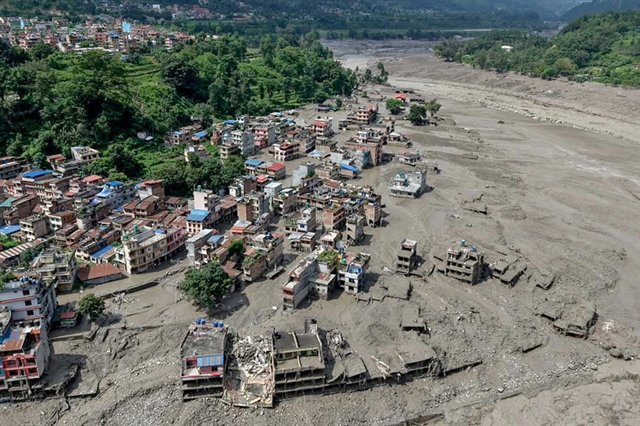 |
| Buildings near Nepal's border with Tibet were buried in a deadly flood that left hundreds missing. — AFP /VNA Photos |
BIDUR — Rescue teams waded through mud on Thursday searching for more than 1,400 people missing after flash floods and landslides struck the Nepal-China border, as the death toll rose again to 392, with entire villages swept away.
Experts warned of the risk of further floods a day after the devastating tsunami-like wall of freezing water and mud wiped out towns under a torrent of sludge, engulfing homes, smashing bridges and dams, and sweeping vehicles away like toys.
Many of the missing are foreign tourists, including trekkers in the Himalayan nation, as well as scores of Hindu pilgrims to sacred snow-capped Mount Kailash in China's Tibet region.
The US Geological Survey (USGS) said the disaster was caused by a glacial collapse that triggered a vast flow of icy debris.
Climate change is causing glaciers to melt worldwide, increasing the risks of glacial lake floods and glacial collapses.
Emergency teams were racing to pluck survivors from affected zones, while Nepali soldiers used sniffer dogs to search for bodies buried under the suffocating dirt.
"It is a giant graveyard," said Omkar Joshi, a 35-year-old Nepali customs agent rescued from a hilltop in the border town of Timure. "All that is left are sand and pebbles, soaked red by human blood."
Nepali police said they had recovered 389 bodies.
Another 910 people, including 517 foreign tourists, were out of contact in the country. China said 100 Chinese citizens – not accounted for in that tally – are also missing in Nepal.
Indians make up the largest number of missing foreigners, while the United States said 90 of its citizens were out of contact.
In China, state media said the "mudslide disaster" at the Gyirong Port in Tibet killed three people, while 558 people, including 260 foreigners, are missing.
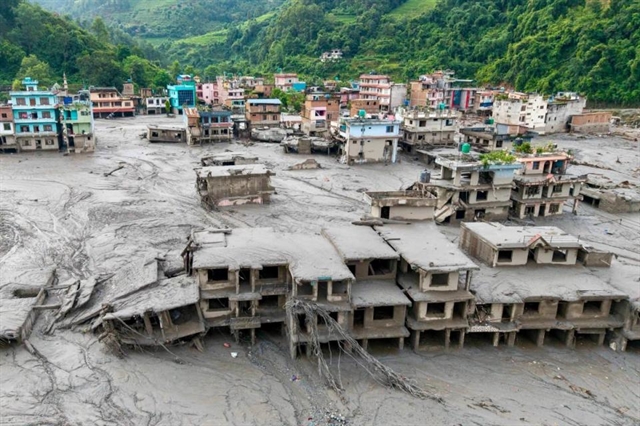 |
| An aerial view shows houses lying deluged in sludge after flash floods at Devighat, Bidur Municipality in Nepal's Nuwakot district. |
Chinese Premier Li Qiang visited the area on Thursday, state media said, to oversee relief work.
'Inland tsunami'
Prime Minister Balendra Shah, who urged the nation to "stand together" hours after the disaster, toured some of the hardest-hit areas on Thursday.
Shah told local authorities to "provide immediate relief to displaced families" and to open blocked roads, his office said in a statement.
Other foreigners out of contact include citizens from Australia, Britain, Malaysia, the Netherlands, Portugal, South Africa and South Korea, Nepal's tourism board said.
The sudden rush of mud and debris was "like an inland tsunami", travelling nearly 170 kilometres south into Nepal, said environmental historian Ruth Gamble, of Australia's La Trobe University.
Chinese government officials in Tibet mobilised nearly 800 emergency workers, as well as sniffer dogs and speed boats to help the rescue efforts, the official Xinhua news agency said.
Promises of aid and assistance began to trickle in soon after reports of the scale of the disaster.
Glacial collapse
The USGS said a glacial collapse caused seismic activity and had "catastrophic" downstream impacts in Nepal and China's Tibet.
"This event was initially reported as a magnitude 4.4 earthquake," it said, but the seismic recordings were analysed and it was found instead to be a "glacial collapse and debris flow".
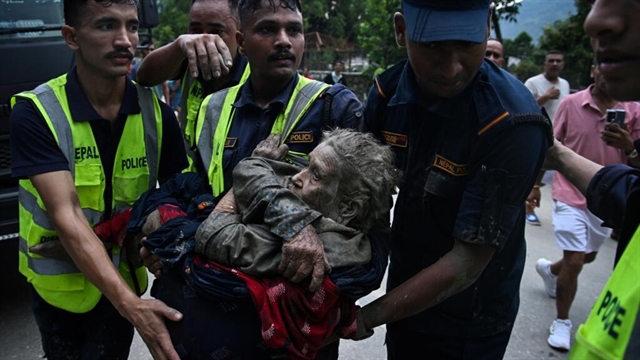 |
| Rescuers carry a flood survivor in Nepal's Devghat, as search efforts continue for hundreds of missing people. |
Fears of more potential floods remain, with water trapped by the immense piles of debris blocking the valley.
"With a blockage still lodged upstream on the Nepal-China border river, authorities warn a second flood may occur," said Qianggong Zhang, head of climate and environmental risks at the Kathmandu-based International Centre for Integrated Mountain Development.
Kathmandu's Flood Forecasting Division issued a "special notice" on Thursday, warning of a growing lake behind debris left by the landslide and urging extreme caution.
Scores of Hindu devotees from across the world are among the hundreds missing on the border, Indian spiritual leader Sadhguru said on Thursday.
They were returning from a holy pilgrimage to Mount Kailash, on the Chinese side of the frontier, when they were caught in the floods at an immigration post.
"The entire group was there in the building," Sadhguru said in a video message to his millions of followers, weeping as he spoke from Tibet, with the anguished wails of other pilgrims heard in the background.
"This is a terrible and extraordinary event."
The Red Cross launched an emergency appeal for US$31 million on Thursday to respond to the devastating flash floods and landslides that struck the Nepal-China border.
The Switzerland-based International Federation of Red Cross and Red Crescent Societies (IFRC) launched the appeal for 25 million Swiss francs the day after releasing one million francs to support the immediate lifesaving response.
The appeal is to cover emergency disaster response followed by supporting the medium and long-term recovery, over the next two years.
"While we are getting a clearer picture of the scale of devastation, we know that entire villages were washed away and needs will grow in the coming hours and days," IFRC secretary general Jagan Chapagain said in a statement.
"Communities that have lost homes and livelihoods will need sustained support as they recover and rebuild."
The devastating tsunami-like wall of freezing water and mud wiped out towns under a torrent of sludge, engulfing homes, and smashing bridges and dams on Wednesday.
"Current estimates suggest around 93,000 people may have been affected, while assessments continue in hard-to-reach areas," the IFRC said.
"The remoteness of the affected areas, combined with damaged infrastructure, is making it harder both to assess the full scale of the disaster and to deliver assistance to people who need it most."
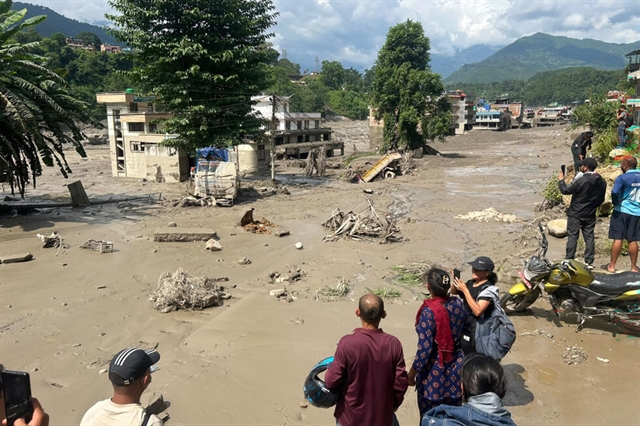 |
| Homes were submerged in Nepal after a flood on the border with China's Tibet. |
The appeal will support the local Nepal Red Cross team's response with shelter, cash assistance, household relief items, water, sanitation and hygiene, mental health and psychosocial support, and restoring family links.
NRC crews have already been providing food, water and emergency supplies including tarpaulins, blankets, first aid kits, stretchers and body bags, the IFRC said.
Australia's Foreign Minister Penny Wong acknowledged on Friday it was "difficult" to locate citizens out of contact in Nepal following deadly flooding.
The number of Australian nationals missing following the floods has risen to 39, Wong told the Today Show.
"We know many people have been killed, many people are missing and the scale of the disaster is quite horrific," Wong said.
Australia's foreign ministry has about 20 people on the ground in Nepal, she said, and will "build on that over the coming days".
The country will spend A$5 million ($3.6 million) on humanitarian assistance for flood relief, she added. — AFP
World
 World
World
 World
World
 World
World
 World
World
 World
World
 World
World
 World
World
 World
World
 World
World
 World
World
 World
World
 World
World
 World
World
 World
World