SCEX completes level 4 information system security assessment, moving closer to official operations
1.
|
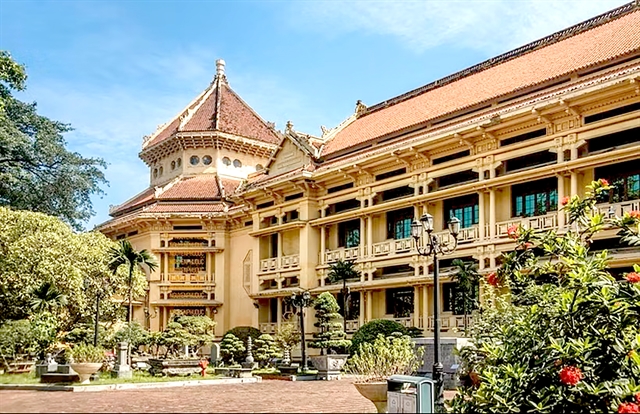
| The Vietnam National Museum of History is housed in a building featuring Indochina-style architecture. — Photo courtesy of the museum |
This year marks a special milestone for the Vietnam National Museum of History (VNMH): the 80th anniversary of President Hồ Chí Minh’s first visit to the museum.
Located in downtown Hà Nội, the institution has not only preserved tangible evidence of the nation’s history but also serves as a unique space for safeguarding and promoting Việt Nam’s cultural heritage across generations.
On November 23, 1945, just over two months after reading the Declaration of Independence, President Hồ signed a decree on the preservation of antiquities throughout Việt Nam.
Article 4 of the decree stated: “The preservation of all antiquities throughout Việt Nam is required, and the destruction of communal houses, pagodas, temples, shrines, antiques, citadels, ramparts, tombs, royal decrees, official documents and other objects of historical value is prohibited.”
At a time when the country had only just won independence and the revolutionary government faced immense difficulties, one of its earliest decrees on heritage preservation demonstrated President Hồ’s foresight and vision for the nation’s history and culture.
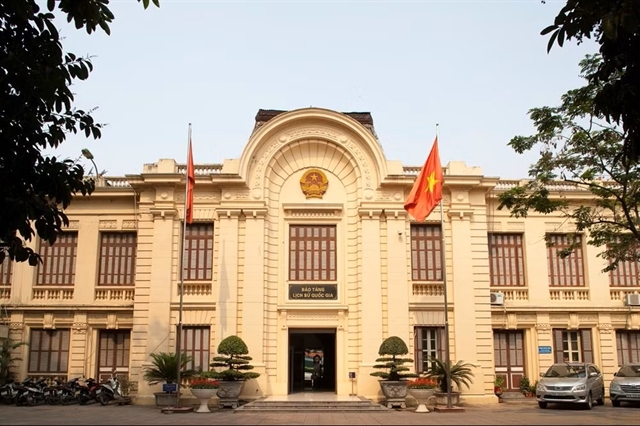
Along with the issue of the decree on heritage preservation, the Louis Finot Museum of the French École française d’Extrême-Orient, built in 1926 and inaugurated in 1932, was transformed into the National Museum in 1945–46, the predecessor of the Việt Nam Museum of History (VMH).
On February 9, 1946, President Hồ attended the opening of the exhibition Historical Documents on Vietnamese Culture at the museum. This was his first visit to the institution, which is now part of the VNMH.
According to Nguyễn Văn Cường, former director of the VNMH, the visit was particularly significant. In the early days of the Democratic Republic of Việt Nam, when the country was grappling with numerous urgent challenges, President Hồ still made time to focus on preserving evidence of the nation’s history and culture.
|
| The Vietnam Revolution Museum, now part of the Vietnam National Museum of History. — Photo courtesy of the museum |
The museum was thus regarded not merely as a repository of artefacts, but also as a place for educating people about history and culture and fostering a sense of national identity and connection to their roots.
After 1954, the Party and Government continued to prioritise the development of museums. The VMH was established on the basis of the facilities, documents and artefacts inherited from the Louis Finot Museum.
Following a period of research, collection and acquisition of documents and artefacts, and the transformation of the institution from an art museum into a history museum, the VMH officially opened to the public in September 1958.
Four years earlier, a Government Council meeting chaired by President Hồ had approved the establishment of a museum to be named the Museum of the Revolution.
On January 5, 1959, he visited the museum to preview its displays ahead of its official inauguration as the Vietnam Revolution Museum (VRM) the following day. With their distinct themes, collections and histories, the two national museums became important institutions for preserving the nation’s collective memory.
In 2011, the VNMH was established through the merger of the VMH and the VRM, marking a continuation of the long-standing work of collecting, preserving, researching and promoting the value of cultural heritage.
|
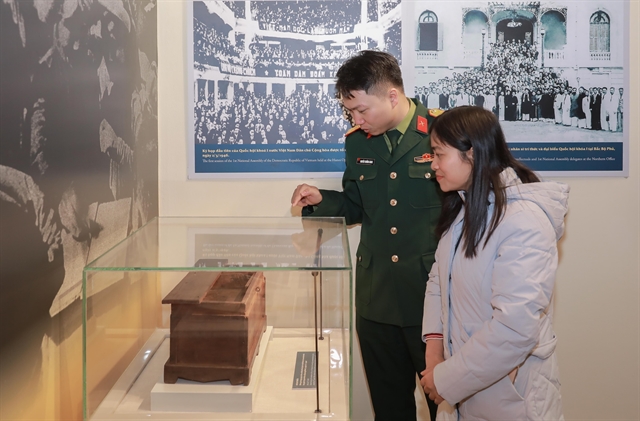
| Visitors examine a historical artefact — a ballot box used in Quảng Bình Province during the election of the first National Assembly on January 6, 1946. — Photo courtesy of the museum |
Enduring lessons
A distinctive feature of the VNMH is its deep connection with President Hồ. During the existence of its two predecessor museums, he visited them seven times to view exhibitions, talk with staff and give guidance on their content and methods of operation.
|
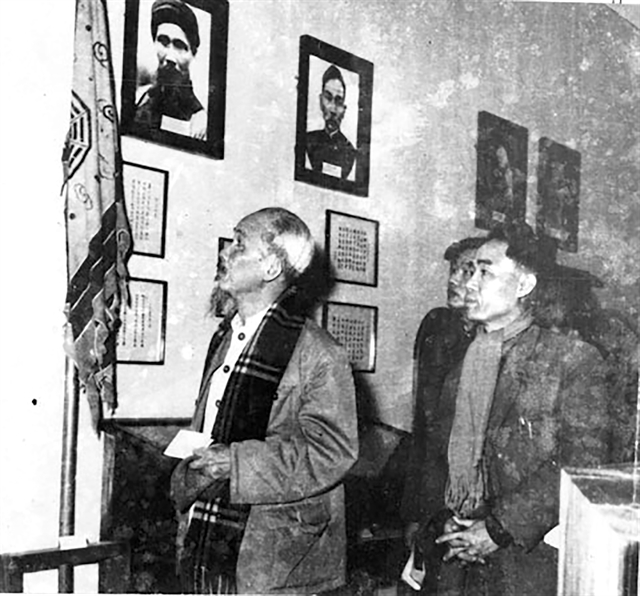
| President Hồ Chí Minh is pictured on his second visit to the museum on January 5, 1959. — Archive photo courtesy of the Việt Nam National Museum of History |
President Hồ Chí Minh is pictured on his second visit to one of the VNMH's predecessor museums on January 5, 1959. — Archive photo courtesy of the Vietnam National Museum of History
On his second visit in 1959, he presented the museum with a tortoiseshell comb, a keepsake given to him by his sister Nguyễn Thị Thanh, so that it could be preserved and displayed to the public.
Over two months later, the President visited the museum with Indian President Rajendra Prasad. He personally explained to his guest how pieces of artillery were hauled up to steep mountains by soldiers using their own strength during the Điện Biên Phủ Campaign.
He visited the museum again on June 25 of the same year with Indonesian President Sukarno, during which he made a remark to a museum guide about Vietnamese scholar and patriot Phan Chu Trinh, which became a profound lesson in the interpretation of history.
When the guide introduced Trinh as a leading advocate of reformism in Việt Nam's early 20th-century patriotic movement, President Hồ said: “Phan Châu Trinh was truly a patriot.” His response underscored the need for care, objectivity and depth when presenting historical figures and events.
On July 4, 1959, writing under the pseudonym T.L., President Hồ published an article entitled Visiting the Museum of the Revolution in Nhân Dân (People) newspaper. He emphasised the educational value of museums, noting that a well-guided visit could teach visitors a great deal about revolutionary history.
|
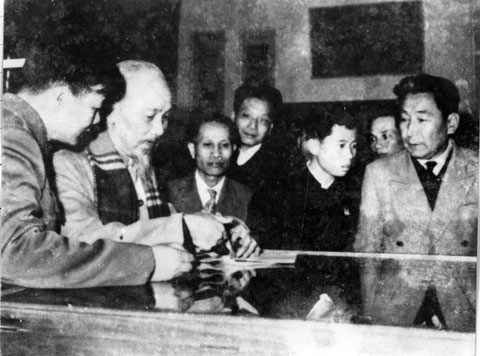
| President Hồ Chí Minh (2nd left) views a display cabinet featuring gifts from people in southern Việt Nam at the Việt Nam Revolutionary Museum, now the Việt Nam National Museum of History, on January 5, 1959. — Archive photo courtesy of the Việt Nam National Museum of History |
President Hồ Chí Minh (second from left) views a display cabinet featuring gifts from people in South Việt Nam at the Vietnam Revolution Museum, now part of the Vietnam National Museum of History, on January 5, 1959. — Archive photo courtesy of the Vietnam National Museum of History
He advised: “In short, visitors to the museum should not only look at the exhibits but also reflect on them and relate what they see to themselves. Those responsible for guiding visitors should clearly explain the revolutionary significance of the exhibits. This would be highly beneficial.”
Presentation is key
In the VRM's commemorative book, President Hồ wrote: “With well-arranged exhibits and clear explanations, the museum is an excellent school for learning about the revolutionary history of our Vietnamese nation.”
These guiding principles have stood the test of time, becoming enduring tenets of museum practice: artefacts must be placed within their historical context; exhibitions must be clear and accessible; and museum guides must be knowledgeable and able to tailor their explanations to different audiences.
The President visited the VMH on February 13, 1961, when he closely examined the decorative patterns on the ancient Ngọc Lũ bronze drum, and then visited again on March 13, 1963, and October 21, 1964, with King Sisavang Vatthana of Laos and Malian President Modibo Keïta, respectively. On these visits, he paid particular attention to keeping the exhibition content up to date.
While viewing the Revolutionary Movement in Southern Việt Nam gallery, he called for its content to be revised and supplemented. He also offered suggestions on the layout of diagrams and gallery signage to help visitors navigate the museum more easily.
Notably, while listening to a presentation on the victory at Điện Biên Phủ, he reminded the museum’s guides to keep their explanations concise and focused, getting straight to the point and taking visitors’ time constraints into account. He then personally delivered a presentation in French lasting about seven minutes.
These accounts show that President Hồ was concerned not only with preserving artefacts but also with how they were presented to the public. For him, a museum could only fulfil its true purpose when visitors could understand and reflect on what they saw and find connections between the exhibits, history, their own lives and their personal responsibilities.
This remains the enduring value of the VNMH today. Over time, collections may be expanded, exhibition methods may evolve and technology may offer new ways of engaging with the past, but the fundamental goal remains unchanged: to make history accessible, relatable and thought-provoking for the public.
“Building on these foundations, the VNMH is not only a repository for the nation’s precious artefacts but also an institution for research, education and cultural communication," said Nguyễn Văn Đoàn, director of the museum.
"It connects the past with the present, helping each generation gain a deeper understanding of the country’s formation and development." VNS
 Sunday/Weekend
 Sunday/Weekend
 Sunday/Weekend
 Sunday/Weekend
 Sunday/Weekend
 Sunday/Weekend
 Sunday/Weekend
 Sunday/Weekend
 Sunday/Weekend
 Sunday/Weekend
 Sunday/Weekend
 Sunday/Weekend
 Sunday/Weekend
 Sunday/Weekend