 Sunday/Weekend

SCEX completes level 4 information system security assessment, moving closer to official operations
1.
|
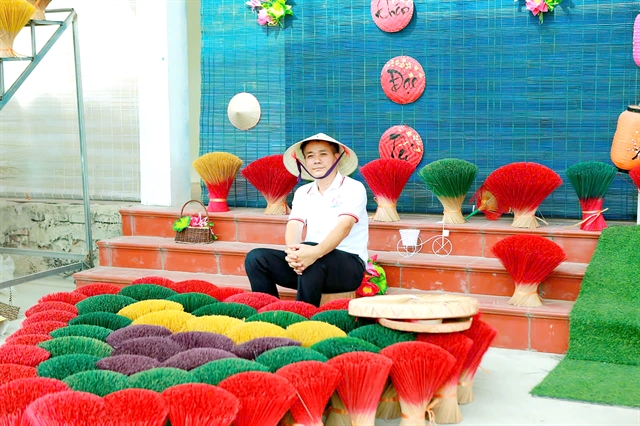
| Nguyễn Tiến Thi, a master artisan of the Xà Cầu Incense Cooperative, poses with bundles of incense sticks, the traditional product of Xà Cầu Village on the outskirts of Hà Nội. Photo by Nguyên Hạnh |
At the traditional incense village of Xà Cầu on the outskirts of Hà Nội, craftspeople are making concerted efforts to maintain the trade, secure local livelihoods and spread traditional cultural values. A master artisan of the Xà Cầu Incense Cooperative, Nguyễn Tiến Thi, spoke to Việt Nam News reporter Trần Như about ongoing efforts to preserve the traditional craft future development strategies for the village in the modern era.
With its long history of incense making, what has enabled residents to preserve the tradition across generations?
Incense-making here has been passed down through generations and is deeply intertwined with the spiritual life of the Vietnamese people. In 2003, Xà Cầu black incense craft village in Ứng Thiên Commune was officially recognised as a traditional craft village.
My family has been involved in the craft for four generations, and I personally have nearly 20 years of hands-on experience in incense production. In 2016, we founded a cooperative to preserve the heritage of our forebears, create stable jobs for our members, and contribute to safeguarding the traditional values of our homeland.
In my view, preserving the craft must first and foremost stem from a love of and deep appreciation for the profession. Producing incense is not merely an economic activity; it is closely linked to ancestral worship customs and the spiritual culture of the Vietnamese people. Therefore, even during difficult market conditions, we have steadfastly persevered, maintained production and sought ways to develop the craft.
Amid a market flooded with mass-produced products, what unique characteristics allow Xà Cầu traditional black incense to maintain its appeal among consumers?
Black incense is produced according to a time-honoured family recipe, using two primary ingredients: nhựa trám (elemi resin) and finely ground charcoal. Our production process uses no artificial fragrances or chemical scent enhancers.
We have always believed that incense-making is a vocation tied to spiritual life; therefore, integrity and conscience must come first, along with a focus on quality and the preservation of traditional techniques. An incense stick serves not only a practical purpose but also evokes cultural values, familial affection and gratitude to ancestors.
Toward the end of the year, market demand typically surges as people prepare for traditional rituals and festive breaks. This year, our cooperative's sales rose by approximately 30 per cent compared with last year, yet at times supply still fell short of demand. We had to work overtime and run night shifts to keep up with deliveries.
While this creates production pressure, it is also a heartening sign that traditional products continue to be embraced by consumers. However, for long-term development, the craft village cannot rely solely on seasonal spikes; we must continually improve quality, build our brand reputation, and cultivate more stable, year-round markets.
What role does branding play in preserving and developing traditional craft villages?
Building and obtaining legal protection for the collective trademark Xà Cầu Incense with the support of Hà Nội authorities and local administration, hold immense significance for us. The trademark is not only a source of pride, but also an opportunity for the product to establish a distinct market identity.
Once the trademark is protected, consumers gain a reliable basis for recognising authentic craft village products, which helps curb confusion regarding product origin. This also creates the conditions for our cooperative to strengthen its credibility, promote our offerings and progressively expand distribution channels.
Preserving craft villages must go hand in hand with economic viability. If finished goods lack a viable market, workers can hardly sustain production, and the younger generation will have little incentive to carry on the craft. Therefore, alongside safeguarding traditional formulas and artisanal techniques, we must focus more on brand promotion, sales networks, and shaping the product image.
I hope craft village support initiatives will continue prioritising trade promotion and showcasing products at cultural events, trade fairs and through appropriate media channels. Through these efforts, the cultural and economic value of Xà Cầu incense can transcend the local market and reach a broader consumer base.
Do you have plans to link the preservation with tourism and experiential activities to promote the craft?
I believe developing craft village tourism is a fitting approach, as visitors want not only to buy products but also to discover the story, history, and craftsmanship behind them.
The locality currently has designated areas for display, photography and craft promotion that draw both domestic and foreign tourists. Many visitors have come to tour the workshops, explore the production process, and try their hand at making incense on-site. We are always glad to welcome and guide guests free of charge, as we simply wish to share and spread the traditional values of our homeland.
At present, our cooperative still focuses primarily on manufacturing. However, if structured initiatives are developed to connect us with local authorities, tour operators, or craft village experience-based tours, we are ready to participate.
I believe that if organised professionally, tourism will create more opportunities to promote our products and help locals generate supplementary income. Through experiential activities, visitors can better appreciate the artisans’ dedication, the raw ingredients, the incense-making techniques, and the cultural significance of the product in Vietnamese spiritual life.
To achieve this, close coordination among residents, cooperatives, and local authorities is essential to establish reception areas, showcasing products, ensuring environmental sanitation and creating suitable experiential spaces.
What are your expectations for the future of the Xà Cầu craft village and Hà Nội's traditional craft villages in general?
We hope that the incense-making craft will continue to thrive, gain access to broader markets, and provide stable employment for locals. Crucially, the younger generation must understand the value of this traditional heritage and recognise genuine career opportunities within it so that they remain committed to carrying the craft forward.
Preserving craft villages does not mean adhering rigidly to every old method. Instead, it requires preserving core artisanal values while innovating in promotional methods, production models and market engagement strategies. When products maintain consistent quality, when the brand achieves clear recognition and when artisans earn a dependable living, the preservation of the craft gains a truly sustainable foundation.
For us, every stick of incense is not merely a commercial product; it carries stories of the trade, family traditions and long-standing Vietnamese customs. Our greatest aspiration is to keep the flame of the craft alive, ensuring that Xà Cầu incense not only serves contemporary life but is also recognised and cherished by generations to come.
I hope the craft village will have more opportunities to participate in Hà Nội's broader cultural initiatives, tourism circuits and trade promotion programmes, thereby safeguarding our traditional heritage while actively contributing to local economic growth. VNS
Sunday/Weekend
 Sunday/Weekend
 Sunday/Weekend
 Sunday/Weekend
 Sunday/Weekend
 Sunday/Weekend
 Sunday/Weekend
 Sunday/Weekend
 Sunday/Weekend
 Sunday/Weekend
 Sunday/Weekend
 Sunday/Weekend
 Sunday/Weekend
 Sunday/Weekend
 Sunday/Weekend