 Sunday/Weekend

ECO Expo Asia opens at Hong Kong AsiaWorld-Expo in late October
1.
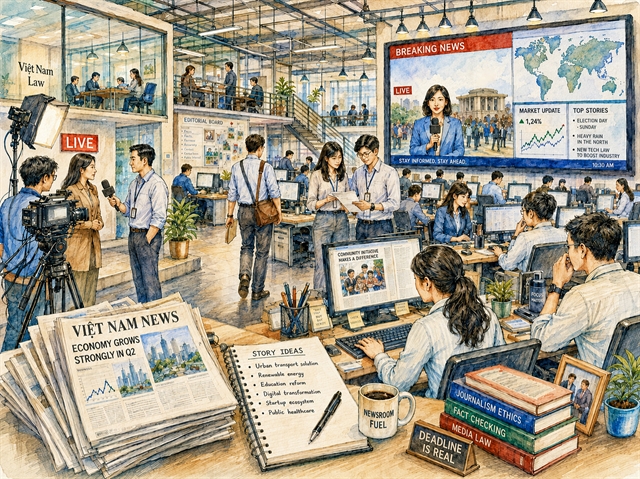 |
| Charting a course through downsizing and technological change, the newly merged newsroom steers towards the future. Art by AI |
by Nguyễn Mỹ Hà
Steering journalism as we know it into the era of AI means battling fake news, psychological manipulation, public disorientation and finally, twisted truths while continuing to deliver the real-life stories of Việt Nam to the world.
Amid the ever-increasing pressure to break the latest stories, fierce competition from other online platforms and social media, newsroom contingents continue to shrink, merge and multitask more than ever before, and the quality of news may suffer.
As news becomes more of a flash flood than a steady stream, Việt Nam News cannot stay outside the main current. It must adapt to new circumstances, while upholding its traditions and continuing to provide a fresh platform for people's voices in Việt Nam.
Bridge abroad
During its 35 years of existence, the original print tabloid grew to function as a serious broadsheet, expanding from providing news for the expat community in Việt Nam in the early 1990s to its current role as a trustworthy, influential and authentic voice in the region.
The paper's first seven years defined it as the daily print newspaper we see today. From primarily reporting on official decisions by the Government, Party resolutions and mainstream policies, topics covered in Việt Nam News widened, embracing the voices of the people as the driving force behind the strengths of the country and its Government.
Founded in 1991 on a hot summer day in June, the first office of Việt Nam News was on the second floor of a French villa. It lacked many of the facilities a newspaper needed, but it had the best possible team of graduates in English from top Vietnamese colleges, who worked under the leadership of people sharing a vision: to report on the current issues in Việt Nam and publish news of the world provided by major Western news agencies including AP, AFP and Reuters.
At the time, Vietnam News Agency's General Director Đỗ Phượng was the nominal Editor-in-Chief. However, most of the work was led by Nguyễn Công Khuyến, known by staff as Mr K. He became Việt Nam News' Editor-in-Chief shortly afterwards, with a dozen-strong team of men and women working day in, day out in a newsroom full of typewriters and paperweights and cooled only by ceiling fans.
The first paper was published in mid-June, and in August a massive story broke in Moscow with signs of the then-Soviet Union falling apart. To keep up with the latest on this world-shattering story, news had to be fetched by hand via bicycle from the international desk at the VNA headquarters during the rainy season and into typhoon season. When the story finally died out, the newsroom secretary was rushed to hospital for exhaustion.
On its third anniversary, Việt Nam News began international cooperation with a media corporation from Thailand, the Manager Group, which invested in office upgrades. The newsroom saw new personal computers replacing the old typewriters, and soon it was refurbished with all-glass windows, carpeted floors and air conditioners to cool the summer Hà Nội heat for the machines. Staffers also benefited from the air conditioning, but on occasion someone would open all the windows to get fresh air, leading to a fight as steady temperatures had to be maintained for the expensive cooling system.
“You can adjust, but the machines cannot. Just walk outside to get some fresh air if you need it,” the chief tech officer ruled. No more complaints!
In 1999, before his retirement, Mr K made Việt Nam News a founding partner of the first alliance that formed the Asia News Network (ANN) in Bangkok, which included six other English-language newspapers in Southeast Asia.
The next Editor-in-Chief, Trần Mai Hưởng, was a long-time VNA war correspondent following the Hồ Chí Minh Campaign to Sài Gòn in April 1975. His strength as a reporter and his signature photo of the tank entering Independence Palace put the seal of approval on his career, marking him as someone who put himself on the front line of his country’s defining moments.
During his tenure, staff gained more professional journalism training. As graduates in English, they went on to use these skills to tell more in-depth stories, conduct interviews, write profiles and commentaries, and respond to readers' letters.
Digital shift
Việt Nam News saw even more vigorous growth in the many years leading up to its 20th anniversary.
In 2003, general news magazine The Outlook hit newsstands and immediately became an authoritative voice from Việt Nam. It was catalogued in the United Nations library in New York City. Contributors and subscribers wanted to buy monthly copies of the magazine on international Vietnam Airlines flights, in airport business lounges and as study materials for college students. Copies were mailed from Việt Nam to France, the US and Australia, as former war opponents gradually became trading partners.
As the staff grew to 100 people with offices in the country's three biggest cities, the management at the time and everyone else saw great success well into the paper's next chapter of growth.
But setbacks started to arise a couple of years later. The financial crisis that broke out in 2008 continued taking its toll well into 2011. As the paper celebrated 20 years of existence, its success was applauded and awarded, but staff had no idea of the hard times awaiting them ahead.
The next Editor-in-Chief, Trịnh Thanh Thuỷ, was the first woman to do this job and had perhaps one of the most difficult jobs yet, helming the ship in a time of crisis and cutbacks.
Under the umbrella of the State-run Vietnam News Agency, Việt Nam News was a government establishment and had to function under the administrative regulations of a government agency, but its business side also had to adhere to market conditions, and its finances were audited as for any other business entity.
The downsizing of magazines and newspapers in the market, the rise of online platforms and the e-commerce explosion drove traditional advertising clients elsewhere for cheaper ways to reach multitudes of people.
One of the hardest cuts to make in the push to lower production costs was to stop printing The Outlook magazine in 2013, after 10 years of serving readers.
As the old saying goes, misfortunes never come alone. During the COVID-19 pandemic, one Việt Nam News reporter tested positive for the virus. She was immediately hospitalised, and five others had to be quarantined at home and at the hospital to stop the virus' spread.
With the office closed, the paper had to resort to publishing online only for a fortnight. The reporter in question never developed any serious symptoms of the disease, and after 21 days was released from hospital with a bouquet of flowers on national television.
Not everyone was so lucky, as the virus strain ended up killing 40,206 people in Việt Nam, about 0.4 per cent of all infected cases, among 14.9 million deaths worldwide according to the World Health Organization.
New era
This month Việt Nam News marks its 35th anniversary, one year after it merged with Vietnam Law & Legal Forum, a magazine also published by the VNA, in its latest reshuffle and internal reorganisation.
In 2025, the Government issued a decree making English the second language in the Vietnamese school system under a 10-year programme through 2035. The new Việt Nam News & Law will be among the drivers of this movement to integrate the country further with the rest of the world.
.JPG) |
| SEA-ING THE NEWS: Soldiers stationed on one of the islands on the Trường Sa (Spratly) archipelago browse Việt Nam News. VNS Photo |
Today, schoolchildren in many cities can communicate freely and easily in English. Access to the internet, with English songs and lessons, films and online classes, also helps in this process.
The National High School Graduation Examination can be extremely hard, even for native speakers. Language used to be a means to open doors to new opportunities, but what’s even more important is discovering what to tell the world in the language.
While using this newest tool to integrate globally, we still need to remember our roots and traditions, our Vietnamese culture. This way we can keep the values that Việt Nam needs to maintain as a nation, and set an example for any other countries that want to keep pace globally while also maintaining their age-old customs and history.
Using the English language in school can help children tell Việt Nam's story, while treasuring the sacrifices made by their forefathers to build a peaceful and prosperous country. Learning the latest technology will not abolish traditions, but only enhances them, so young people can appreciate the lessons, craft and morale that generations of Vietnamese people continue to build through previous wars and now through a time of peace.
However, Vietnamese people should be careful of buying into false information generated by AI, which does not protect their values. AI is not the goal; AI serves as the tool, the means to better tell the Vietnamese story of how independence must be maintained, how freedom was won with such immense sacrifices, so children and their children can enjoy living in peace, learn English and tell the world about Việt Nam.
Over 100 years ago, Gia Định Báo, or the News of Gia Định, was the first newspaper published in Vietnamese, the romanised script used by Portuguese missionaries. It was initially an official newsletter, with an aim of publishing French colonial government decrees and announcements, new laws and rules. Later, a section published other news on a variety of subjects, including politics, economics and local life and culture.
The romanised script gradually gained popularity in French Cochinchina because the traditional Han script was difficult and largely confined to scholars and literary circles. The vast majority of the population could neither read nor write, with an illiteracy rate of 90 per cent recorded in 1945.
Human edge
Just one week after the Declaration of Independence, the Hồ Chí Minh Government declared war on illiteracy and launched a nationwide literacy movement. The national budget could afford to pay only 1,000 teachers, although 100,000 were needed.
 |
| DANCING QUEENS: Việt Nam News reporters from across the newsroom show off their dancing skills at an event marking the 74th anniversary of the Vietnam News Agency. VNS File Photo |
Graduates of the first teacher-training classes went on to teach others. Three months later, half a million people could read and write, and by the end of 1946, six million people had become literate. Teachers volunteered their services, and illiteracy was defeated through this low-cost yet highly effective approach.
If teaching English borrowed from this method, then students in Việt Nam will gain a better command of the English language. Then, Việt Nam News & Law would be scrutinised even more, as it gained more and smarter readers.
Whether readers or writers, both sides will benefit. And the newspaper’s staff will not simply stand by and watch; they will roll up their sleeves and get to work. If more people learn to use AI effectively and provide accurate information, it will generate better results. But AI cannot breathe a soul into its work. Humans must remain in charge of the tools, rather than allowing the tools to take charge of them. — VNS
Sunday/Weekend
 Sunday/Weekend
 Sunday/Weekend
 Sunday/Weekend
 Sunday/Weekend
 Sunday/Weekend
 Sunday/Weekend
 Sunday/Weekend
 Sunday/Weekend
 Sunday/Weekend
 Sunday/Weekend
 Sunday/Weekend
 Sunday/Weekend
 Sunday/Weekend
 Sunday/Weekend