 Sunday/Weekend
Data centre market faces energy challenges
1.
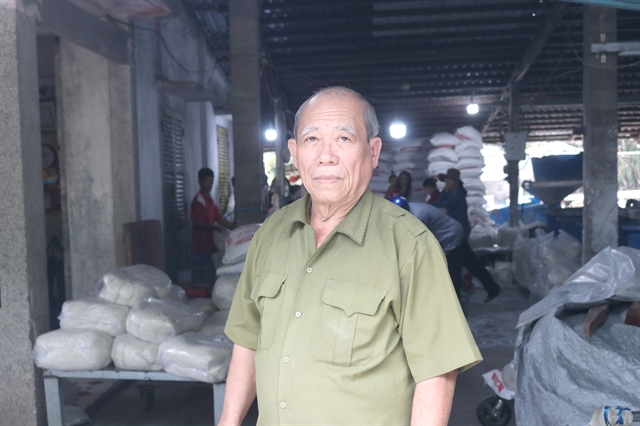 |
| Trương Văn Thuận, an artisan who has spent more than four decades preserving and developing the craft of making the famous Mỹ Tho noodles. — VNS Photo Hồng Linh |
Trương Văn Thuận, now in his 70s, has practised the traditional craft of Mỹ Tho rice noodle making since 1983 and leads a production cooperative in Mỹ Phong Ward, Đồng Tháp Province. He shares with Việt Nam News insights into the noodle-making process and the challenges of preserving the craft.
Could you tell us how the famous Mỹ Tho noodles are created?
The process starts with soaking the rice in vats of clear water so the grains can expand and be cleaned. After soaking, we put the rice into a grinder to turn it into batter.
The wet rice flour is then separated from the water and soaked in saltwater overnight until it settles to the bottom. The next morning, we change the saltwater and repeat the process. We keep the salt concentration at about one to two per cent, which helps avoid sourness.
Early in the morning, the treated wet rice flour is cooked using a machine. We mix a little arrowroot powder into the thick rice batter, and the machine automatically pumps it up, spreads it onto bamboo boards and runs it along a conveyor belt.
By the time it reaches the other end, the sheets come out cooked. The batter forms thin sheets on the boards.
We put these bamboo boards out to dry in the sun during the morning. If the light is favourable, the process takes about three hours. We have to check them regularly while they are drying to make sure the rice sheets do not dry out too much and stay chewy.
Once the rice sheets are dry enough, we collect the boards and peel the sheets off. We coat these rice sheets with a thin layer of oil so they do not stick together. After that, we put each sheet through a machine to cut it into thin strands.
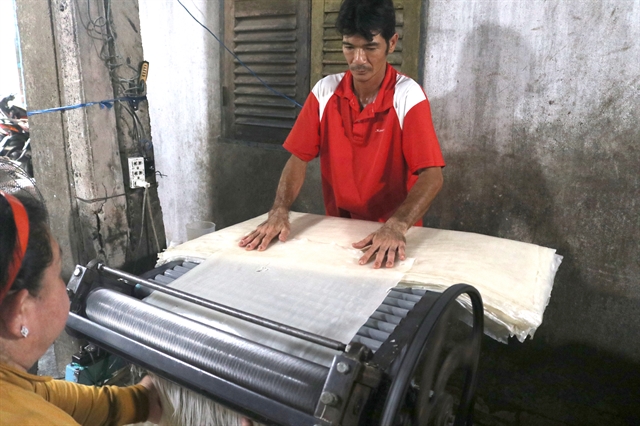 |
| A worker at Thuận's workshop operates a machine used to cut dried rice starch sheets into the signature Mỹ Tho noodle strands. — VNS Photo |
A finished noodle product that meets quality standards must have a translucent colour and a chewy texture.
What difficulties have you faced during your career making the famous Mỹ Tho noodles?
When I first started in the rice noodle trade, it was very difficult. There were no lights or proper roads here, and every stage of the production process was done by hand.
The journey has seen many ups and downs. There were periods when the price of input materials equalled the output price. We were losing money, but we still tried to keep the business going.
Furthermore, since the noodles are largely produced by hand, we are impacted heavily by the weather. If there are storms or rain, we cannot dry the rice sheets in the sun and must use the drying kiln, which takes considerable time and effort.
However, even though this work is hard, it keeps people employed and ensures the livelihoods of locals.
Given the many difficulties of producing and selling Mỹ Tho noodles, have you had any support to keep the craft alive?
In 2007, the local government recognised the traditional rice paper and rice noodles craft, and our Mỹ Tho rice noodle production cooperative was established at the same time.
From that point, the production group obtained the trademark of "Hủ Tiếu Mỹ Tho Đặc Sản Truyền Thống" (Mỹ Tho Noodles, a Traditional Speciality) as a nationally recognised exclusive brand.
Local authorities have also provided support through preferential loans and helped introduce our products in promotion programmes and festivals.
They helped us adapt and implement production technology, enabling the facilities here to combine manual work with machines in production. Some workshops have fully switched to fully mechanised production, helping them avoid the impact of weather.
Furthermore, many newspapers and television stations have come here to report on and promote this profession to the public.
My children have gone to other places to study and develop their own careers, so they are not continuing with this job. This profession is too hard and they are not interested in it.
I am old now and have plans to retire, but I will continue this work for as long as I can. — VNS
Sunday/Weekend
 Sunday/Weekend
 Sunday/Weekend
 Sunday/Weekend
 Sunday/Weekend
 Sunday/Weekend
 Sunday/Weekend
 Sunday/Weekend
 Sunday/Weekend
 Sunday/Weekend
 Sunday/Weekend
 Sunday/Weekend
 Sunday/Weekend
 Sunday/Weekend
 Sunday/Weekend