 Sunday/Weekend

Doctor brings hope to infertile couples in Lào Cai
1.
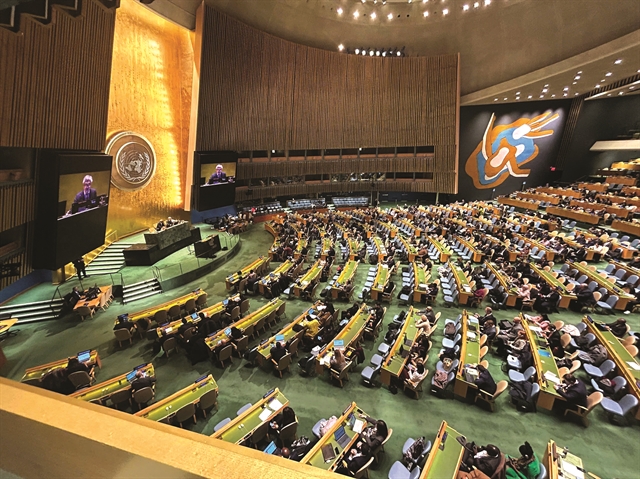 |
| The United Nations General Assembly adopted its Convention on Cybercrime by consensus in December 2024. VNA/VNS Photo |
Nguyễn Hữu Phú, deputy director general of the Department of International Law and Treaties at the Ministry of Foreign Affairs, speaks to Việt Nam News ahead of the signing ceremony of the Hanoi Convention, the United Nations’ first global treaty on cybercrime. He discusses the nearly two-decade journey leading to the convention, Việt Nam’s active role in shaping it, and the country’s growing influence in global digital governance.
Could you give an overview of the UN Convention Against Cybercrime, also known as the Hanoi Convention, and share how Việt Nam has contributed to shaping this important international agreement?
Discussions within the UN on cyberspace and the eventual negotiation of a convention on cybercrime have been a process spanning almost 20 years.
The UN General Assembly first became interested in the issue in 1998, when it decided to establish a working group to discuss matters concerning cyberspace security. For more than a decade, the UN explored how to respond to the rapid growth and complexity of cyberspace. At that time, countries had not yet reached a shared understanding of how to approach the issue.
Europe was the first region to act, introducing the Budapest Convention on Cybercrime in 2001. That experience demonstrated that cyberspace could indeed be governed by international law. By 2010, the UN Crime Congress had agreed that the organisation should pay greater attention to cybercrime.
In 2013, the UN Office on Drugs and Crime issued a comprehensive study on cybercrime, stressing the need for a new global legal instrument to address it. There was significant debate over this proposal but, by 2019, member states recognised the urgent need for an international legal framework to deal with increasingly sophisticated cyberattacks threatening national and global security.
When Russia proposed initiating negotiations that same year, it was not an easy decision for many countries, especially those that had already implemented the Budapest Convention. However, Việt Nam maintained the view that the UN needed a unified legal framework. When the vote took place, Việt Nam was among the 80 countries that supported the start of the negotiation process.
From the beginning, Việt Nam participated actively in discussions and supported the idea that developing countries -- which are most affected by cybercrime -- should have a leading role in the negotiations. Eventually, the member states agreed to appoint Algeria’s ambassador as the chair of the negotiating conference.
After nearly five years of effort, the UN adopted the Convention on Cybercrime in September 2024. This was a significant milestone, particularly for the Asia-Pacific region, which previously lacked any international legal framework for cooperation in this area. Given that Asia and the Pacific are now the world’s most dynamic region -- contributing over 70 per cent of global GDP, the adoption of the convention represents a major step forward.
When Việt Nam proposed hosting the signing ceremony, many countries expressed strong support. They recognised that the convention deserved to be launched in Hà Nội in 2025, a year of great significance for our nation.
Could you share more about the diplomatic significance of this event and whether it could help strengthen bilateral cooperation in this field?
The decision demonstrates the international community’s recognition of our country’s growing reputation and leadership. Over the years, Việt Nam has distinguished itself at major multilateral forums, including its tenure as a non-permanent member of the UN Security Council during 2020–2021.
Many countries appreciated our active contributions to the negotiations as well as our strong achievements in digital transformation and technological innovation. These factors demonstrate that Việt Nam has the capacity to support the implementation of such an important global instrument.
Hosting the ceremony not only reaffirms Việt Nam’s prestige and credibility but also signals our commitment to promoting international cooperation in combating cybercrime.
The convention will bring tangible benefits by reducing the need for multiple bilateral negotiations, saving time, resources and human effort.
At the same time, it strengthens Việt Nam’s role in shaping global digital governance and supports our ambition to play a more active role in ensuring cybersecurity, protecting digital sovereignty and safeguarding national information security.
What message does the Hanoi Convention send to the global public?
The Convention represents the collective intellectual effort of all UN member states to address the urgent challenge of cybercrime. It reflects a shared understanding that preventing and combating cybercrime is primarily the responsibility of states, but one that requires close cooperation with international, regional, and civil-society organisations, as well as research institutions.
After eight official sessions and five intersessional meetings since February 2022, involving more than 150 countries and 150 international organisations, the Convention was successfully drafted and adopted in December 2024.
The Convention responds to the growing duality of digital technology. While it offers immense potential for development, it also creates new opportunities for criminals, increasing both the scale and complexity of offences such as terrorism, human trafficking, arms and drug smuggling and illegal trade in cultural goods.
Its adoption is therefore a necessary response to the urgent need for global cooperation against cybercrime. Nations are determined to prosecute offenders wherever they operate and to ensure justice for victims, particularly vulnerable groups.
The Convention underscores the need to strengthen international coordination, technical assistance and capacity-building, especially for developing countries, to improve legal frameworks, enhance law enforcement capabilities and promote the rule of law.
It continues the international criminal justice agenda of protecting societies from cyber threats by establishing harmonised legal definitions, investigative powers and mechanisms for cooperation at all levels. Beyond prosecution, it also supports prevention, detection and recovery, including asset tracing and restitution for victims.
Ultimately, the Hanoi Convention creates a unified standard for communication and cooperation among authorities, service providers, and victims in cyberspace. It defines the responsibilities of each party: enforcement agencies operate with legitimate authority, service providers cooperate responsibly, and victims -- whether individuals or enterprises -- receive the protection and support they deserve.
The Hanoi Convention also carries important messages for younger generations. What is its significance in protecting children and youth in cyberspace?
Việt Nam welcomes and strongly supports the Hanoi Convention as a 21st-century legal instrument that comprehensively safeguards the legitimate rights and interests of individuals and organisations in cyberspace.
Countries involved in the negotiations shared a common goal of building a safe, healthy and secure digital environment for future generations -- ensuring that such protection begins now, even before those generations have fully matured.
In today’s digital era, cybercrime has become a global, borderless phenomenon. The Hanoi Convention serves as a global solution to strengthen international cooperation in combating such crimes. It distinguishes itself from international frameworks through new provisions for the protection of children online, particularly by criminalising acts such as approaching or psychologically manipulating children for abusive purposes.
Articles 14 and 15 of the Convention require member states to take strict action against child sexual abuse materials and to enhance protection for children in cyberspace, including content generated through artificial intelligence. These provisions align with the UN Convention on the Rights of the Child and its Optional Protocols, representing a major step forward in global child protection.
The Convention also establishes clear measures to safeguard child victims and witnesses in cyberspace, obliging states to remove or restrict access to harmful materials that depict child abuse.
Equally important, it encourages states to avoid criminalising minors for online behaviour committed without full awareness of its legal implications, recognising that children, especially those under 18, may not yet fully understand issues such as privacy, self-representation, or online interaction.
Moreover, it promotes preventive actions through education, training and awareness-raising programmes on online risks, while urging countries to remove harmful content and cooperate with service providers to ensure that children can participate in a safe online environment.
What does the Hanoi Convention mean for the business community, especially technology companies?
In today’s world, cyberspace is essential to nearly every aspect of life -- from the global economy, trade, banking and telecommunications to energy, transportation, healthcare and entertainment. Therefore, every nation shares the responsibility of preventing the misuse of information and communication technologies for criminal purposes. Cybersecurity and safety are now core interests of all countries and societies.
During the negotiation process, the participation of the business community, particularly technology companies, was unprecedented. Over 30 months of talks in New York and Vienna, major tech corporations attended sessions, shared their experiences and provided input on the Convention’s content, including lessons learned from implementing regional instruments like the Budapest Convention. Their contributions were valued and reflected in the final text.
The Hanoi Convention dedicates several provisions to service providers, both individuals and organisations, providing digital services, recognising them as key partners in law enforcement efforts. These entities possess critical information on user identities, behaviours and data exchanges that can serve as vital evidence in cybercrime investigations.
The Convention also encourages companies to adopt robust cybersecurity measures, work with experts to strengthen customer protection and take responsibility for safeguarding victims and witnesses -- especially children -- from the effects of cybercrime.
It provides a clear legal framework for cooperation between authorities and technology companies, ensuring privacy and user rights are protected. It also guarantees mechanisms for service providers to challenge or respond to unclear or improper requests from governments, thereby protecting the interests of third parties.
Furthermore, the Convention acknowledges that businesses themselves can be victims of cyberattacks. It requires states to establish mechanisms for compensation and recovery when information systems are affected by cybercrime and to protect companies from retaliation or further attacks.
As part of its implementation, the UN will also organise training programmes to help countries strengthen their capacity to protect business victims of cybercrime.
After adoption, what will be Việt Nam’s next steps in implementing it?
During the negotiation phase, the Ministry of Foreign Affairs, under the direction of the President, acted as the lead agency for the Vietnamese delegation and coordinated closely with all relevant ministries and sectors. Ambassador Đặng Hoàng Giang, head of Việt Nam’s Permanent Mission to the UN in New York, was appointed as chief negotiator.
The delegation included experts from the Ministry of National Defence and the Ministry of Public Security on technical matters, the Ministry of Justice, the Supreme People’s Court and the Supreme People’s Procuracy on legal issues, and the Ministry of Foreign Affairs on external relations. This multi-sectoral approach ensured Việt Nam's comprehensive and in-depth participation throughout the negotiations.
The next stage involves signing the Convention on October 25, followed by ratification together with 40 other countries. The Convention requires member states to harmonise their cybercrime legislation and investigative procedures, as well as to enhance international cooperation through data sharing, mutual legal assistance, and periodic review conferences among state parties.
Việt Nam will also need to build capacity and allocate adequate resources for international cooperation — including operationalising its 24/7 focal point, responding promptly to cross-border requests, and conducting joint investigations.
The Hanoi Convention is designed to be a living instrument that will continue to evolve in response to new forms of cybercrime and emerging technologies.
As the host of the signing ceremony, Việt Nam hopes not only to fulfil its responsibilities as a member state but also to serve as a model for others — sharing expertise and contributing to global capacity-building in cybersecurity and digital governance. VNS
Sunday/Weekend
 Sunday/Weekend
 Sunday/Weekend
 Sunday/Weekend
 Sunday/Weekend
 Sunday/Weekend
 Sunday/Weekend
 Sunday/Weekend
 Sunday/Weekend
 Sunday/Weekend
 Sunday/Weekend
 Sunday/Weekend
 Sunday/Weekend
 Sunday/Weekend
 Sunday/Weekend