 Society

Lacquer painting exhibition brings 62 works to HCM City
1.
|
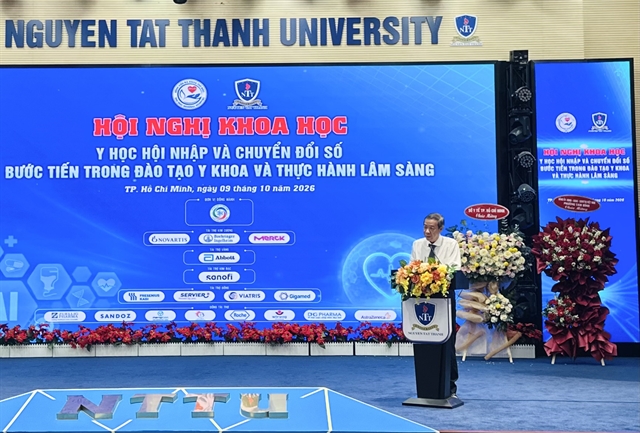
| Dr Nguyễn Văn Vĩnh Châu, deputy director of the HCM City Department of Health, speaks at the scientific conference in HCM City on October 9. — VNS Photos Nguyễn Diệp |
HCM CITY — The healthcare sector must transition from basic record digitisation to digitising the entire decision-making and governance process to build smarter hospitals and enhance patient safety, Dr Nguyễn Văn Vĩnh Châu, deputy director of the HCM City Department of Health, said at a scientific conference on October 9.
Speaking at the conference called "Integrated medicine and digital transformation: Advancements in medical training and clinical practice,” Châu said data-driven management and operational innovation are essential for modern healthcare delivery.
“Digital tools must be anchored by robust educational foundations, ensuring future medical practitioners are both clinically competent according to international standards and adept at mastering modern biomedical technology,” he said.
True international integration requires a systematic elevation of standards across medical training, research, clinical practice, and hospital administration, with patient safety remaining the ultimate priority, he added.
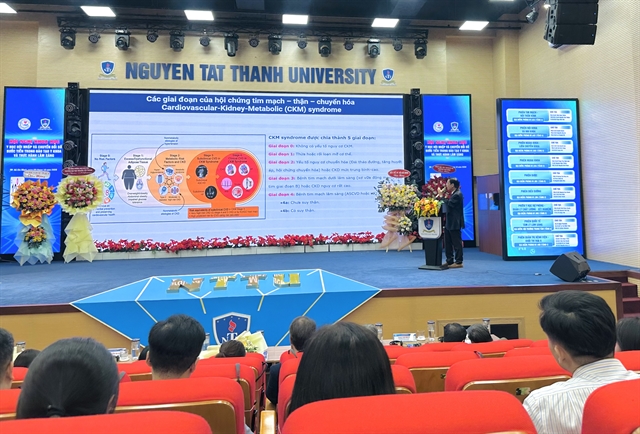
The conference, co-organised by Thủ Đức General Hospital and Nguyễn Tất Thành University, brought together over 450 domestic and international experts, physicians, lecturers, and healthcare professionals.
The event served as a platform to share professional updates, explore emerging clinical trends, and discuss digital transformation solutions in healthcare and medical education.
|
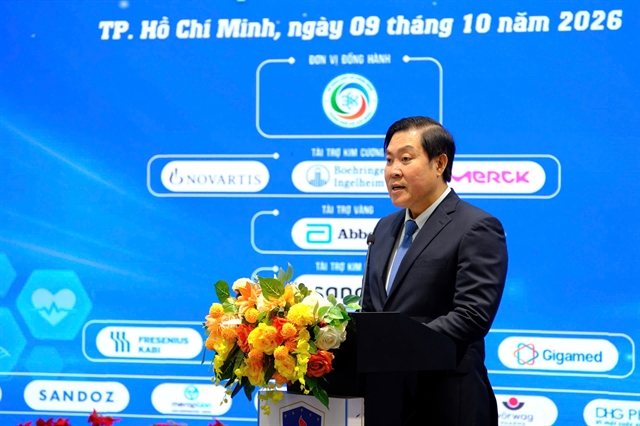
| Dr Vũ Trí Thanh, director of Thủ Đức General Hospital, highlights the transformative role of technology in modern medicine at the scientific conference in HCM City on October 9. |
Advances in CKM care, AI, stroke governance
At the plenary session, Prof. Dr Đặng Vạn Phước, honorary rector of the School of Health Sciences at Nguyễn Tất Thành University, highlighted advanced management strategies for Cardiovascular-Kidney-Metabolic (CKM) syndrome.
"Cardiovascular-kidney-metabolic conditions are closely linked, coexisting and amplifying one another; blood glucose control alone is insufficient to protect the cardiovascular system," Prof. Dr Phước emphasised.
He stressed the critical need for proactive intervention: "Managing CKM from early stages is essential; the earlier active treatment is initiated, the higher the effectiveness in long-term complication prevention."
Furthermore, he underscored the clinical value of modern pharmacological options, noting that early combination with SGLT2 inhibitors prolongs the time patients can delay dialysis, helping to optimally protect nephrons and reduce the burden of complications.
Dr Vũ Trí Thanh, director of Thủ Đức General Hospital, highlighted the transformative role of technology in modern medicine.
“Amidst a constantly changing healthcare landscape, integration and digital transformation are no longer mere trends but have become practical requirements for medical training and healthcare delivery,” he said.
Echoing this perspective, Dr Nguyễn Kim Quốc from the Faculty of Information Technology at Nguyễn Tất Thành University, said artificial intelligence (AI) serves as an operational assistant rather than a replacement.
"AI turns data into suggestions, while doctors review and decide on actions; human ownership of technology is the prerequisite for sustainable digital transformation," he said.
“Reliable and interoperable data serve as the foundation for AI to create value, supporting continuous patient care before, during, and after treatment."
A key highlight of the conference was the presentation of the "Life Saving Engine" (LSE) model implemented at Thủ Đức General Hospital for stroke emergency care.
Dr Vũ Trí Thanh said stroke care is fundamentally a matter of "time, coordination, and responsibility," requiring continuous monitoring from admission to treatment, care, and outcome evaluation.
“Effective hospital governance demands rapid and structured execution,” Thanh said. "Effective management requires answering four key questions at the exact moment a risk arises: Who is in charge? What needs to be done? Which milestone is at risk of delay? How should we respond?"
"The core of digital healthcare is the human-in-the-loop principle: 100 per cent of clinical decisions remain with the doctor, while digital tools provide real-time alerts and an operational support layer."
|
| The scientific conference on "Integrated Medicine and Digital Transformation: Advancements in Medical Training and Clinical Practice" held in HCM City on October 9 attracted over 450 domestic and international experts, physicians, lecturers, and healthcare professionals. |
Educational synergies and comprehensive academic scope
Prof. Dr Nguyễn Đức Trọng, rector of the School of Health Sciences at Nguyễn Tất Thành University, said digital transformation in healthcare must be anchored by medical ethics.
"Technology only truly creates value when coupled with professional competence, scientific evidence, clinical experience, and above all, the ethical responsibility of medical professionals towards patients."
The strategic "hospital-university" collaboration model with Thủ Đức General Hospital provides students with hands-on clinical exposure while allowing faculty, physicians, and scientists to align research directly with real-world healthcare needs, he said.
He highlighted a landmark achievement in international recognition, noting that 2026 marks the first time Nguyễn Tất Thành University entered global university rankings across multiple disciplines, with its clinical health field ranking between 501st and 600th worldwide and placing second among ranked higher education institutions in Việt Nam.
The conference featured a comprehensive academic programme comprising one plenary session and nine specialised parallel tracks featuring 60 scientific reports.
These sessions addressed a broad spectrum of topics, including neurology, cardiovascular protection, metabolic dysfunction-associated steatotic liver disease (MASLD), paediatric hypertension, AI clinical assistants, surgical innovations, gynecological pain interactions, pharmacy student happiness predictors, and hospital management.
Thủ Đức General Hospital is a Grade I general hospital under the city’s Department of Health and one of the top 10 ranked hospitals in the city for quality evaluation in 2024.
It continues to demonstrate its commitment to smart healthcare infrastructure, research, and clinical excellence. — VNS
Society
 Society
 Society
 Society
 Society
 Society
 Society
 Society
 Society
 Society
 Society
 Society
 Society
 Society
 Society