 Society
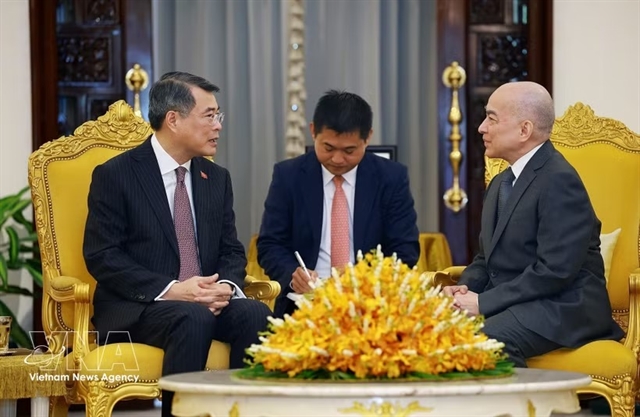
Vietnamese PM pays courtesy visits to Cambodian King, Queen Mother
1.
|
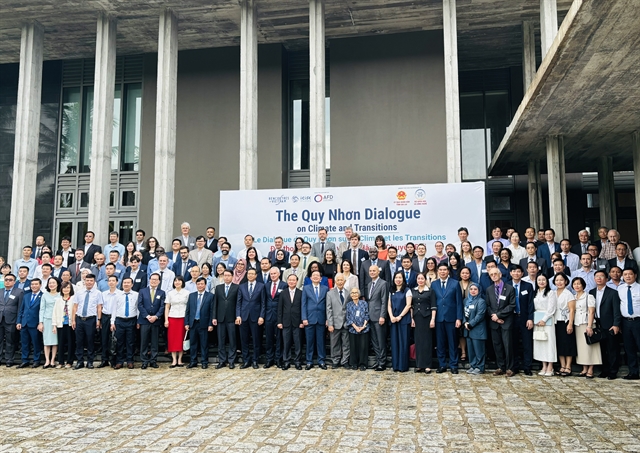
| About 120 scientists, diplomats and policymakers from 25 countries and territories attend the Quy Nhơn Dialogue on Climate and Transitions on Saturday and Sunday. — VNS Photos Khánh Dương |
GIA LAI — Vietnamese and French officials attending the Quy Nhơn Dialogue on Climate and Transitions on Saturday agreed that development and the ecological transition must go hand in hand and serve the interests of the people.
Hosted by Rencontres du Vietnam and the International Centre for Interdisciplinary Science and Education (ICISE) in the southern province of Gia Lai on Saturday and Sunday, with the support of the French Development Agency (AFD) as a founding partner, the dialogue brought together about 120 scientists, diplomats and policymakers from 25 countries and territories to discuss policy options, financing approaches and coalitions to advance climate action in the decade ahead.
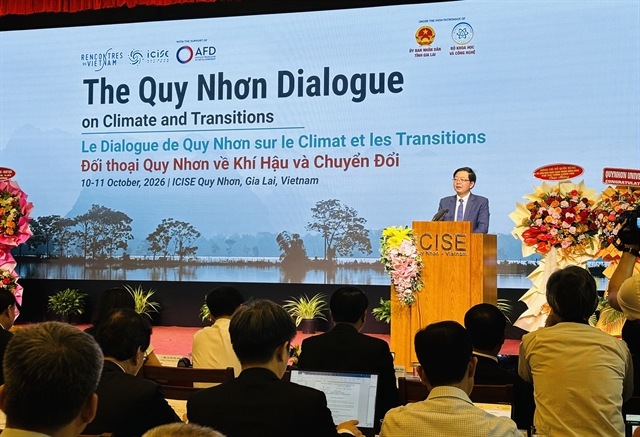
Highlighting the need to put people at the centre of the transition, Deputy Prime Minister Hồ Quốc Dũng said its success should be measured not only by emissions reductions and funding mobilised, but also by whether people are better protected from natural disasters, have access to new skills and employment opportunities, businesses are better equipped to innovate, and vulnerable groups can participate in and benefit from development.
“The transition is sustainable only when it does not constrain development opportunities, but instead creates new opportunities for countries and their people to thrive,” he said.
Việt Nam is among the countries most vulnerable to climate change, with natural disasters and climate change causing annual gross domestic product (GDP) losses of 1-1.5 per cent.
In 2025 alone, the country experienced exceptionally severe natural disasters, with 21 typhoons and tropical depressions, a record high since 1961, leaving 484 people dead or missing and 811 injured. Total economic losses exceeded VNĐ104 trillion (approximately US$4 billion).
|
| Deputy Prime Minister Hồ Quốc Dũng called for the dialogue to be translated into cooperation and concrete action. |
The Deputy Prime Minister said Việt Nam was entering a new phase of development, with the goal of achieving double-digit economic growth while pursuing net-zero emissions by 2050. The challenge was not to choose between growth and climate action, but to ensure that the transition would generate new drivers of development.
Economy-wide transformation would require substantial financial resources, appropriate technologies and the capacity to implement them, he said.
For developing countries such as Việt Nam, the priority would be not only to mobilise additional funding, but also to secure access to finance at reasonable costs, gain access to and master technologies, and strengthen domestic capacity, he said.
He called for more effective coordination of public resources, concessional finance, multilateral development banks, climate funds and private capital.
The Deputy Prime Minister also called for the dialogue to be translated into cooperation and concrete action, stressing that the values of the event lay not only in discussions but also in lasting connections, research programmes, policy initiatives and cooperation projects that could be implemented in practice.
He expressed hope that the dialogue would gradually establish a long-term cooperation network bringing together scientists, policymakers, international organisations, financial institutions and businesses, and eventually become a major international event.
“The Vietnamese Government supports and hopes to see the Quy Nhơn Dialogue develop into a reputable annual forum that helps deepen understanding and promote action towards a sustainable future,” he said.
France’s support
|
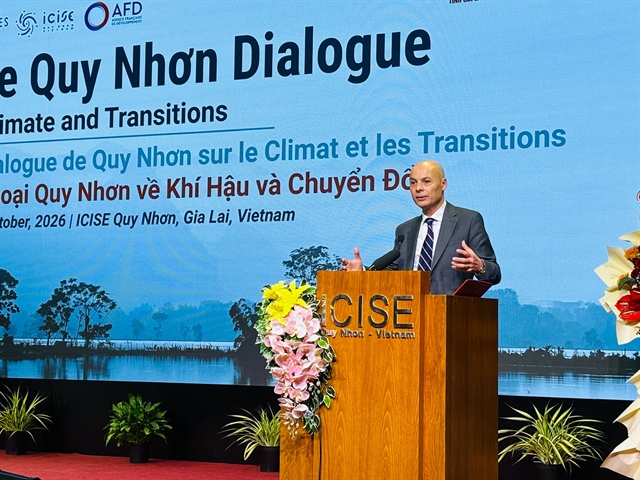
| French Ambassador to Việt Nam Didier Le Bret. |
In his opening remarks, French Ambassador to Việt Nam Didier Le Bret said the close relationship between Việt Nam and France was founded on a shared philosophy: the two countries must not choose between development and the ecological transition, but integrate the two, ensuring that development primarily serves the interests of the people.
He affirmed France's readiness to support Việt Nam in its energy transition, noting that the country had a relatively diversified energy mix.
Over nearly three decades, France has allocated more than 3 billion euros exclusively to projects aimed at ecological transformation in Việt Nam with the latest project involving more than 150 million euros to help adapt infrastructure across the country to the challenges of the ecological transition, he said.
The Quy Nhơn Dialogue featured high-level plenary sessions, parallel dialogue sessions and technical workshops covering key issues related to climate and transition, including climate science, energy security, decarbonisation, transition finance, value chains, climate risks and resilience, as well as economic policies, investment and financial instruments.
Ana Toni, chief executive officer of the 30th Conference of the Parties to the United Nations Framework Convention on Climate Change (COP30), reflected on lessons from COP30 and advocated a shift from setting targets towards building an implementation ecosystem driven by science.
She emphasised the need to bridge the gap between scientific analysis and practical application to accelerate progress.
Moussa Faki Mahamat, special envoy for the Pact for Prosperity, People and the Planet, highlighted the importance of combining science and political action to address global climate and financial challenges.
Tackling climate change would require a strong scientific evidence base, particularly amid challenges to multilateralism, while scientific knowledge must be used to inform and influence international decision-making, he said. — VNS
Society
 Society
 Society
 Society
 Society
 Society
 Society
 Society
 Society
 Society
 Society
 Society
 Society
 Society
 Society