 Society
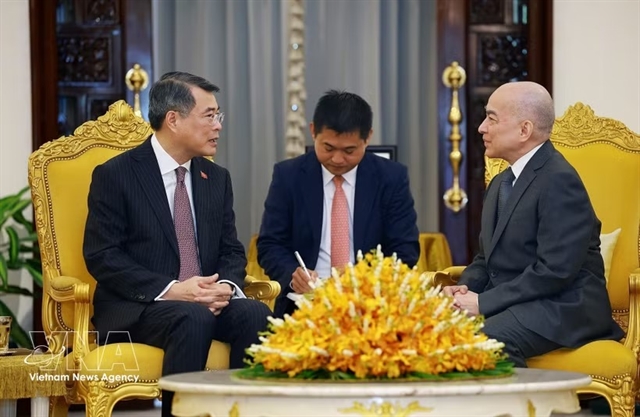
Vietnamese PM pays courtesy visits to Cambodian King, Queen Mother
1.
|
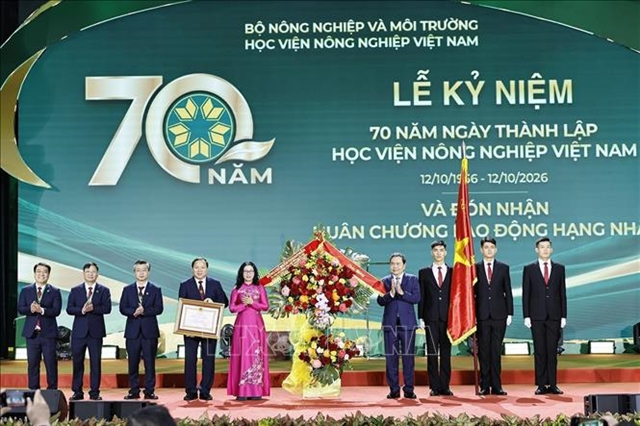
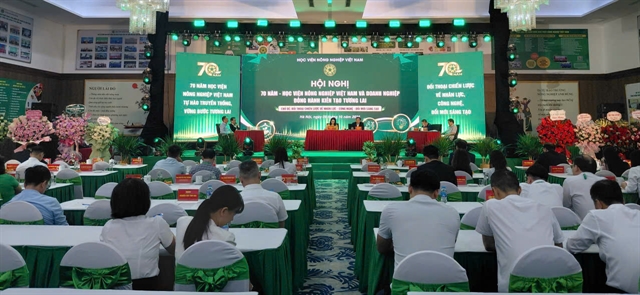
| NA Chairman Trần Thanh Mẫn (fourth from right) presents the first-class Labour Order to the Vietnam National University of Agriculture at the ceremony in Hà Nội on Saturday. — VNA/VNS Photo |
HÀ NỘI — National Assembly chairman on Saturday urged the country’s leading agriculture university to overhaul its training programmes and prepare global citizens for a modern farming sector.
Trần Thanh Mẫn made the call at a ceremony marking the 70th anniversary of the Vietnam National University of Agriculture, where he presented the institution with the First-Class Labour Order. The award recognised its achievements in education and community-focused scientific research, and its contribution to the country’s socio-economic development.
Việt Nam was entering a new phase of development, Mẫn said, adding that recent policies on science, technology, innovation, digital transformation and education had opened up new opportunities for universities. The institution should translate those priorities into practical programmes and research that benefit the country, he said.
It should move away from teaching only what it already offers and instead align its courses with the needs of society, businesses and national development, Mẫn said.
Graduates should leave with strong professional knowledge, practical skills, digital capabilities, an innovative mindset and the ability to work internationally. The university should also attract young people interested in agriculture, technology and entrepreneurship, he added.
Science, technology, innovation, digital transformation and artificial intelligence should become core drivers of the university’s development, NA chairman said. He urged researchers to focus on areas where Việt Nam has pressing needs and where new work could produce tangible economic benefits.
Research should help reduce production costs, raise farmers’ incomes and make Vietnamese agricultural products more competitive in global markets, he said. The university should also connect government, researchers, businesses and farmers, bringing knowledge from lecture halls and technology from laboratories into agricultural production.
Knowledge must move from lecture halls to fields; technology from laboratories into production; research findings into businesses; and the benefits of science to farmers, Mẫn said, calling for practical problems faced by farmers to feed back into research and teaching.
He also urged the university to take a greater role in shaping and reviewing policies on agriculture, farmers and rural development, and to deepen its international research and education partnerships. The institution should bring foreign scientists to Việt Nam, support students in gaining international experience and promote Vietnamese agricultural science and technology abroad, he said.
|
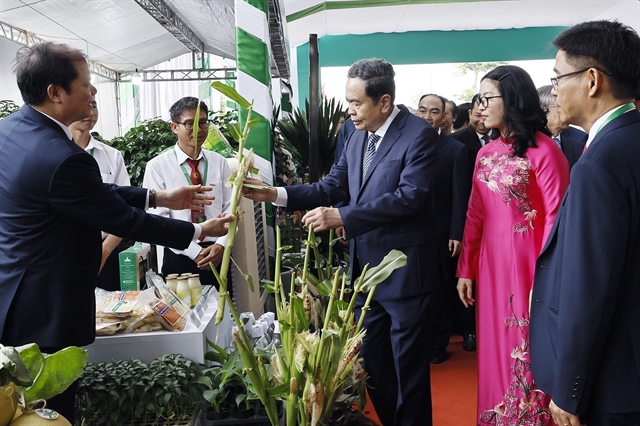
| NA chairman Mẫn and officials visit an exhibition of products made by the Vietnam National University of Agriculture at the ceremony. |
The NA chairman called for modernised university management, including wider use of artificial intelligence, smart learning environments, transparent governance and greater accountability. The university should create conditions for scientists to pursue research and be rewarded for their contributions, while investing in young researchers, he said.
The institution should aim to rank among Asia’s top 100 universities by 2045, Mẫn said, urging students to study hard, pursue research and entrepreneurship, and be prepared to work in disadvantaged and challenging areas.
Founded in 1956 as the University of Agriculture and Forestry, the university had remained closely linked to the development of Vietnamese agriculture and rural communities through war, peace and economic reform, said the university's director, Professor Nguyễn Thị Lan.
Its founding mission – to educate people, advance science and put knowledge to work for the country, farmers and rural communities – had endured despite changes in its name and scale, she said.
The university planned to renew its training programmes, strengthen research and technology transfer, and focus on fields where it has expertise and the country has pressing needs. It also aimed to become a respected research university in the region, with a focus on smart, green and sustainable development, Lan said. — VNS
Society
 Society
 Society
 Society
 Society
 Society
 Society
 Society
 Society
 Society
 Society
 Society
 Society
 Society
 Society