 Economy


Vietnamese cellist to perform alongside world’s cello legend Mischa Maisky
1.
|
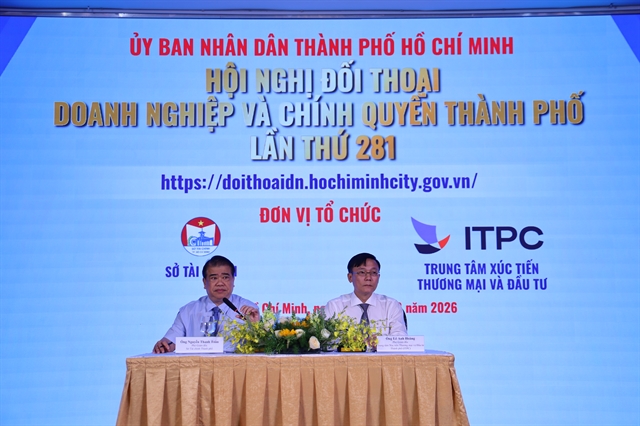
| The Investment and Trade Promotion Centre of HCM City and the HCM City Department of Finance jointly hold the 281st Business-Government Dialogue Conference on investment and business registration procedures in HCM City on October 30, 2026. — Photo courtesy of ITPC |
HCM CITY — HCM City is accelerating administrative reforms to shorten investment approval times, improve business support and address bottlenecks facing the private sector, according to the Investment and Trade Promotion Centre of HCM City (ITPC).
ITPC and the municipal Department of Finance jointly held the 281st Business-Government Dialogue Conference on October 30 to discuss difficulties businesses face in implementing the Law on Investment and the Law on Enterprises, particularly regarding investment and business registration procedures.
Speaking at the event, Lê Anh Hoàng, deputy director of ITPC, said the city remained committed to building a transparent investment environment that put residents and businesses at the centre of public service delivery.
Investment and business registration procedures were the first legal gateway for projects entering the market, directly affecting implementation progress and operational efficiency, he said.
“Promptly addressing obstacles, simplifying processes and shortening administrative processing times are strategically important. These efforts not only help businesses bring projects into operation sooner but also unlock investment resources and enhance HCM City's competitiveness,” he said.
ITPC, as the standing agency of the city's business-government dialogue system, would continue to receive business proposals and urge relevant authorities to address outstanding issues. Matters beyond its authority would be referred to competent agencies, Hoàng added.
Nguyễn Thanh Toàn, deputy director of the municipal Department of Finance, said HCM City had attracted more than US$19.2 billion in foreign direct investment in the first 10 months of 2026, exceeding its full-year target of $11.5 billion. The total included 1,726 newly licensed projects.
However, the resilience of the private sector remains weak.
Despite more than 44,700 new enterprises being established in the period, business formation was slowing. More than 36,000 enterprises had temporarily suspended operations and over 16,000 had been dissolved.
He highlighted the urgent need for the city government to step up efforts to improve the investment and business environment.
“Support must go beyond initial registration and licensing procedures to create a comprehensive ecosystem that enables businesses to survive and grow,” Toàn said.
His department had worked with relevant agencies to establish a coordination mechanism for investment approval procedures. Under a new decree, investment licensing now takes 15 days, including weekends, he said.

|
| A business representative raises a question at the 281st Business-Government Dialogue Conference in HCM City on October 30, 2026. — Photo courtesy of ITPC |
The city is also developing support criteria for strategic investors and is working to resolve difficulties affecting hundreds of stalled projects.
To reduce start-up costs, the department has partnered with Viettel to introduce the STC 700 digital solution, which can cut expenses for services such as digital signatures and electronic invoices by up to 75 per cent.
HCM City is also preparing funding for free management, accounting and tax training for household businesses transitioning to the enterprise model.
At the conference, Châu Ngọc Thạch, a representative of the Department of Finance's Business Registration Division, outlined new requirements for declaring beneficial ownership information.
The Government issued Decree No. 296/2026 on July 23, 2026, amending regulations on identifying and declaring beneficial owners of enterprises with legal personality.
Under the criteria presented, a beneficial owner must be an individual who directly or indirectly holds at least 25 per cent of a company's charter capital or voting shares.
For partnerships, every general partner qualifies as a beneficial owner, regardless of their individual capital contributions. The rules also cover groups of individuals with family relationships or contractual agreements who jointly hold at least 25 per cent of a company's charter capital, directly or indirectly. Each qualifying individual is identified as a beneficial owner.
Where no individual meets the ownership threshold, enterprises must identify those exercising actual control, including the power to appoint or dismiss the chairperson, board or members' council members, or the director or general director; amend the company charter or organisational structure; determine financial, investment and operating policies; or decide on restructuring or dissolution.
If no individual meets the ownership threshold, the enterprise must identify the individual holding the highest level of management authority and acting on behalf of the enterprise as its beneficial owner. Individuals representing state capital are excluded.
At the conference, relevant agencies also addressed questions on investment project amendments, foreign investors' market access, capital contributions and share acquisitions, changes to business registration details and registered offices, and business location registration.
Businesses also sought guidance on accessing administrative records, corporate dissolution, closing subsidiaries and terminating branches and representative offices, as well as available legal support. — VNS
Economy
 Economy
 Economy
 Economy
 Economy
 Economy
 Economy
 Economy
 Economy
 Economy
 Economy
 Economy
 Economy
 Economy

.JPG)



