 Sci-Tech
Việt Nam, EU and Belgium seek deeper, practical cooperation
1.
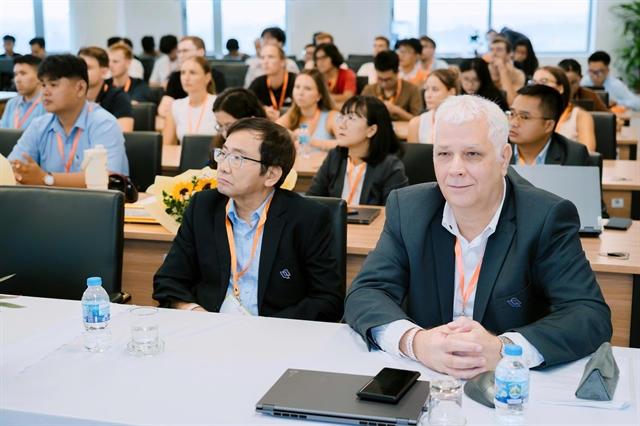 |
| Experts and students attend the opening session of an international symposium on Sustainable Infrastructure and Construction Innovation at the Vietnamese-German University in HCM City on September 30. — Photos Courtesy of VGU |
HCM CITY — Construction supervision must evolve from manual, post-construction inspection to intelligent, real-time management to meet the demands of smart urban development, green building materials, and carbon reduction, a conference heard in HCM City on September 30.
The International Symposium on Sustainable Infrastructure and Construction Innovation (SICI 2026), organised by the Vietnamese-German University (VGU) and Biberach University of Applied Sciences in Germany at the VGU campus, had the theme “Advancing Sustainable Construction and Smart Construction Management through German-Vietnamese Research Collaboration”, and attracted international researchers, civil engineers, and industry leaders.
Delivering a keynote address on supervision consultancy, Trần Bảo Phương, deputy general director of Saigon 3 Construction Quality Control Joint Stock Company, said supervision remains vital to ensuring quality, safety, and adherence to schedules throughout a project's lifecycle.
“However, modern infrastructure requires a shift towards automated digital technologies.”
He highlighted the need to integrate unmanned aerial vehicles, artificial intelligence, 3D laser scanning, and digital twin technology into construction supervision.
These technologies enable real-time monitoring, early risk detection, and data-driven decision-making.
He also called for standardised acceptance frameworks to regulate the use of recycled and green construction materials.
Drawing on experience from major transport infrastructure projects in the city, including Ring Road No. 3 and Metro Line No. 2, he outlined the challenges of supervising complex construction works.
These include bored piles, diaphragm walls, underground structures, and earth pressure balance tunnel boring machine operations in densely populated urban areas.
From an academic perspective, Prof. Dipl. Wirt.-Ing. Jens Schmid, professor of project management and project control at Hochschule Biberach (Biberach University of Applied Sciences) in Germany, said: “Methodology alone does not guarantee project success.”
Comparing international standards such as PRINCE2, the PMBOK Guide, and Germany’s AHO Booklet No. 9, he said project outcomes depended heavily on adapting methods to the local context, identifying risks early, and maintaining strong interpersonal communication, rather than rigidly following procedures.
Decarbonising the building envelope
Addressing upfront environmental impacts, Frank Mueller, vice president of design, engineering, and project management at the leading façade contractor Quân Đạt & Partners, presented research on material carbon footprints (embodied carbon) in building envelopes, which account for 15-25 per cent of a building’s initial embodied carbon.
Focusing on unitised curtain-wall panels, he noted that while aluminium represented only 20-25 per cent of a panel’s mass, it accounted for 52 per cent of its total embodied carbon.
The carbon footprint of aluminium ranges from a global average of 16.7kg CO₂e per kilogramme to less than 0.5kg CO₂e, depending on the use of renewable energy and recycled content.
For glass, adopting low-carbon float glass and maximising the use of recycled cullet can halve emissions.
He recommended four strategic measures: optimising structures to reduce material use, setting strict carbon caps in tender specifications through Environmental Product Declarations, procuring off-site unitised fabrication powered by low-carbon energy, and designing modular panels with dry gaskets to allow easy disassembly at the end of their service life.
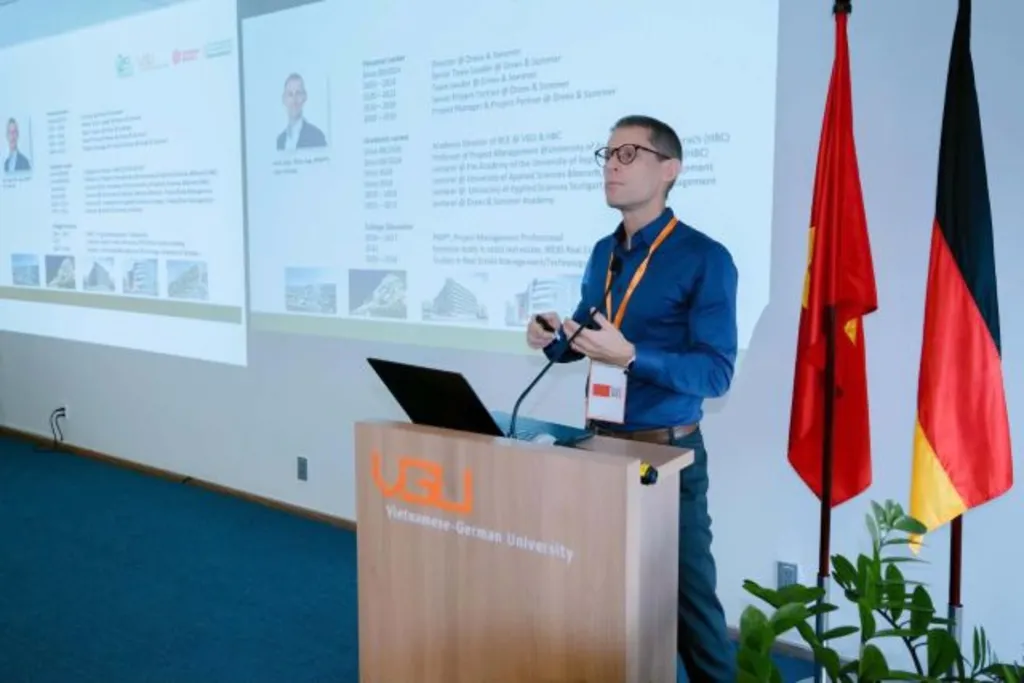 |
| Prof. Dipl. Wirt.-Ing. Jens Schmid, professor of project management and project control at Biberach University of Applied Sciences in Germany, speaks at the international symposium on Sustainable Infrastructure and Construction Innovation at the Vietnamese-German University in HCM City on September 30. |
Applied research and green innovation
The symposium featured two simultaneous afternoon technical sessions focusing on academic research and student research and innovation.
Dương Vĩnh Nhiều of the Industrial University of HCM City presented research on using biomass bottom ash from tree bark and wood-chip combustion in industrially produced vibro-cast concrete bricks.
A mix containing 26.7 per cent bottom ash achieved a compressive strength of 25.1MPa and water absorption of 11.9 per cent, meeting the conformity requirements of QCVN 16:2023/BXD, and heavy-metal leaching well below safety thresholds.
A joint VGU team presented a cross-platform mobile application that uses GPS and Google Maps to track daily commutes, calculate users’ personal CO₂ footprints, and reward low-carbon transport choices with redeemable eco-credits.
Đoàn Văn Bình of the VGU presented a satellite-based analysis of flooding in the Mekong Delta from 2001 to 2023.
The data showed that peak flood extent in the Vietnamese Mekong Delta fell from 18-23.7 per cent in 2001 to 5.7-18.8 per cent in 2023 following the construction of high dykes.
Student presentations covered crumb-rubber-modified asphalt using end-of-life tyres, sound-absorbing foamed concrete incorporating rice husk ash and bamboo-fibre reinforcement for urban traffic noise barriers, and comparative design practices for porous asphalt concrete in Việt Nam, Germany, France, and the US.
The event opened with remarks by Dr Hà Thúc Viên, vice president for academic and student affairs at the VGU, followed by a sponsorship appreciation and award ceremony recognising key industry partners, including QDP, MiTek, KHT Steel, SCQC3, Wealthcons, and PERI.
The symposium concluded with a guided tour of VGU’s civil engineering and construction management laboratories and research showcase, highlighting the long-term academic and technical cooperation between Việt Nam and Germany. — VNS
Sci-Tech
 Sci-Tech
 Sci-Tech
 Sci-Tech
 Sci-Tech
 Sci-Tech
 Sci-Tech
 Sci-Tech
 Sci-Tech
 Sci-Tech
 Sci-Tech
 Sci-Tech
 Sci-Tech
 Sci-Tech
 Sci-Tech