 Society

Top Vietnamese leader highlights new horizon for Việt Nam–Denmark cooperation
1.
|
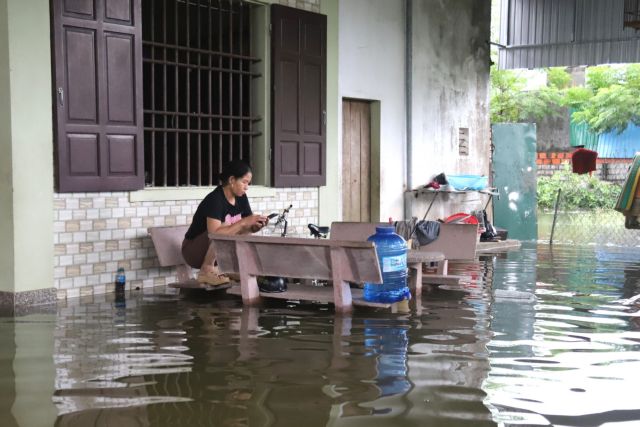
| Floodwaters rise deep onto the porches of a home in Diễn Châu Commune, in the central province of Nghệ An. —VNA/VNS Photo Xuân Tiến |
NGHỆ AN — Torrential rain from Wednesday afternoon through Thursday morning caused flooding, landslides and the temporary isolation of thousands of households in many parts of the central province Nghệ An.
Heavy water flows from upstream areas rapidly raised water levels in major rivers and streams, flooding roads and disrupting local travel.
In Tam Thái Commune, rising river and stream levels on Thursday morning inundated several roads, temporarily cutting off seven villages that are home to more than 3,000 residents.
Lô Dương Khánh, Chairman of the People’s Committee of the commune, said several sections of Route 541B, including the spillway bridge leading to Xốp Nặm, Xỏng Con and Khổi villages, were flooded, temporarily isolating the seven remote villages.
Several sections of National Highway 7 in the commune were also inundated. Local authorities advised residents to avoid deeply flooded areas and locations with strong currents to ensure their safety.
In Mường Típ Commune, at around 7am on Thursday, a large amount of soil and rock from a mountainside slid onto Route 543D in Xốp Típ Village, completely blocking the road.
Commune authorities immediately mobilised excavators, vehicles and personnel to clear the debris and restore traffic as soon as possible.
Vi Thị Quyên, Secretary of the Mường Típ Commune’s Party Committee, said heavy rain was still falling at noon on Thursday, while several sections of the route remained at high risk of rockfalls and landslides, posing a threat to road users.
The locality was closely monitoring the situation, issuing warnings and guiding residents to proactively avoid dangerous areas.
The committee asked the province to direct relevant agencies and units to inspect, repair and restore the route as soon as possible, particularly high-risk sections, to ensure traffic safety and protect residents’ lives and property.
In Mường Quàng Commune, heavy rain also caused water levels to rise on National Highway 48D, flooding and disrupting traffic at several locations.
Water from surrounding areas flowed into low-lying sections, making travel difficult, particularly where roads were crossed by fast-flowing water.
In Tam Quang Commune, rising water levels and fallen trees also disrupted traffic.
Kha Thị Hiền, Deputy Chairwoman of the commune People’s Committee, said a large tree in the Săng Lẻ forest area had fallen across the road, bringing traffic to a standstill.
After receiving the report, the commune authorities dispatched officials and machinery to the site on Thursday morning to cut up and remove the fallen tree and clear the road.
In Diễn Châu Commune, heavy rain from Wednesday afternoon to Thursday morning caused severe flooding in Hải Bích Hamlet.
Water levels rose rapidly, reaching nearly one metre in some places, flooding roads and homes and temporarily isolating several residential areas.
Located in a low-lying area, the site was overwhelmed by water flowing in from surrounding areas, exceeding local drainage capacity.
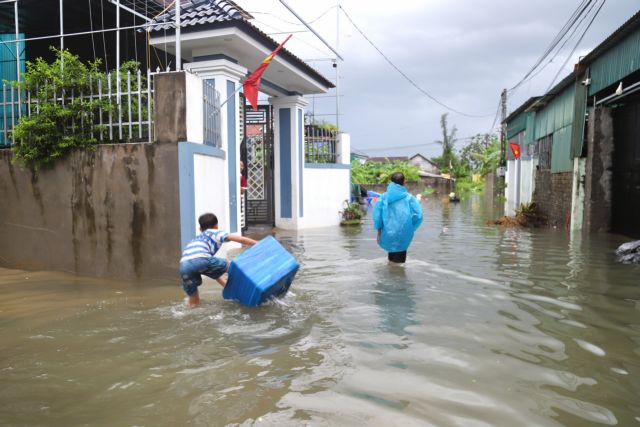
Several roads were deeply flooded, forcing residents to wade through the water.
Motorbikes, bicycles and other belongings were moved to higher ground, while water also entered yards, gardens, livestock areas and homes, prompting many households to raise their belongings to protect them from damage.
In Thành Bình Thọ Commune, heavy rain damaged and washed away a section of a temporary diversion road under construction near Khe Trằng Bridge in the former Thọ Sơn area.
Authorities fenced off the site and banned pedestrians and vehicles from passing through due to safety concerns.
Nguyễn Đình Diện, head of the commune’s Economic Office, said local authorities had warned residents not to cross the Khe Trằng Bridge area under any circumstances.
Motorists and other road users can instead take the diversion route through the former Bình Sơn area.
Nghệ An Hydro-Meteorological Station said many areas of the province experienced heavy rainfall from 7pm on Wednesday to 7am on Thursday, with some locations recording more than 100mm.
Rainfall totals reached 209mm at Quỳnh Lưu Meteorological Station, 167mm in Vinh, 150mm in Quỳ Hợp and 124mm in Đô Lương.
|
| Local residents struggle to navigate the inter-hamlet road after heavy rain in Diễn Châu Commune, the central province of Nghệ An. |
Response measures
The provincial People’s Committee issued Official Dispatch No. 18/CĐ-UBND, instructing authorities to proactively respond to the developing natural disaster situation.
The provincial People’s Committee Chairman, who also heads the provincial Civil Defence Command, ordered departments, sectors and localities to closely monitor weather and disaster developments and proactively implement response and recovery plans, ensuring they were prepared for emerging situations.
Authorities were instructed to take decisive and timely action and would be held accountable by the provincial People’s Committee Chairman for delays, negligence or complacency resulting in loss of life.
They were also ordered to urgently review areas at high risk of flash floods, flooding and landslides and prepare evacuation plans to move residents out of dangerous areas when necessary, with protecting lives as the top priority.
The provincial Hydro-Meteorological Station was tasked with continuing to monitor and forecast weather conditions and providing authorities and residents with timely and accurate information on rainfall, flooding and potential impacts to support proactive responses.
The standing office of the provincial Civil Defence Command and the Department of Agriculture and Environment were instructed to maintain round-the-clock duty and closely monitor weather and disaster developments, while promptly updating authorities and residents on the situation.
Departments and sectors were also required to implement measures to ensure the safety of people, vehicles, equipment and infrastructure under their management, with particular attention to dykes, reservoirs and dams, flood prevention, power and telecommunications systems, educational and healthcare facilities, and transport and irrigation projects under construction.
Given the complicated weather conditions, the provincial People’s Committee asked local authorities to maintain personnel, vehicles, supplies and other necessary resources under the 'four on-the-spot' motto, ensuring they were ready to respond to emerging situations and minimise damage caused by natural disasters. — VNS
Society
 Society
 Society
 Society
 Society
 Society
 Society
 Society
 Society
 Society
 Society
 Society
 Society
 Society
 Society