 Society

Liechtenstein Prime Minister concludes official visit to Việt Nam
1.
|
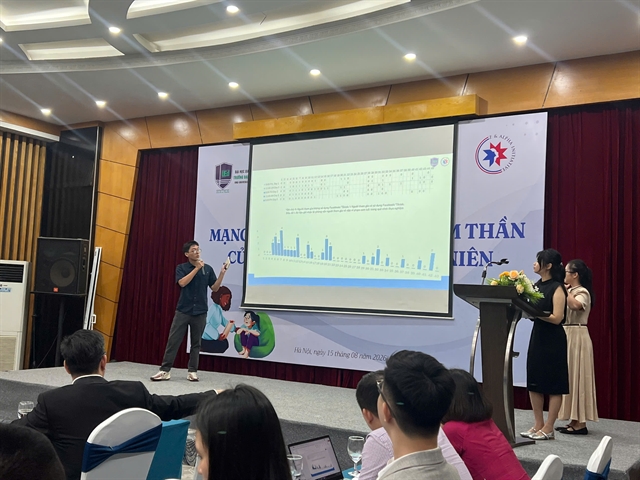
| A presentation at a conference on social media and young people's mental health in Hà Nội. — Photo courtesy of the organiser |
HÀ NỘI — As social media becomes an increasingly integral part of children's and adolescents' lives, experts are calling for coordinated action to address its potential impact on their mental health.
Việt Nam is among the countries with the highest rate of social media use in the world, with about 78 per cent of the population using the internet and 73 per cent active on social media. A large proportion of users are aged 15-34.
The figures are even higher among students. A study of 1,015 lower and upper secondary students nationwide found that more than 90 per cent used TikTok and 22.5 per cent spent more than six hours a day on social media. A separate survey of 462 students in Grades 6-9 at four lower secondary schools in Hà Nội and Ninh Bình found that 42 per cent used Facebook frequently or very frequently.
"Digital spaces allow children to learn, connect, create and express themselves. At the same time, however, they are also exposed to considerable pressure on social media, particularly during a critical stage of psychological and neurological development," Associate Professor Dr Trần Thành Nam, rector of the University of Education under Việt Nam National University Hà Nội, said.
Nam was speaking at a recent conference on social media and mental health of children and adolescents.
For many young people, social media is no longer simply a communication tool, but has become almost their entire world, according to Nam.
Young users under pressure
Nam said adolescence is a critical stage of development, marked by significant biological, psychological and social changes. As the brain continues to develop, young people's ability to regulate themselves remains limited, while their need for peer acceptance grows, making them particularly sensitive to how others perceive them.
As a result, online experiences can quickly affect young people's emotions, self esteem and sense of identity. When online interaction increasingly replaces face-to-face communication, young people may have fewer opportunities to develop essential social skills and may become more anxious about communicating in person.
According to Nam, cyberbullying can pose an even greater threat. Unlike traditional bullying, harmful or humiliating content can spread quickly, remain online for long periods and follow children from school into their homes. Excessive screen time can also reduce physical activity, disrupt sleep and increase the risk of obesity.
|
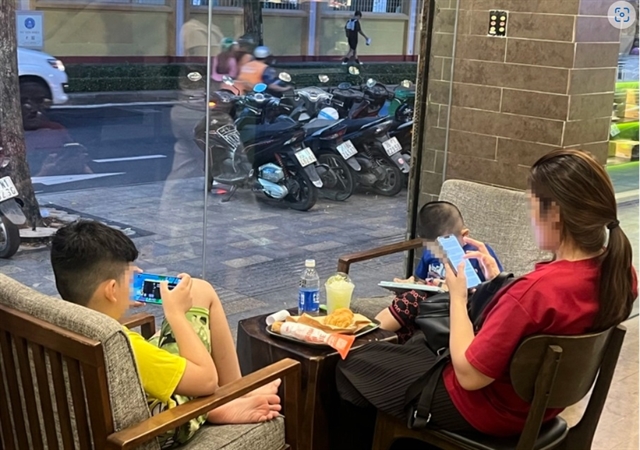
| Children use smartphones while sitting with a parent at a café in Hà Nội, highlighting the growing role of digital devices in young people's daily lives. — Photo tuoitre.vn |
Growing concern about these risks has led governments in several countries to tighten age rules for social media.
Australia's restrictions on social media accounts for under-16s took effect in December 2025, while France has proposed tightening access for children under 15. Other countries are considering similar measures, while some governments have opted for age-based limits on screen time and platform features rather than outright bans.
Dương Ngô Minh Nam, deputy head of the Government Office's Department of Science, Education, Culture and Social Affairs, said protecting children's mental health and rights requires coordinated action from families, schools, regulators and technology companies.
The legal framework needs to be strengthened, but any new regulation should be carefully assessed for feasibility, effectiveness and its implications for children's rights, he said.
Protection, not isolation
Lê Anh Lan, an education specialist at UNICEF Viet Nam, said that protecting children should not mean simply banning or isolating them from the digital world.
She called for a balance between children's right to protection from online risks and their rights to education, recreation and participation, as well as to have their voices heard. Social media can still provide valuable opportunities for young people to develop digital skills, connect with others and access new knowledge, Lan said.
Ngô Quốc Anh, a student at Chu Văn An High School in Hà Nội and a Youth Mental Health Leader with the Z-Alpha Initiative, argued that scientific evidence on the relationship between social media use and mental health should continue to be interpreted with caution.
Yet policymaking cannot necessarily wait until every scientific debate has been conclusively settled, he said. Many countries have adopted a precautionary stance, setting minimum ages for independent social media account creation at between 13 and 16, in an effort to reduce risks during a period when young people remain particularly vulnerable in terms of neurological and psychological development.
Experts agreed that no single measure will be sufficient. Families need to support and guide children rather than merely monitor them. Schools should strengthen education on digital literacy and mental health. Technology companies need to design safer online environments, while public policy should be grounded in evidence and take children's own experiences and voices into account.
"Children today are growing up in two worlds: the physical world and the digital world," Nam said. "Our responsibility is to make both of them safe." — VNS
Society
 Society
 Society
 Society
 Society
 Society
 Society
 Society
 Society
 Society
 Society
 Society
 Society
 Society
 Society