 Society

Sơn La holds second coffee festival, targeting stronger businesses in future
1.
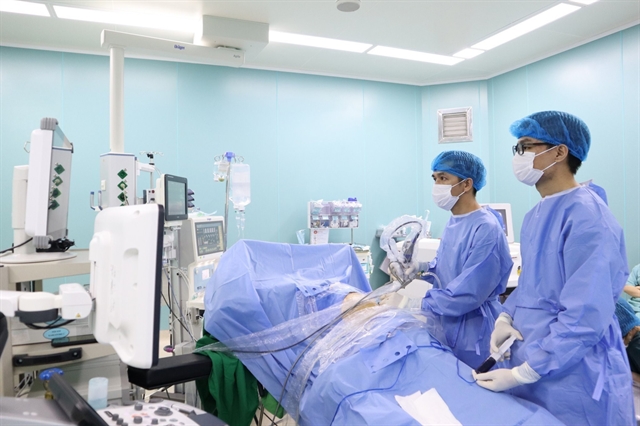 |
| A surgical team at Buôn Ma Thuột Medical University Hospital performs a percutaneous procedure to remove a patient's kidney stones. — VNA/VNS Photo |
HÀ NỘI — A 63-year-old woman arrived at Buôn Ma Thuột Medical University Hospital several days ago, seizing and barely conscious.
Doctors diagnosed a blockage in her basilar artery – a rare, often fatal form of stroke.
A decade ago, a patient with that diagnosis in the Central Highlands might not have reached treatment in time; the nearest facility equipped to handle it was often a central-level hospital hours away by road.
This time, she didn't have to go anywhere. A team at the hospital activated an emergency stroke protocol, pulled in specialists from multiple departments, and performed an emergency clot-aspiration procedure guided by digital subtraction angiography, restoring blood flow to her brain. She survived.
"With stroke, every minute of delay costs a patient about two million neurons," said Dr. Bùi Hoàng Luân, who was on the treatment team – a measure of how much the speed of that response mattered.
Cases like hers are becoming less of an anomaly outside big cities.
Under Resolution 72, a Party directive on strengthening public healthcare, provincial hospitals are increasingly offering procedures once reserved for central-level hospitals – a shift reshaping where, and how fast, patients can get advanced treatment.
Complex care, closer to home
Hundreds of kilometres north, Phú Thọ General Hospital recently carried out the province's first autologous stem cell transplant, treating a patient with Lambda light-chain multiple myeloma with technical backing from the National Institute of Hematology and Blood Transfusion.
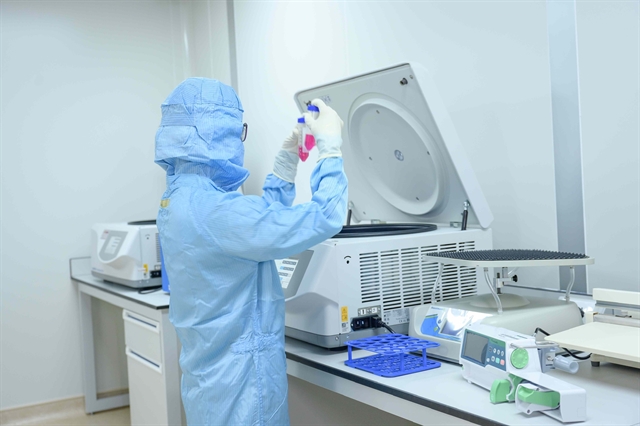
Reaching that point required assembling a full set of specialised equipment and meeting strict biosafety requirements ahead of the procedure.
A hospital representative said the hospital can now perform more than 70 per cent of the procedures expected of top-ranked 'special-grade' hospitals, and that once-exceptional operations – organ transplants, open-heart surgery, cerebral vascular intervention, advanced radiotherapy, ECMO life support – have become part of its routine caseload.
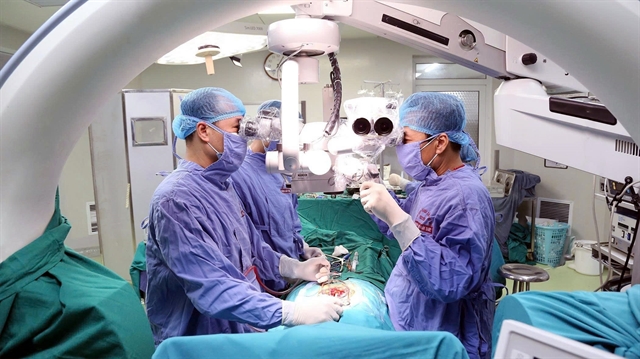 |
| A surgical team performs microsurgical spine surgery at Phú Thọ General Hospital. — VNA/VNS Photo |
Farther south, in the Mekong Delta, Cần Thơ General Hospital recently treated a 50-year-old woman for three serious knee injuries in a single operation: a complex tibial plateau fracture and torn ACL and MCL ligaments, all repaired arthroscopically in one sitting.
Under the old approach, she would have needed two separate surgeries spaced more than six months apart. The combined procedure meant less tissue damage, a shorter hospital stay and a lower risk that the joint would stiffen during the long wait between operations.
Cần Thơ has also emerged as a stroke-care hub - the city hosted an international conference this year on robotics and AI in stroke treatment, featuring 6D imaging and AI-assisted diagnosis.
That reputation is backed by results, not just events.
At S.I.S Cần Thơ International General Hospital, the share of stroke patients treated within the critical 'golden hour' has climbed from under 13 per cent to 25 per cent - a track record that has earned it consecutive Diamond awards from the World Stroke Organssation, a level of recognition rare for a hospital outside Việt Nam's major metropolitan centres.
In the central city of Huế, Huế Central Hospital completed its 11th liver transplant from a brain-dead donor.
A hospital representative said the hospital now runs its entire multi-organ transplant programme in-house, covering hearts, livers, kidneys and corneas, and can perform procedures in seven operating rooms simultaneously.
That capacity, doctors said, comes down to tightly coordinated specialist teams who have learned to manage the complications that often follow transplant surgery in patients with failing organs.
Fixing the data behind the medicine
None of this expansion works without records that follow the patient. The Ministry of Health has framed digital transformation as essential to running a modern health system, and has launched two campaigns to get there.
One is a 100-day drive, running from July 8 to October 15, 2026, to give every citizen an electronic health record through the national VNeID app. The other is a 90-day effort to clean up and standardise 12 specialised health databases.
The goal of the first campaign is straightforward: link hospital treatment records with social insurance data on a national health portal, so that every citizen has a personal e-health record they can access through VNeID for tracking their health over time.
Officials say the data going into that system has to be accurate, complete and free of duplicates, and it will be cross-checked against the national population database to safeguard data integrity and security.
The second campaign is built around a simple checklist – the data should be accurate, complete, clean, current, consistent, shareable, synchronised and continuously updated – and is designed to make good data-keeping a habit rather than a one-time cleanup, laying the groundwork for the health system's broader digitisation.
Not all of the push is about frontier medicine – some of it is about making sure urgent care reaches people in time. In HCM City, Emergency Centre 115 is building a mobile app that will let residents track an ambulance's location in real time and get first-aid instructions from a doctor over the phone while help is on the way.
It's aimed squarely at outlying suburbs, where distance has long slowed emergency response.
City health officials also aim to standardise emergency training at every commune-level health station by 2030, part of a broader effort to protect that same 'golden hour' for trauma and acute illness.
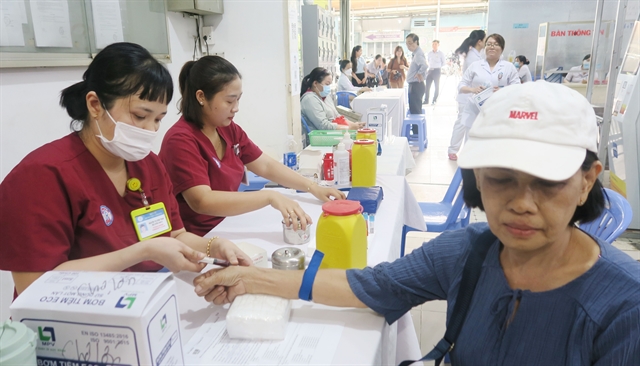 |
| A resident has blood drawn for testing at a health station in HCM City, part of the city's free health check-up programme. — VNA/VNS Photo |
The city has also launched a 150-day sprint to give every resident a free health check-up, under a slogan pairing each hospital with a local community and casting mobile medical teams as an extension of the health system reaching into every neighbourhood.
It's the first time public and private health providers have joined a single preventive-care campaign at this scale, covering all 168 communes, wards and special zones in the city. More than 1.1 million residents have already been screened this year, with officials aiming for full coverage by the end of 2026.
The Ministry of Health is now taking that model nationwide. Under Circular 25, every citizen will be entitled to at least one free health checkup a year starting in 2026.
A separate set of guidelines covers children under six, spelling out checks on vital signs, nutrition and vaccination status, plus autism spectrum screening for children between 16 and 30 months old – with results feeding into the same national databases and the health insurance system. — VNS
Society
 Society
 Society
 Society
 Society
 Society
 Society
 Society
 Society
 Society
 Society
 Society
 Society
 Society
 Society