 Society
HCM City honours fallen soldiers with solemn musical tribute
1.
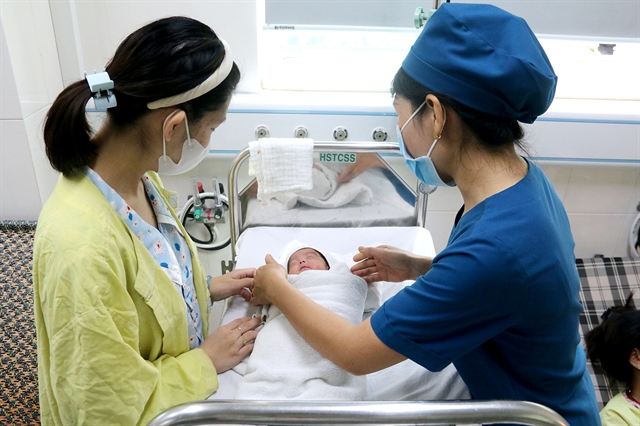 |
| A medical worker and a mother take care of a new-born at the Đồng Nai Children’s Hospital. Provinces and cities will conduct support policies for childbirth and child-rearing. — VNA/VNS Photo Lê Xuân |
HÀ NỘI — Việt Nam is seeking to reverse a sustained decline in births, with the Ministry of Health (MoH) proposing a yearly increase of two per cent in the national average total fertility rate as part of a drive to reach replacement level by 2030.
The target is among the most notable measures in a plan to implement the National Programme to Ensure Replacement-Level Fertility by 2030, signed by Minister of Health Đào Hồng Lan, as authorities respond to fertility falling below the threshold needed to maintain population stability.
Under the plan, the Government aims to gradually restore fertility to replacement level through coordinated measures, including enhanced public communication campaigns, improved policies to support childbirth, and expanded reproductive health services.
More than 95 per cent of couples of childbearing age are expected to receive comprehensive information on marriage, childbirth and maintaining replacement-level fertility. All provinces and centrally run cities will be required to adopt locally appropriate policies to support childbirth and child-rearing.
Officials say efforts will focus not only on increasing birth rates but also on improving population quality, with an emphasis on the comprehensive development of future human resources.
The plan also calls for a review and refinement of existing support and incentive policies, including proposed amendments to regulations deemed inconsistent to achieve and sustainably maintain replacement-level fertility, particularly those related to handling population policy violations.
It proposes new rules to emphasise the exemplary role of cadres and Party members in having children, raising them well and building progressive, stable families in line with national fertility goals.
Key activities include assessing the impact of current regulations on fertility outcomes and issuing amendments, supplements or repeals of provisions that no longer align with policy objectives.
In parallel, provinces and cities will introduce support measures for couples and individuals based on local socio-economic conditions and budget capacity, with priority given to areas where fertility is below replacement level and to ethnic minority groups with very small populations.
The plan also requires the continued removal of regulations linked to past fertility reduction goals, alongside the expansion of incentives encouraging childbirth within families and communities.
According to the MoH, the national fertility rate has fallen below replacement level, declining from 2.11 children per woman in 2021 to 1.91 in 2024 and 1.93 last year. This shortfall means the country has not met its target of maintaining replacement-level fertility during the 2020–2025 period.
Data from the General Statistics Office show that, after July 1 last year, 11 of 34 provinces recorded fertility rates below 2.0 children per woman, while 19 provinces reported rates of 2.2 or higher and four provinces were near replacement level at 2.0–2.2.
Assessments of the Fertility Adjustment Programme indicate that the downward trend is widespread, affecting both high- and low-fertility areas. Projections suggest that achieving the national replacement-level fertility target by 2030 will be challenging. — VNS
Society
 Society
 Society
 Society
 Society
 Society
 Society
 Society
 Society
 Society
 Society
 Society
 Society
 Society
 Society




